Who Owns AI-Generated Code? An IP Checklist for AI Startup Founders
A coding agent can now build much of a startup. That raises a question many founders have not asked yet: who actually owns all of it? Here is a checklist.
Key takeaways:
- There is no one-line answer. Ownership depends on human authorship, your AI provider’s terms, your founder and contractor agreements, third-party and open-source code, and copyright law.
- A contract with an AI provider is not the same as legal protection for the code. Treat them as two separate questions.
- AI tools do not fix missing IP assignments from founders, employees, and contractors.
- A simple internal AI development policy makes later fundraising or diligence much easier.
Today, a founder can build an enormous share of a startup with AI. A coding agent can create:
- frontend code,
- backend functions,
- database schemas,
- tests,
- documentation,
- images,
- copy,
- and sometimes entire applications.
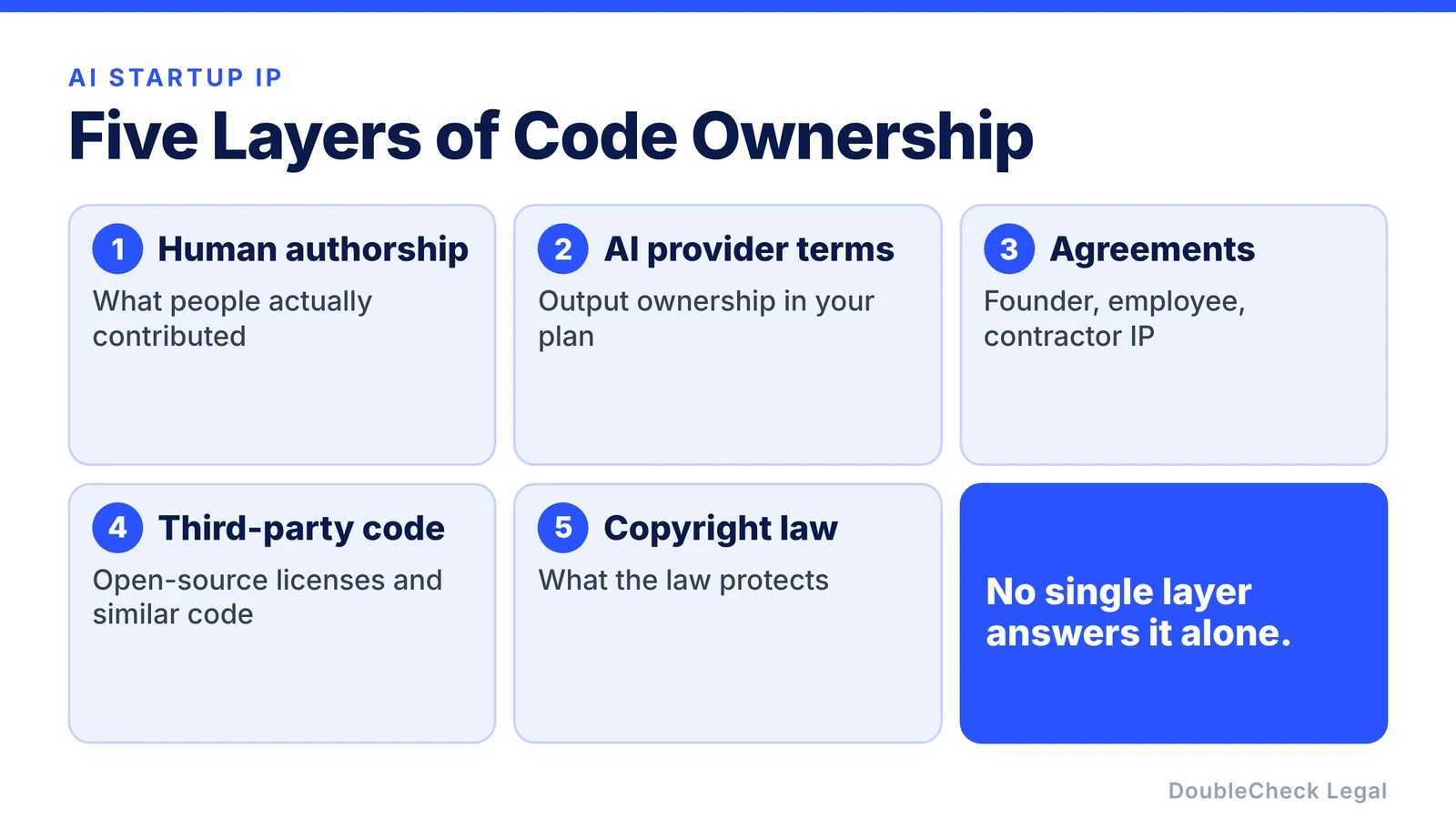
That creates a new founder question: who actually owns all of this? There is no one-line answer. For an AI startup, ownership can depend on several layers: human authorship + AI provider terms + employee and contractor agreements + third-party code + open-source licenses + copyright law.
That makes IP verification increasingly important before fundraising or due diligence.
1. Start with who built the product
Before worrying about the AI, answer a simpler question: who actually created the startup’s code? Was it:
- you personally before incorporation,
- a cofounder,
- an employee,
- a freelance developer,
- an agency,
- or several people?
If the company is supposed to own the technology, make sure the agreements and IP assignments actually support that. An AI tool does not fix missing founder or contractor IP paperwork.
2. Check the AI provider’s terms
Different AI services operate under different contracts, and terms can vary by product and plan. Read the terms for the tool and account type you actually use, and look for:
- who owns the output,
- whether your inputs can be used to train models,
- how consumer terms differ from business terms,
- and what the provider says about similar outputs for other users.
Terms change, so check the current version and keep a copy of what applied when your code was written.
3. Contract rights and legal protection are separate questions
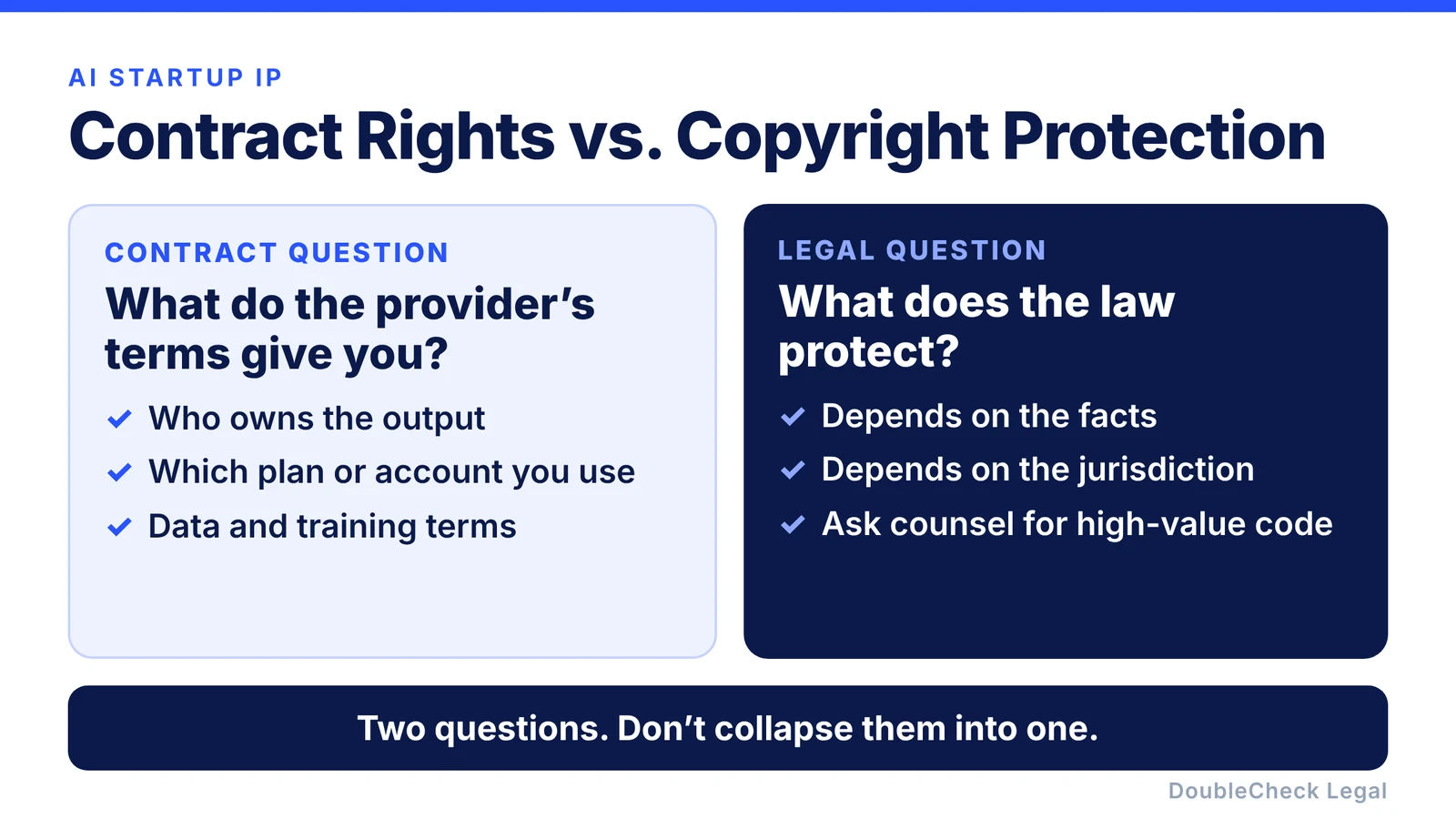
This distinction is important. What your AI provider’s contract says is one question. What legal protection exists in the resulting work is another, and the law around AI-assisted work is still developing.
For a startup, that means two separate questions:
- What rights does my AI provider give me contractually?
- What intellectual-property protection exists in the resulting work under applicable law?
Do not collapse them into one question, and ask counsel about anything core to your company’s value.
4. AI-generated code can still create third-party issues
Even if your provider’s terms favor you, founders should still think about:
- open-source code,
- license obligations,
- third-party copyrighted material,
- patents,
- confidential information,
- and code that may resemble material from elsewhere.
That does not mean every similar code pattern is infringement. It means high-value or highly distinctive generated code can deserve additional review.
5. Do not paste confidential company information everywhere
Ownership is not the only concern. Before sending proprietary source code, customer data, trade secrets, or unreleased technology to an AI system, read the product’s privacy and data-use terms. Business and consumer accounts can come with different data commitments.
The general rule for founders:
Know what account and contractual terms your team is actually using before feeding sensitive company information into an AI system.
6. Create an AI development policy before diligence forces you to
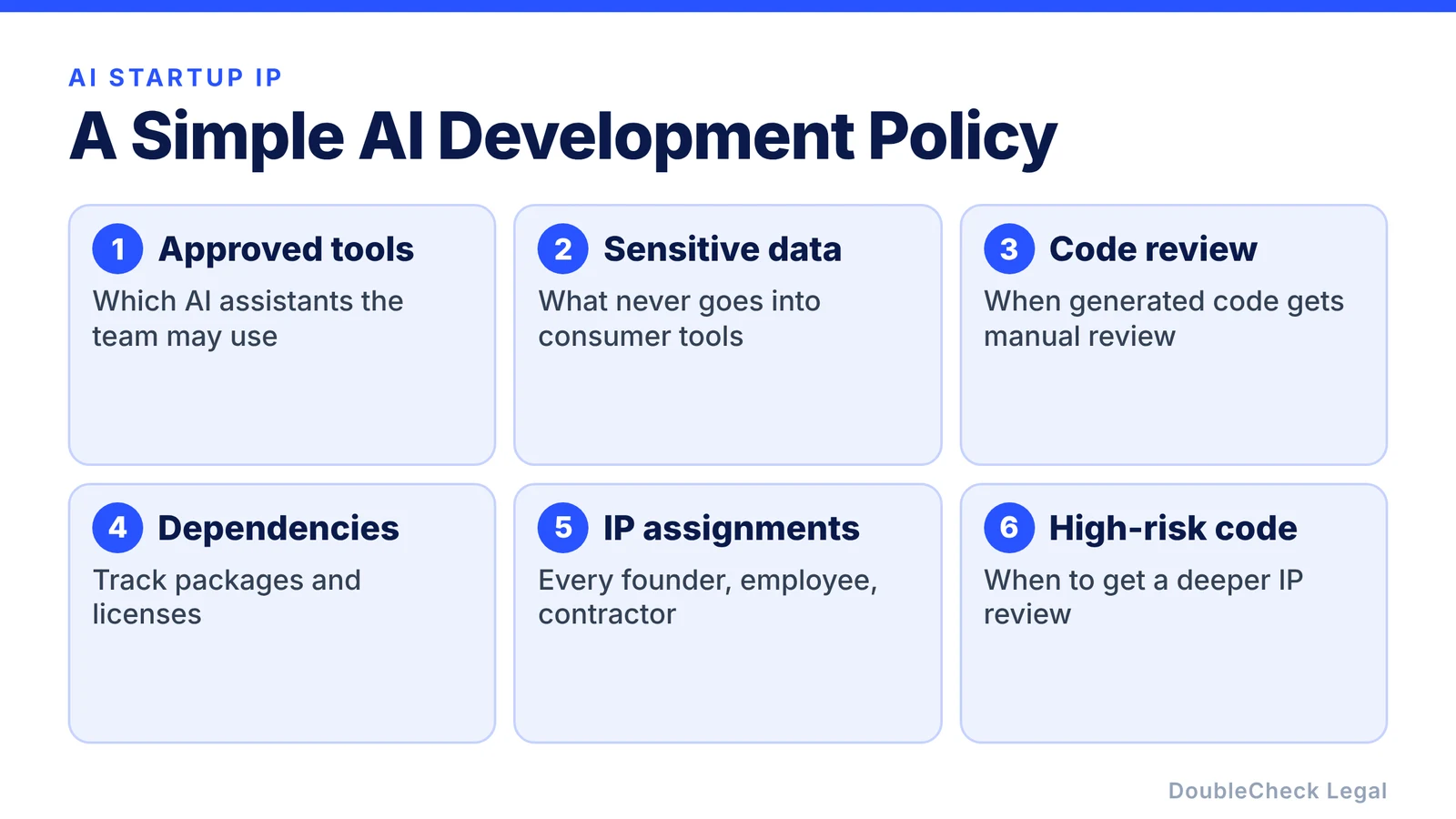
Even a five-person startup can benefit from a simple internal record covering:
- Approved AI tools: which coding assistants can employees use?
- Sensitive information: what cannot be pasted into consumer AI tools?
- Generated code: when should code receive manual review?
- Dependencies: how are packages and open-source licenses tracked?
- IP assignments: has every founder, employee, and contractor assigned relevant company IP?
- High-risk code: when should something receive a deeper IP or security review?
You do not need a 40-page AI governance manual. You need enough information to confidently answer: “Where did our core technology come from, and do we have the rights we think we have?”
7. Use AI to audit AI
There is a useful irony here: AI itself can help organize this process. You can ask an AI system to:
- inventory dependencies,
- identify license files,
- map who committed major code,
- summarize vendor terms,
- detect missing IP assignments,
- flag unusual code,
- and create a diligence checklist.
But once again, the AI should help surface questions rather than declare “Your entire codebase is legally safe.” That conclusion requires much more than language-model confidence.
How DoubleCheck could help AI founders
This is an example of why founders need something richer than a generic chat window. A DoubleCheck workspace could organize:
- AI providers used: ChatGPT, Claude, Cursor, and others
- Provider terms: current terms and ownership language
- Founders and contractors: IP assignments present or missing
- Open-source dependencies: license review status
- Human authorship: areas requiring clarification
- Potential issues: items that deserve source or professional review
Then the platform can connect every conclusion to the underlying source, instead of asking the founder to trust an AI-generated paragraph. For an AI-native startup, that can become particularly valuable before a financing round, acquisition, enterprise sale, or IP diligence process.
FAQ
Who owns code generated by an AI tool?
It depends on the terms for the specific product and plan you use, plus other factors such as human authorship and any third-party material. Check the current terms for your account, and ask a professional for anything high-value.
Is AI-generated code automatically copyrighted?
Not necessarily. Copyright treatment of AI-assisted work is an evolving area and depends on the facts and the jurisdiction, so for core code ask an IP attorney.
Can AI-generated code contain open-source or third-party material?
AI-generated output can raise questions involving third-party rights or similarity. Businesses should still review dependencies, licenses, and high-value generated code.
Should my startup track which AI tools developers use?
For AI-heavy development teams, maintaining a basic list of approved tools, account types, data practices, and review procedures can make later diligence much easier.
Does using AI mean my startup cannot own its software?
No. AI-assisted development does not automatically prevent a company from having intellectual-property rights. The analysis depends on how the software was created, contractual rights, human contributions, and other applicable IP rules.
When should a founder get professional IP help?
Consider it when core technology, fundraising, acquisition diligence, licensing, patents, potentially copied code, or other high-value IP issues are involved.
General information only. This article is not legal, tax, investment, or accounting advice.