How to Draft a Job Offer Letter With AI: 9 Things to Check Before You Send It
AI can write the first draft of an offer letter in seconds. But an offer letter makes real promises about pay, work, and benefits. Check these nine things before you send it. This is general information, not legal, tax, or HR advice.
Key takeaways:
- Decide whether you need an offer letter or a fuller employment agreement.
- Verify pay, title, start date, and benefits yourself; do not let AI invent them.
- Do not let AI decide exempt status or invent equity terms.
- Check at-will wording, conditions, and state law, and use an attorney-approved template where you can.
You found the person you want to hire, so you ask ChatGPT, Claude, or Gemini to write the offer letter. This is becoming common: in DoubleCheck’s 2026 survey of businesses using AI for legal documents, 51% reported using AI for employment agreements or offer letters. AI can create the first draft, but the letter contains real promises about compensation, work, benefits, and other terms.
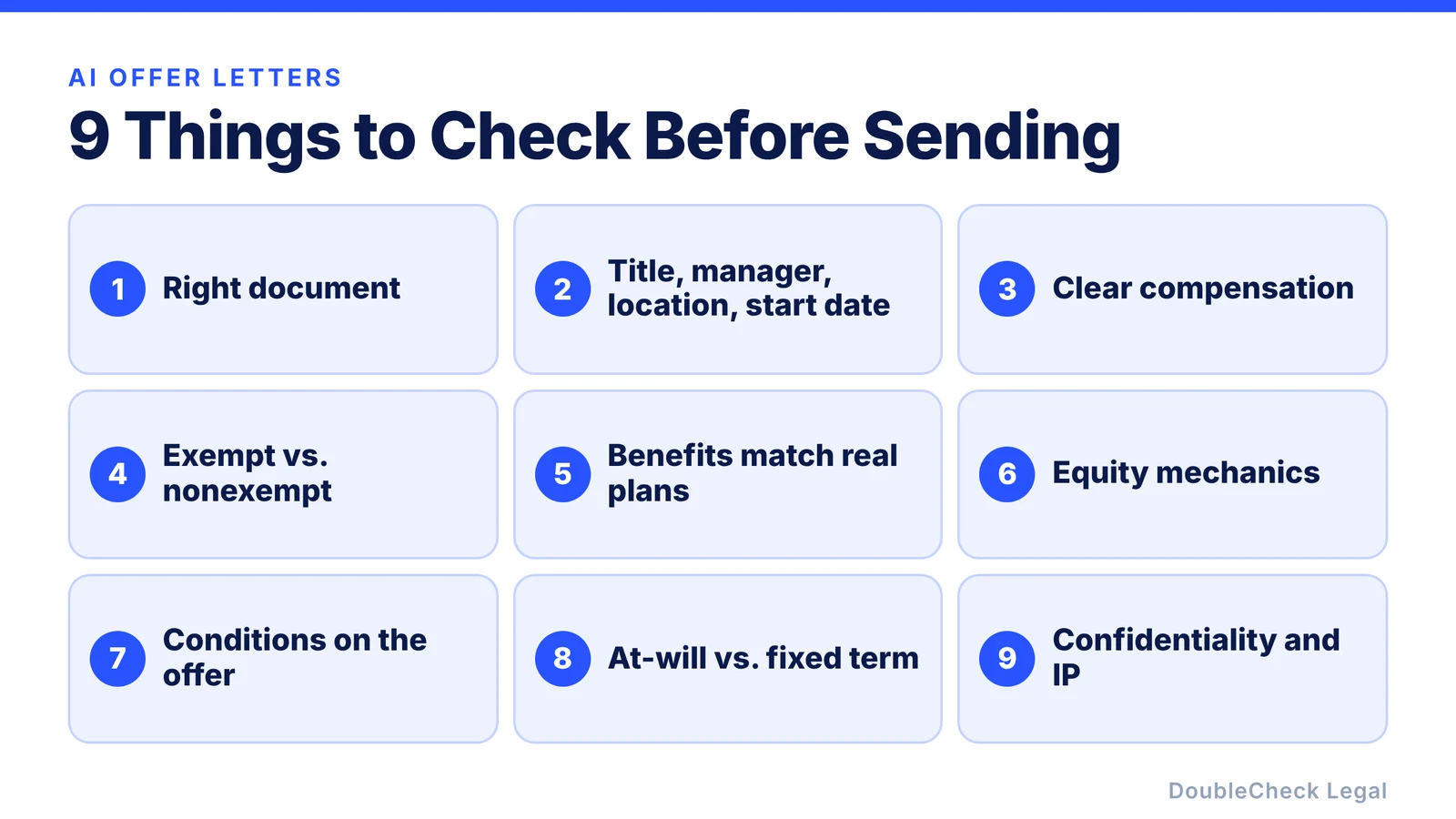
1. Make sure you are drafting the right document
First, distinguish an offer letter from a more extensive employment agreement.
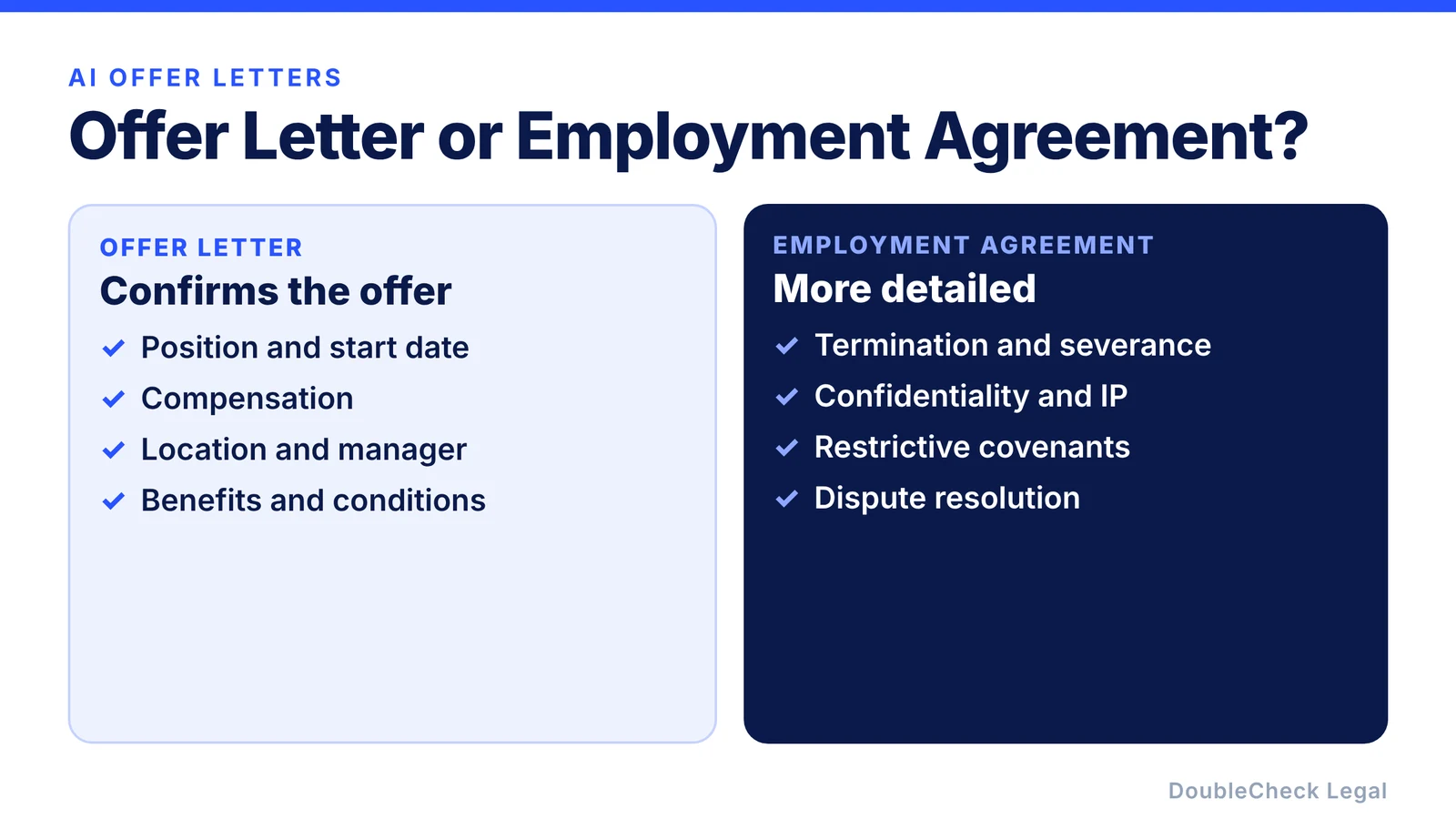
A typical offer letter confirms the major terms: position, start date, compensation, location, reporting relationship, benefits, and conditions. An employment agreement can be far more detailed, covering termination rights, severance, confidentiality, intellectual property, restrictive covenants, and dispute resolution. Do not tell AI “Write me an employment contract” if you really need a simple offer letter. Define the document’s purpose first.
2. Check the employee’s title, manager, location, and start date
AI can invent details when you do not provide them. Check manually: legal name, job title, who they report to, work location, remote, hybrid or onsite status, expected start date, and full-time or part-time status. These should match what you already told the candidate. A polished offer letter with the wrong start date is still wrong.
3. Write compensation extremely clearly
Do not let AI use vague language around money. Check base salary or hourly rate, pay frequency, commissions, bonuses, signing bonus, guaranteed versus discretionary pay, and any conditions on payment.
If you say “Salary is $120,000,” make clear it is an annual rate if that is what you mean. If a bonus is discretionary, do not let AI make it sound guaranteed. If pay depends on a separate commission plan, reference the correct plan instead of asking the AI to improvise one.
4. Be careful with exempt vs. nonexempt classification
This is something AI should not guess. You may tell ChatGPT “The employee is salaried, so make them exempt.” That does not necessarily follow.
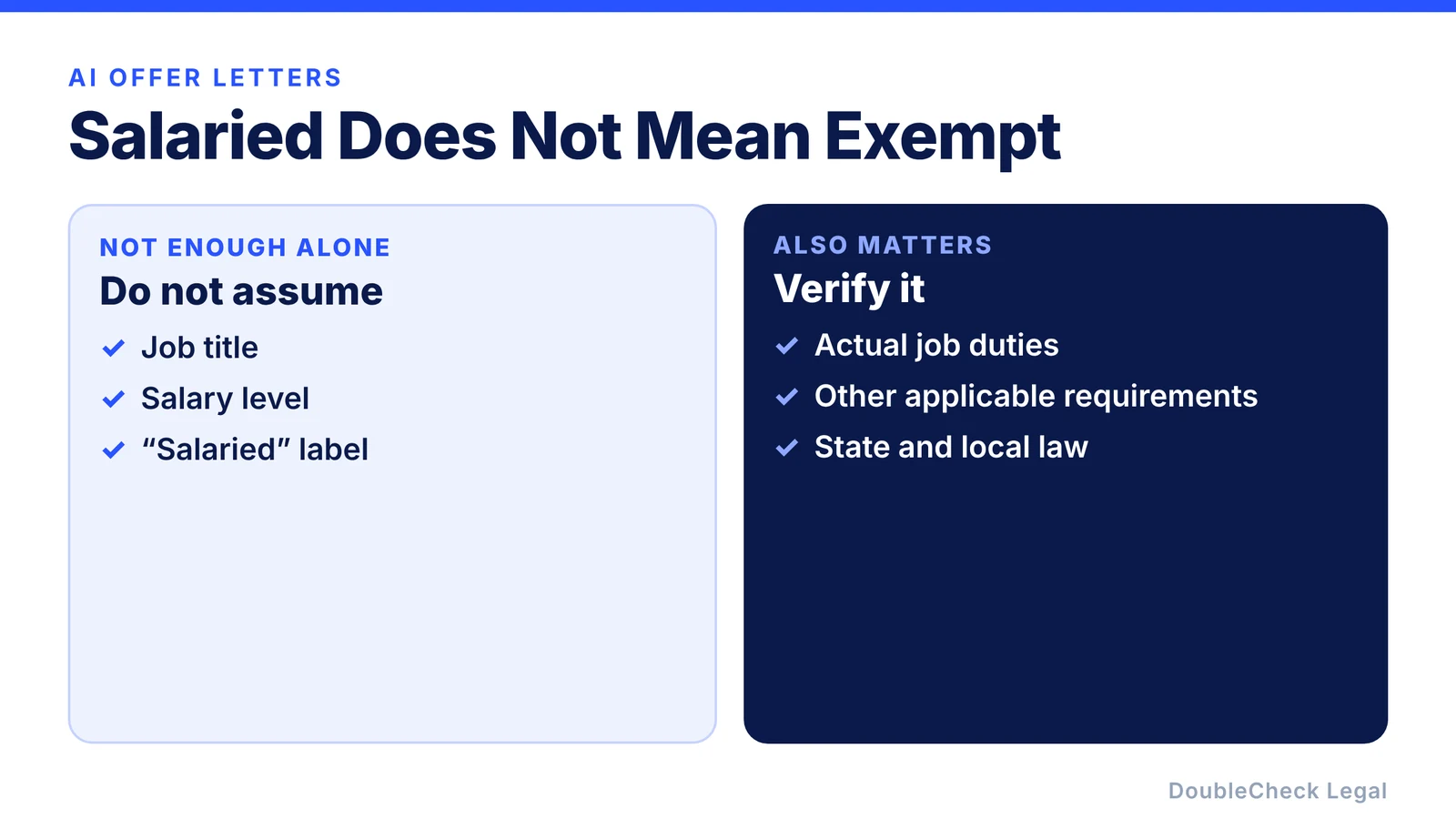
Under the federal Fair Labor Standards Act, job titles and salary alone do not determine whether an employee is exempt from overtime. Duties and other requirements matter, and state law can add more. Instead of asking AI to decide, use it to organize the facts and identify the applicable tests, then verify using current authoritative sources or professional advice. Misclassification can cost much more than fixing an offer letter before it goes out.
5. Make sure benefits language matches the actual plans
AI loves to make offer letters sound generous. If it writes “You will receive unlimited paid vacation, comprehensive health insurance, a 401(k) match, and parental leave,” make sure your company actually provides those things on those terms. Benefits may be governed by separate plan documents and eligibility rules. A safer structure summarizes benefits and says eligibility and coverage are governed by the applicable plans and policies. Do not let the AI create a benefit because it sounds standard.
6. Treat equity carefully
For startups this is especially important. “You will receive 20,000 stock options” raises more questions:
- What type of award is it?
- Whose approval does it need?
- What is the vesting schedule?
- Which equity plan governs it?
- What is the exercise price or pricing process?
- Are there separate grant documents?
- Is the number of shares or percentage described accurately?
Avoid asking AI to casually invent the legal mechanics of an equity grant. Your offer letter should match the company’s actual plan and approval process. Our post on co-founder agreements and vesting explains the vesting basics, and this is a place where startup counsel can be especially useful.
7. Check any conditions attached to the offer
An offer may depend on conditions such as verification of work authorization, background screening where lawful, references, or signing company agreements. Write them precisely. There are legal limits on certain pre-employment inquiries too. For example, under the federal ADA, employers generally cannot ask disability-related questions or require medical exams before making a conditional job offer, and different rules can apply afterward. Do not ask AI to add a generic list of “standard hiring conditions” without checking that you actually use them and that they are appropriate where the employee works.
8. Be precise about at-will or fixed-term employment
AI may automatically insert “Your employment is at will.” That language is common in parts of the United States, but do not use it blindly everywhere. Rules vary by jurisdiction and by the actual arrangement. Ask:
- Is employment intended to be at will?
- Is there a guaranteed term?
- Is there an existing employment agreement?
- Does local law affect the wording?
- Are there termination provisions elsewhere?
The wording should not conflict with other promises in the offer. Saying “You are guaranteed employment for the next two years” in one section and describing the job as freely terminable elsewhere creates an obvious inconsistency. Ask the AI to search specifically for contradictions.
9. Check confidentiality and IP documents
If the employee will create software, designs, inventions, research, written content, or data, the offer letter may not be the only document you need. Your company may use a separate confidentiality agreement, proprietary information agreement, invention-assignment agreement, or employment agreement. Do not assume one sentence like “Everything you create belongs to the company” handles the issue; jurisdiction and the type of work can matter. Make sure the offer letter and any separate agreements fit together. For how a similar issue works for contractors, see how to write a freelance contract.
How to prompt ChatGPT or Claude to draft a better offer letter
Do not ask “Write an offer letter.” Give the AI structured facts:
“Draft a concise job offer letter for a U.S. software startup hiring a full-time product designer. The employee will work from California and report to the Head of Product. Annual base salary is $145,000, paid according to normal payroll. Target start date is November 16, 2026. Benefits should be described only generally and remain subject to company plan terms. The employee may receive an equity grant subject to board approval and the company’s equity plan. Do not invent benefits, legal requirements, or company policies. Identify any provisions that require jurisdiction-specific verification.”
Then ask: “List every factual assumption you made.” “Which parts could create a contractual promise?” “Which sections depend on state or local employment law?” “Check the letter for contradictions.” That gives you a much better first draft.
Run a final factual checklist
Before sending, manually verify the facts below. Do not outsource them to AI. You already know them better than the model does.
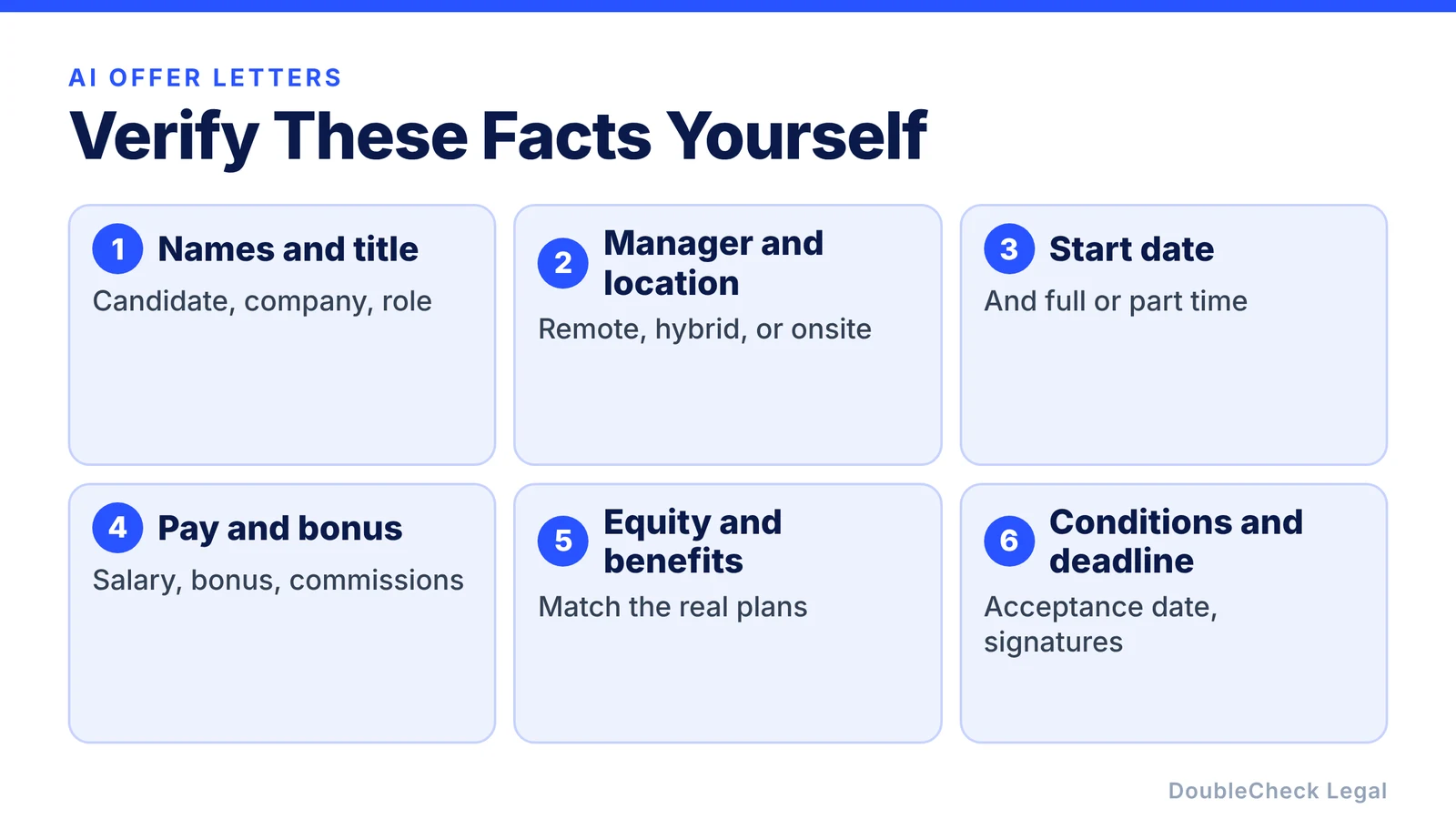
Candidate name, company name, title, manager, location, start date, full-time or part-time status, compensation, bonus, equity, benefits, classification, conditions, acceptance deadline, and required signatures.
Then check the law
Your factual review answers “Does this describe the offer we intend to make?” The legal review answers “Does this document work properly in the relevant jurisdiction?” Those are different questions. Employment law varies substantially by state and locality, so reusing one AI-generated offer letter for employees in multiple states without checking local requirements can create problems. Our guide to verifying an AI-generated legal document walks through the method.
When should an attorney review an offer letter?
For a routine hire using a well-established company template, you may not need a new legal project every time. Professional review becomes more valuable when:
- this is your company’s first hire,
- you are hiring in a new state or country,
- compensation is unusual,
- significant equity is involved,
- the employee is an executive,
- you are using a fixed employment term,
- restrictive covenants are involved,
- classification is unclear,
- or the AI substantially changed your standard language.
One useful approach is to have an attorney approve a strong standard template, then use AI to populate and check it for individual hires, escalating unusual cases for review. See how to find a lawyer to review a document you drafted with ChatGPT.
Where DoubleCheck fits
Offer letters are a natural use case. In DoubleCheck’s 2026 survey of businesses using AI for legal documents, 51% reported using AI for employment agreements or offer letters, one of the most common categories. Draft the first version with ChatGPT, Claude, or Gemini, then bring the existing document into DoubleCheck instead of starting over. The workflow helps identify missing information, surface relevant sources, flag parts that deserve attention, and provide a path to an independent attorney when professional review is warranted.
DoubleCheck is built for businesses that start legal work with AI. Bring your question or draft, use an AI-first workflow to understand and verify it, and when professional advice is warranted, you can connect with an independent attorney. Attorneys on DoubleCheck are independent professionals; an attorney-client relationship forms only if an attorney accepts your engagement.
FAQ
Can ChatGPT write a job offer letter?
Yes, it can help create a first draft, especially if you give it structured facts. You should verify the facts, compensation, classification, benefits, and any jurisdiction-specific requirements before sending it.
Is an offer letter a contract?
It can create real expectations about compensation and terms of employment, depending on its wording and the jurisdiction. That is why the language should be precise and consistent.
Should an offer letter say employment is at will?
Where at-will employment is intended and permitted, many offer letters say so. Wording and rules vary by jurisdiction, and it should not conflict with other promises in the letter.
Do I need a lawyer to review every offer letter?
Not necessarily. A routine hire using an attorney-approved template may not need review each time. Review is more valuable for a first hire, a new state, significant equity, executives, fixed terms, or unclear classification.
Can AI decide whether an employee is exempt or nonexempt?
AI can help organize the facts and identify the applicable tests, but classification should be verified against current authoritative sources or professional advice, not decided by the AI alone.
General information only. This article is not legal, tax, investment, or accounting advice.