Can I Use AI to Write a Privacy Policy? 7 Things to Check Before You Publish It
A privacy policy is not generic legal language. It describes what your company actually collects, why, who receives it, and what choices people have. AI can write the draft, but the facts have to come from you.
Key takeaways:
- Do not publish an AI privacy policy until you check that it describes your real business.
- Give the AI your actual data, vendors, and AI features instead of letting it guess.
- Do not let AI add laws like the CCPA or GDPR without checking whether they apply.
- Audit the policy against the live product, then verify sources before publishing.
You open ChatGPT, Claude, or Gemini and type “Write a privacy policy for my business.” Thirty seconds later you have something that looks professional. Can you publish it? Maybe, but not without checking whether it actually describes your business. Here are seven things to check.
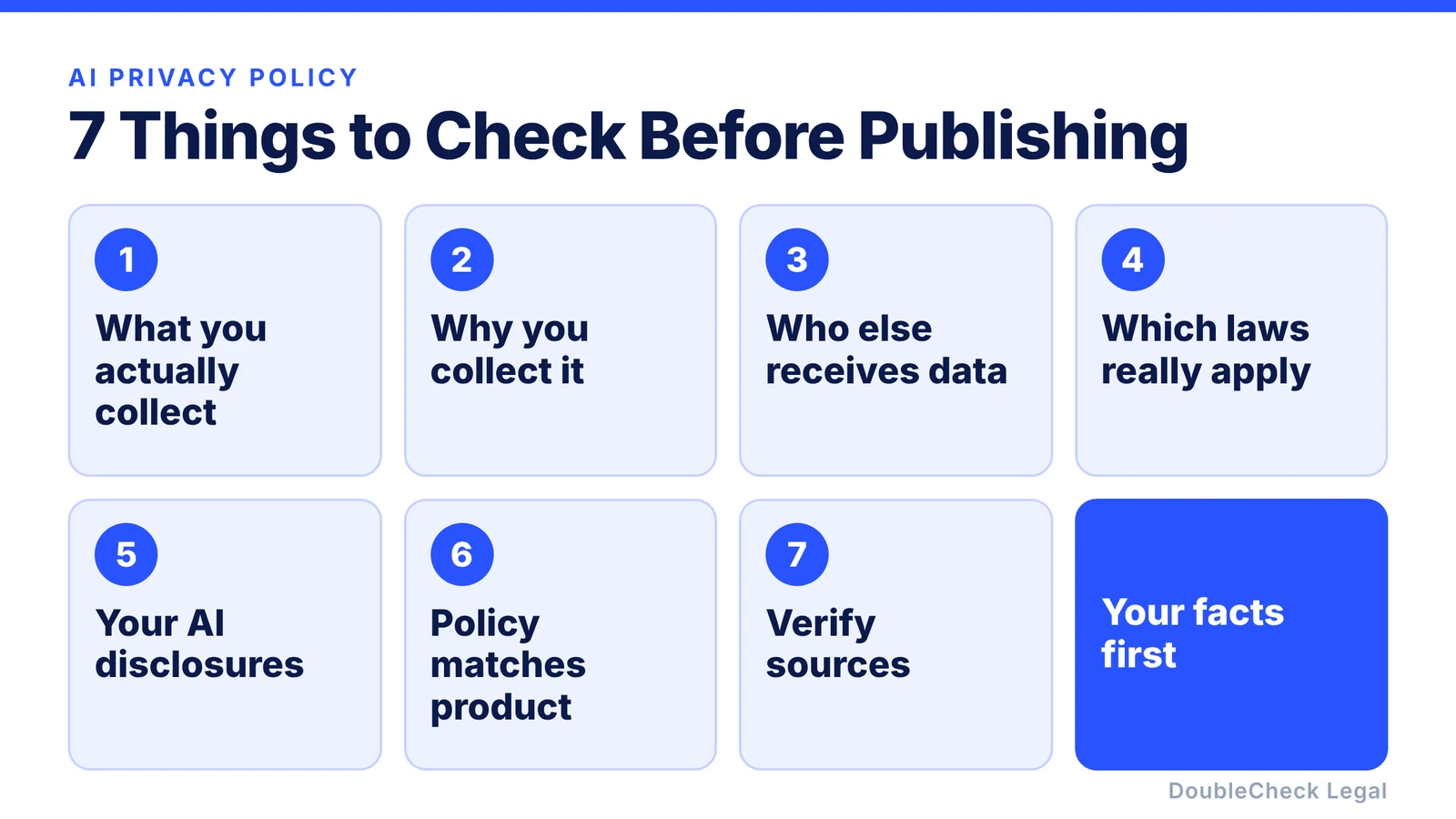
1. What information do you actually collect?
Start with reality. Does your website or app collect:
- names,
- email addresses,
- payment information,
- IP addresses,
- device information,
- location,
- analytics data,
- cookies,
- account information,
- uploaded files,
- or information submitted to an AI feature?
Do not let the AI guess. Look at your actual website, app, forms, analytics, payment provider, CRM, customer-support tools, and other systems, then tell the AI what exists. For example:
“Our website uses Stripe for payments, Google Analytics for analytics, and HubSpot for forms, and customers create accounts using their email address.”
That produces a far more useful policy than “Write a privacy policy for a SaaS startup.” For the general how-to, see our guide to using an AI privacy policy generator.
2. Check why you collect the information
Your policy should not just list data. It should accurately describe what you do with it:
- Email address → create the account and communicate with the customer.
- Payment information → process payments.
- Usage data → improve the product and detect problems.
- Support messages → answer customer questions.
If your policy says data is used for one purpose while your company actually uses it for several, you may have a problem. A privacy policy that does not match your real practices can create regulatory risk, which is why the details have to come from you, not from the AI.
3. Identify the other companies that receive data
Most modern businesses do not process everything themselves. You probably use vendors such as Stripe, AWS, Google Analytics, Cloudflare, HubSpot, an email provider, a support platform, or AI providers like OpenAI or Anthropic.
Do not copy a vendor list from somebody else’s policy. Ask: which services does my business actually use, and what information flows to them?
This matters most when your product itself uses AI. If customers upload information that is then sent to an external model provider, you need to understand that flow before you can describe it accurately. If you are evaluating such a provider, see our AI vendor contract checklist.
4. Do not let AI automatically add laws that do not apply
This is a very common AI problem. You tell the model:
“Make my privacy policy legally compliant.”
It starts adding references to the CCPA, GDPR, CPRA, and other laws. That looks impressive, but it does not mean those laws apply to your company.
California’s CCPA, for example, applies to businesses that meet particular statutory criteria. It is not triggered simply because someone in California can visit your website. Instead of asking AI to “make this CCPA compliant,” first ask:
“What information would you need to determine which privacy laws may apply to this business?”
Then verify that conclusion against official sources.
5. Check your AI disclosures
If your company uses customer information with AI, check:
- Does user information get sent to an AI provider?
- Can prompts contain personal information?
- Are AI-generated outputs stored?
- Is the information retained?
- Can the provider use it to train or improve models?
- Which provider and product tier are you using?
Your policy should reflect what your business actually does, not what you assume the AI provider does. Check the provider’s current terms and your specific plan, and keep checking, because they can change.
6. Make sure the policy and product match
Now run a simple audit. Open your privacy policy in one window and your product in another, then walk the customer journey: homepage, signup, checkout, account creation, analytics, contact form, AI features, newsletter, cookies.
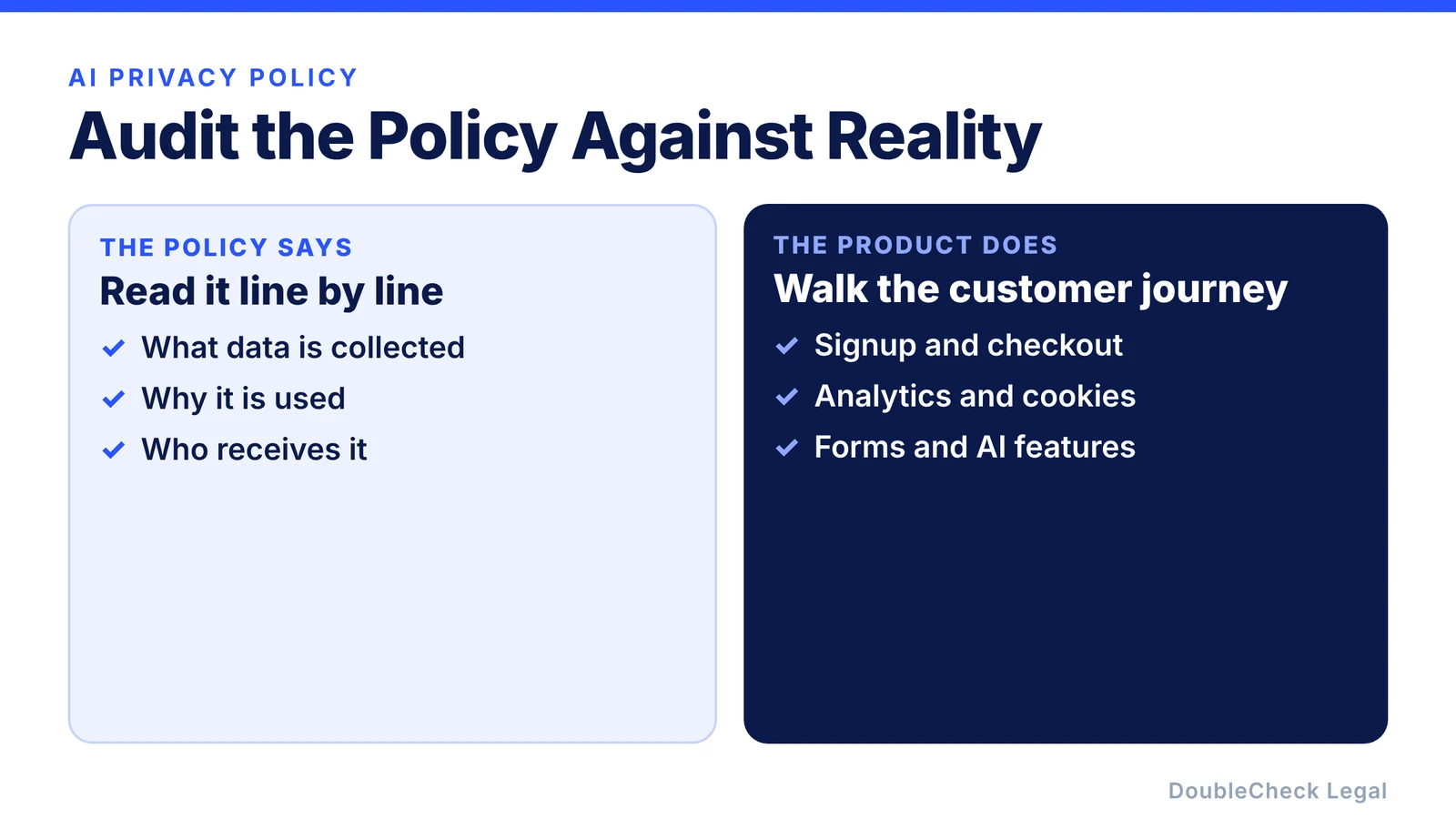
Ask: “Is every meaningful collection and use of personal information reflected in this policy?” You can also give an AI agent your product description, vendor list, and draft policy and ask:
“Identify anything we say we do in the policy that is not present in our product description, and anything in our product description that is missing from the policy.”
That is a much better use of AI than generating generic legal text.
7. Verify before publishing
Ask the AI to attack its own draft:
“What assumptions did you make?”
“What information about my business do you still need?”
“Which parts of this policy depend on jurisdiction?”
“Show me the authoritative sources behind those requirements.”
Then check those sources yourself, preferably official ones such as a state privacy regulator’s guidance. Our guide to verifying AI-generated legal documents walks through the method.
For a simple business, you may be able to catch many issues yourself. If your company handles sensitive data, operates in several jurisdictions, sells or shares personal information, works with children, or is in a regulated field, professional review becomes more valuable. The related terms and conditions guide covers the companion document.
A better way to use AI for your privacy policy
The wrong workflow is: ask AI for a privacy policy → copy → publish.
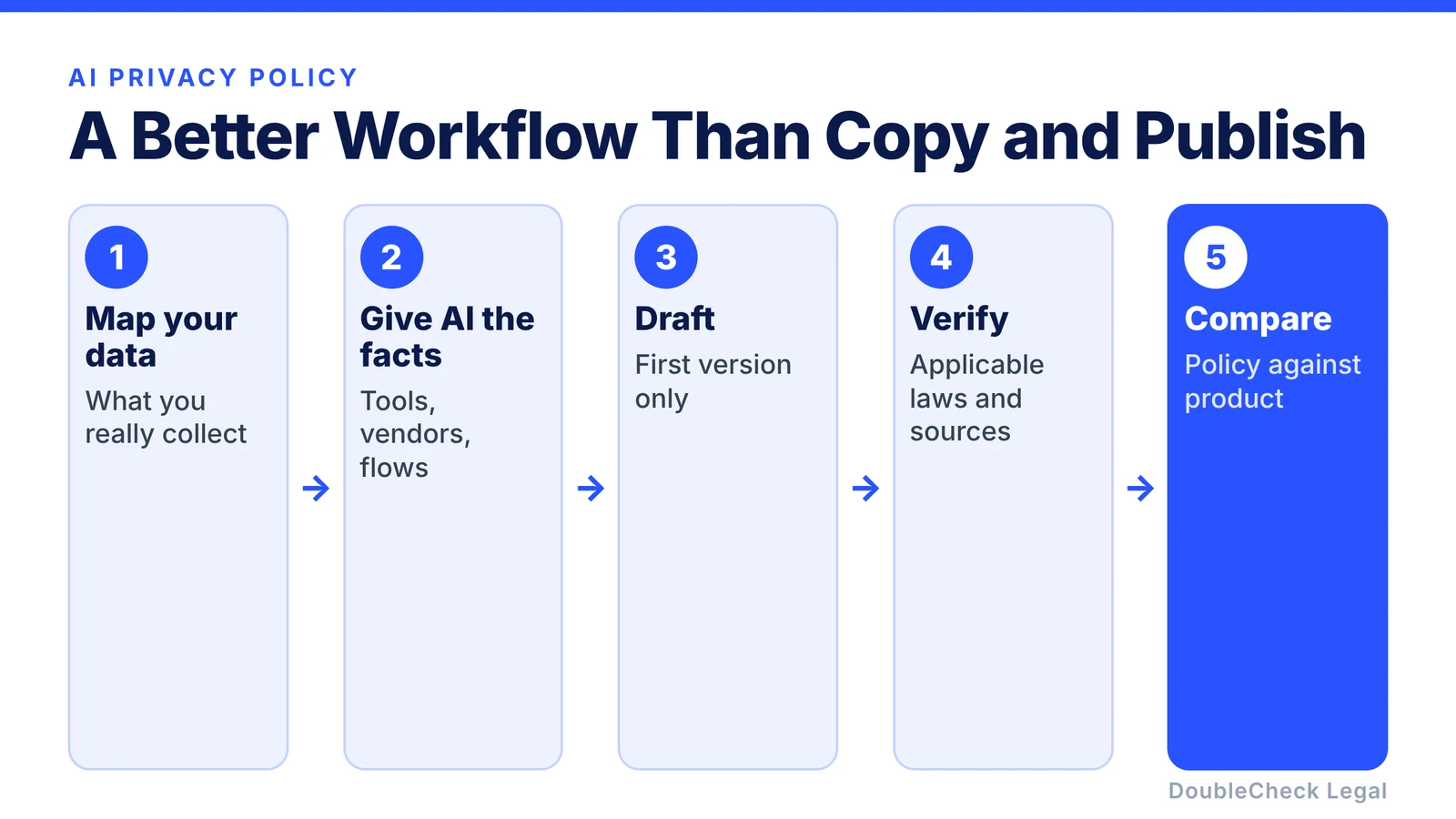
A better one is: map your real data → give AI the facts → generate a draft → identify applicable requirements → verify sources → compare policy against the actual product → professional review if needed.
AI can dramatically reduce the work. It cannot know your company’s data practices unless you give it accurate information.
Where DoubleCheck fits
You may already have a privacy policy generated with ChatGPT, Claude, or Gemini. Instead of starting over, bring the existing document and context, identify assumptions and missing information, and inspect the relevant sources.
DoubleCheck is built for businesses that start legal work with AI. Bring your question or draft, use an AI-first workflow to understand and verify it, and when professional advice is warranted, you can connect with an independent attorney. Attorneys on DoubleCheck are independent professionals; an attorney-client relationship forms only if an attorney accepts your engagement.
Use AI to draft. Use your actual business to validate it. Double-check before you publish.
FAQ
Can ChatGPT write a privacy policy?
Yes. ChatGPT can help create a first draft, particularly if you give it detailed information about what your business collects, why, which vendors receive information, and how the product works. Check the result against your actual practices.
Can I copy another company’s privacy policy?
That is risky. Another company’s vendors, data practices, jurisdictions, product features, and legal obligations may be different from yours.
Does every business have to comply with the CCPA?
No. The CCPA applies based on specific criteria and has exemptions. Determine whether the law applies rather than automatically adding CCPA language to an AI-generated policy.
How often should I update my privacy policy?
Update it when your actual privacy practices or applicable requirements materially change. Businesses subject to specific privacy laws may also have particular updating requirements.
Should a lawyer review my AI-generated privacy policy?
The value of professional review increases with the complexity and sensitivity of your data practices, the number of jurisdictions involved, and the consequences of getting the disclosures wrong.
General information only. This article is not legal, tax, investment, or accounting advice.