Privacy Policy Generator for Small Business: How to Use AI Without Missing Important Details
Launching a website or app usually means you need a privacy policy. AI can draft one in seconds, but the hard part is making sure it matches what your business actually does with data.
Key takeaways:
- The hardest part of a privacy policy is not writing it. It is understanding what your business actually does with data.
- Tell the AI your real technology stack, users, and locations, and ask what information it is missing before it drafts.
- Build a table that ties each policy statement to a business fact, then verify it.
- Treat privacy as a process: review the policy whenever your product or vendors change.
A privacy policy generator is one of the first tools many small businesses look for when they launch a website, app, or online store. And the problem is real. The difficulty is usually not generating policy text. It is knowing whether the policy reflects your analytics, payment providers, user accounts, newsletters, data storage, and other technology.
That distinction matters. The hardest part of a privacy policy is often not writing one. It is accurately understanding what your business actually does with data.
Step 1: Map what your website actually collects
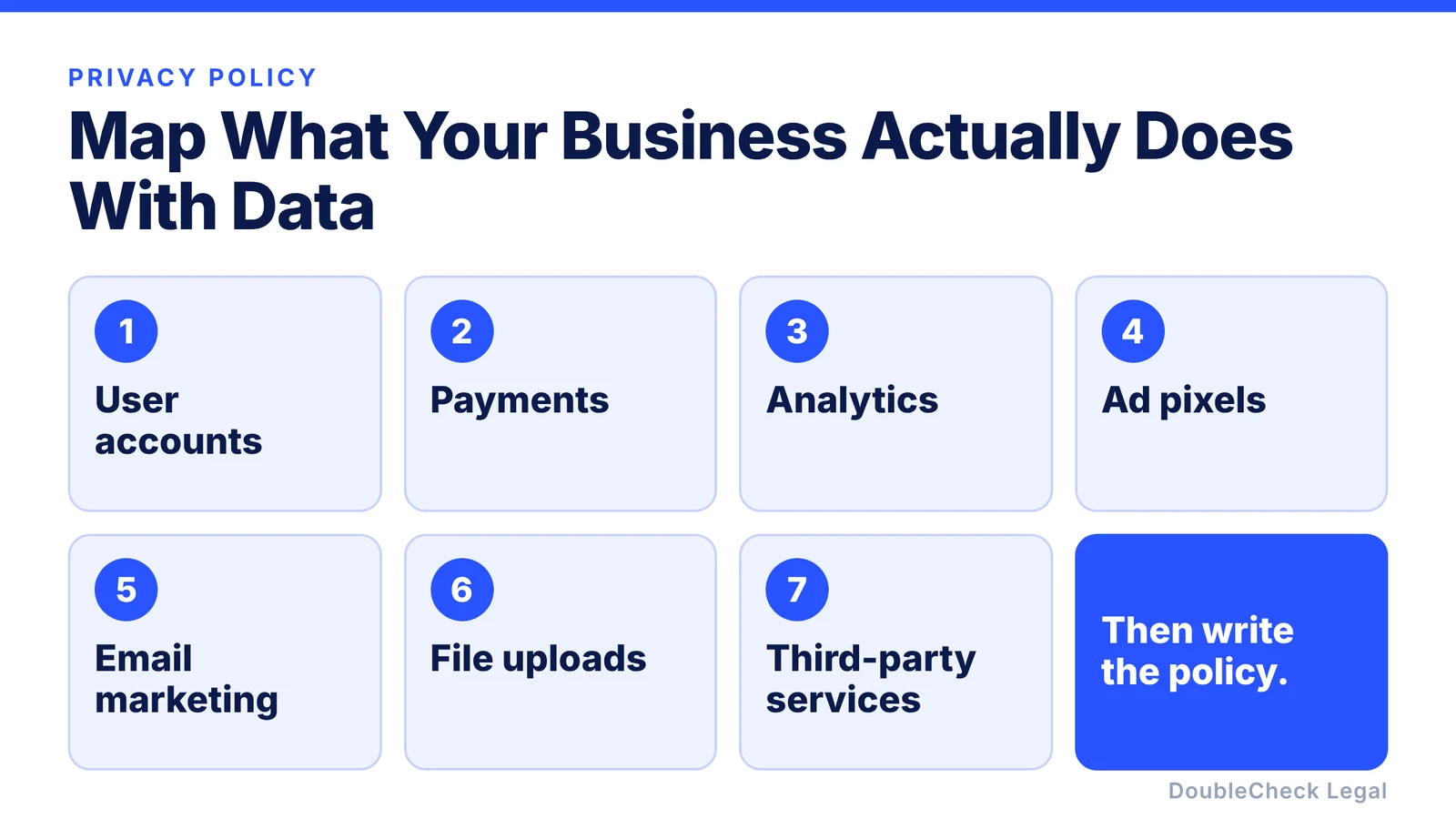
Before generating anything, identify your data flows. Ask:
- Do users create accounts?
- Do you collect names or emails?
- Do you process payments?
- Do you use analytics?
- Do you use advertising pixels?
- Do you run session-recording software?
- Do you send newsletters?
- Do customers upload information?
- Which third-party services receive data?
- Where are your users located?
A generic AI prompt does not know any of this unless you tell it.
Step 2: Tell the AI your actual technology stack
Consider the difference between:
“Create a privacy policy for my SaaS.”
and:
“I operate a U.S.-based B2B SaaS. Users create accounts with email addresses. We use Stripe for billing, PostHog for analytics, Intercom for support, and AWS for hosting. We have customers in the U.S. and EU.”
The second prompt gives the AI a much better factual foundation. Generic generators often fail precisely because they do not understand your actual stack or the services processing user information.
Step 3: Do not invent your data practices from the policy
This is critical. Your privacy policy should describe what your business actually does. You should not generate a sophisticated-looking policy and then assume your website automatically behaves the way the document says.
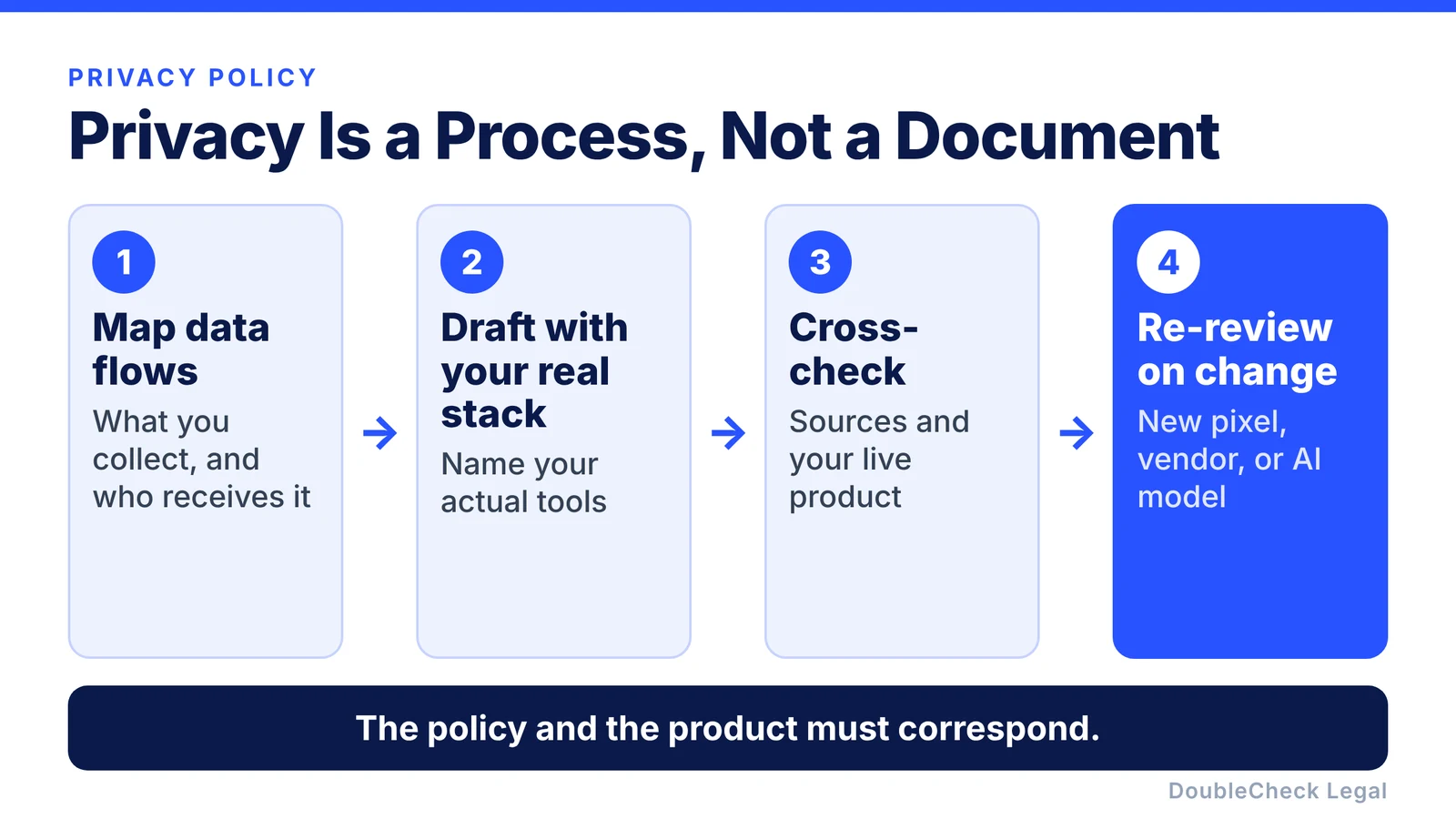
For example, your policy might mention analytics consent while your analytics scripts begin collecting information before the relevant consent mechanism has operated. The document and the product need to correspond.
Step 4: Identify the jurisdictions that matter
Privacy requirements differ across jurisdictions. Depending on the business and its users, potentially relevant rules can come from:
- U.S. states,
- the European Union,
- the United Kingdom,
- and other countries where users reside.
Do not simply tell an AI, “Make this GDPR and CCPA compliant.” Instead ask it to explain:
- which jurisdictions it believes may apply,
- why,
- what factual assumptions it made,
- and which authoritative sources support the conclusion.
Step 5: Ask what information is missing
One of the best prompts you can use is:
“Do not generate the final policy yet. First tell me everything you need to know about my website and data practices.”
This is often more useful than immediately asking for a document. The AI might discover that it does not know:
- whether children use the service,
- whether data is sold or shared,
- which analytics providers you use,
- whether you send marketing email,
- how users can request deletion,
- or where information is stored.
Now you are using AI to expose uncertainty rather than hide it.
Step 6: Generate the first draft
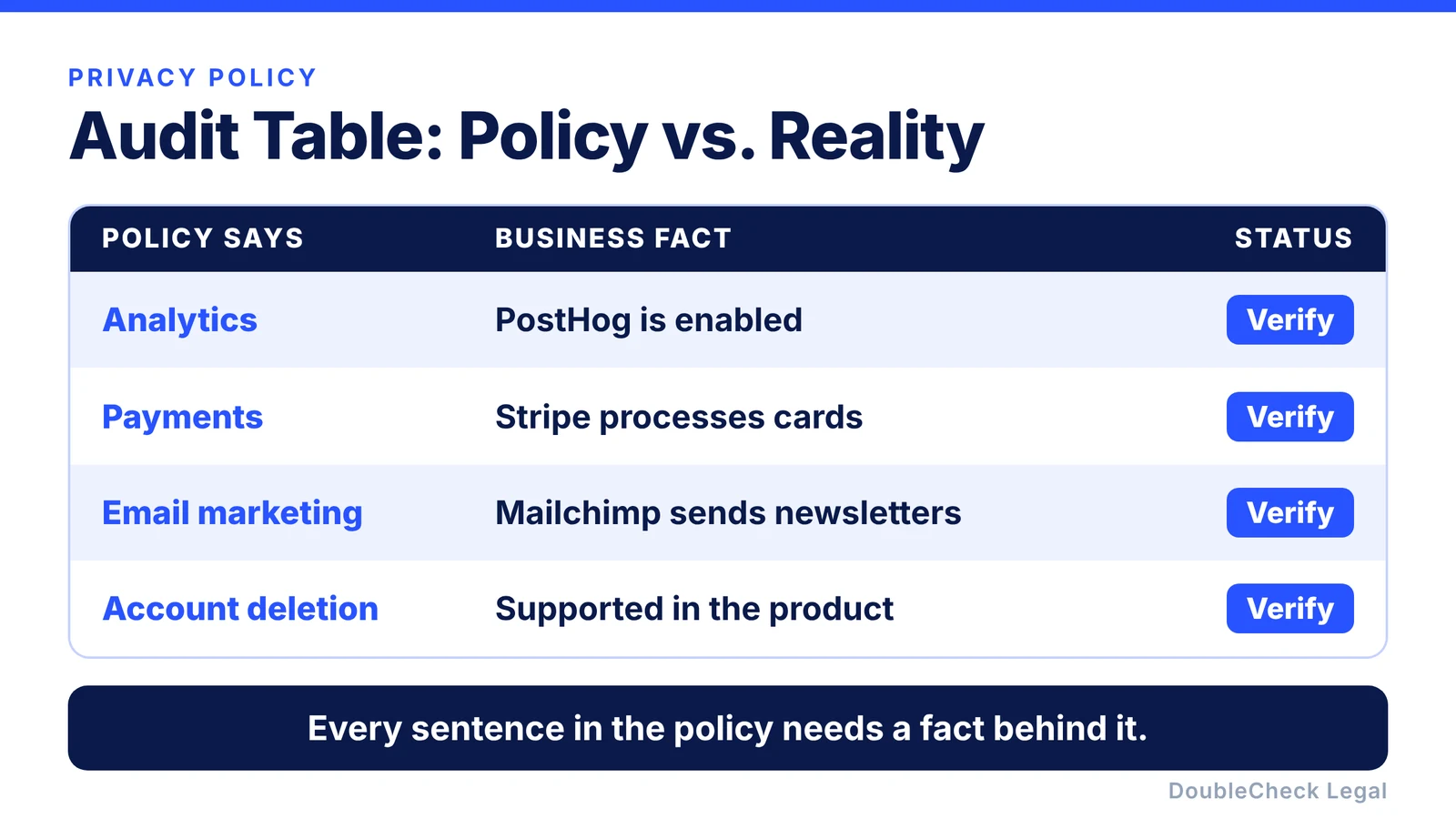
Once the factual picture is clearer, generate the policy. Then ask the AI to create a companion table that makes the policy easier to audit later:
| Policy statement | Business fact supporting it | Source or rule, if applicable |
|---|---|---|
| Analytics | PostHog enabled | Verify |
| Payments | Stripe | Verify |
| Email marketing | Mailchimp | Verify |
| Account deletion | Supported in product | Verify |
Step 7: Review the policy whenever the product changes
Your product evolves. Maybe you add:
- Meta Pixel,
- Google Analytics,
- a CRM,
- a new payment provider,
- an AI model,
- customer file uploads,
- or a new advertising system.
Your privacy policy may need to evolve with it. Privacy should be treated as a process, not a document generated once and forgotten.
Why AI alone can still be risky
AI can produce excellent legal-sounding prose while missing the most important fact about your actual business. AI knows privacy law language. But it does not automatically know that you installed a new tracking script yesterday. The gap between those two things is where errors occur.
How DoubleCheck can help
DoubleCheck is designed to go beyond “generate me a privacy policy.” The stronger workflow is understand the business → identify data practices → generate → source → cross-check → DoubleCheck. That can include:
- AI-assisted questioning,
- identification of missing information,
- relevant source retrieval,
- cross-checking claims,
- structured verification,
- optional human source review,
- and lawyer access if professional advice becomes appropriate.
The value is not simply generating more words. It is helping you understand whether the words correspond to your actual business.
FAQ
Can AI generate a privacy policy?
Yes. AI can create a useful first draft when supplied with accurate information about your business and data practices.
Is a generic privacy policy enough?
A generic template may fail to describe the technologies, information, jurisdictions, and business practices that actually apply to your company.
What information should I give an AI privacy policy generator?
Include the business location, user locations, information collected, account system, analytics, advertising tools, payment providers, email systems, third-party processors, and other relevant data practices.
Can I copy another company’s privacy policy?
That is generally a poor approach, because another company’s data practices, technology stack, jurisdiction, and business model may differ from yours.
How often should I review my privacy policy?
Review it when your data practices, vendors, products, locations, or applicable requirements materially change.
Should a lawyer review my privacy policy?
For businesses with significant data collection, regulated information, multiple jurisdictions, unusual practices, or substantial exposure, professional review may be appropriate.
General information only. This article is not legal, tax, or accounting advice.