AI Contract Review for Small Businesses: How to Review a Contract With AI Before You Sign
Contracts are one of the most practical places for a small business to use AI. Here is a step-by-step way to review one before you sign, without blindly trusting the model.
Key takeaways:
- Use AI to summarize, extract clauses, compare versions, and explain unfamiliar language. It can dramatically improve your first pass.
- Give it context first, and ask it to show the exact contract text behind every point.
- Treat what it flags as signals for where to look next, not as legal conclusions.
- Verify outside legal claims, and add human or attorney review as the stakes rise.
Instead of reading a 40-page agreement from beginning to end without help, you can use AI to summarize the contract, identify important clauses, compare versions, and explain unfamiliar language. That can dramatically improve your first pass.
But AI contract review should not mean uploading a contract and blindly trusting whatever the model says. A better workflow is to use AI to organize the review, then verify the parts that matter.
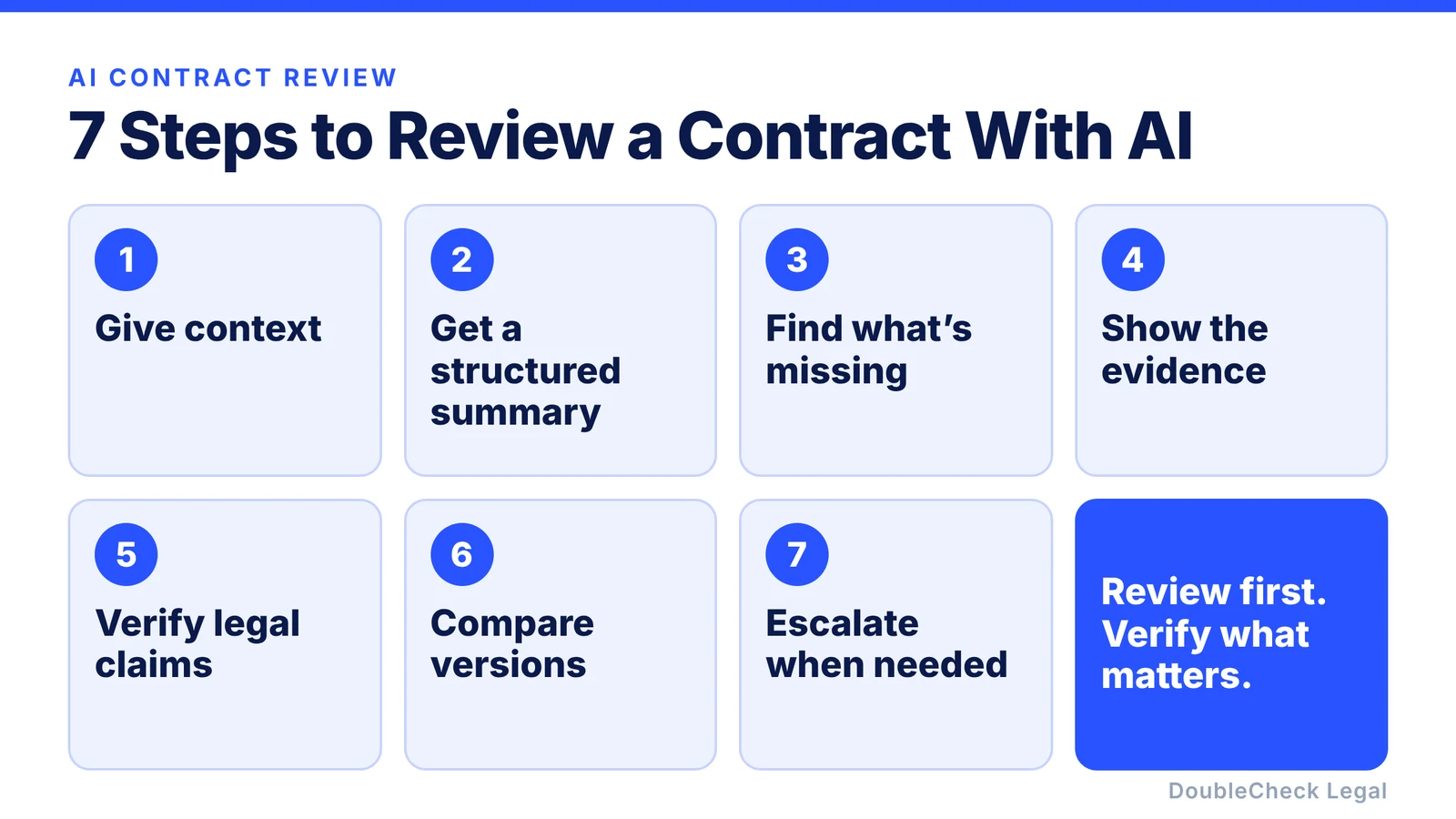
Step 1: Tell the AI what the contract is about
Context changes everything. Do not simply upload a document and say:
“Review this.”
Instead say:
“I run a small software company. This is a customer agreement worth approximately $50,000 per year. I am particularly concerned about liability, IP ownership, payment, termination, and automatic renewal.”
Now the AI knows what the agreement is and what matters to you.
Step 2: Ask for a structured contract summary
A useful AI review organizes the contract around specific categories:
- Parties
- Contract term
- Payment
- Renewal
- Termination
- Liability
- Indemnification
- Intellectual property
- Confidentiality
- Data obligations
- Governing law
- Dispute resolution
This is more useful than a long generic summary. The goal is to turn the contract into something you can quickly inspect.
Step 3: Ask what is missing or unusual
Then ask:
“What provisions appear missing, unclear, unusually broad, or worth checking more carefully?”
AI may identify issues such as:
- no clear termination right,
- automatic renewal,
- broad indemnification,
- unlimited liability,
- unusual IP ownership language,
- unclear payment obligations,
- or inconsistent definitions.
These are not automatically legal conclusions. They are signals for where you should look next.
Step 4: Ask the AI to show the evidence
An AI contract reviewer should not simply say, “The termination provision is risky.” Ask it to show you the relevant clause. A better response looks like this:
Contract text: “This agreement automatically renews for successive one-year periods unless either party provides written notice at least 90 days before renewal.”
AI observation: The agreement includes automatic renewal and requires advance notice to stop renewal.
That separation matters. It lets you inspect what is actually in the document instead of relying entirely on the model’s interpretation.
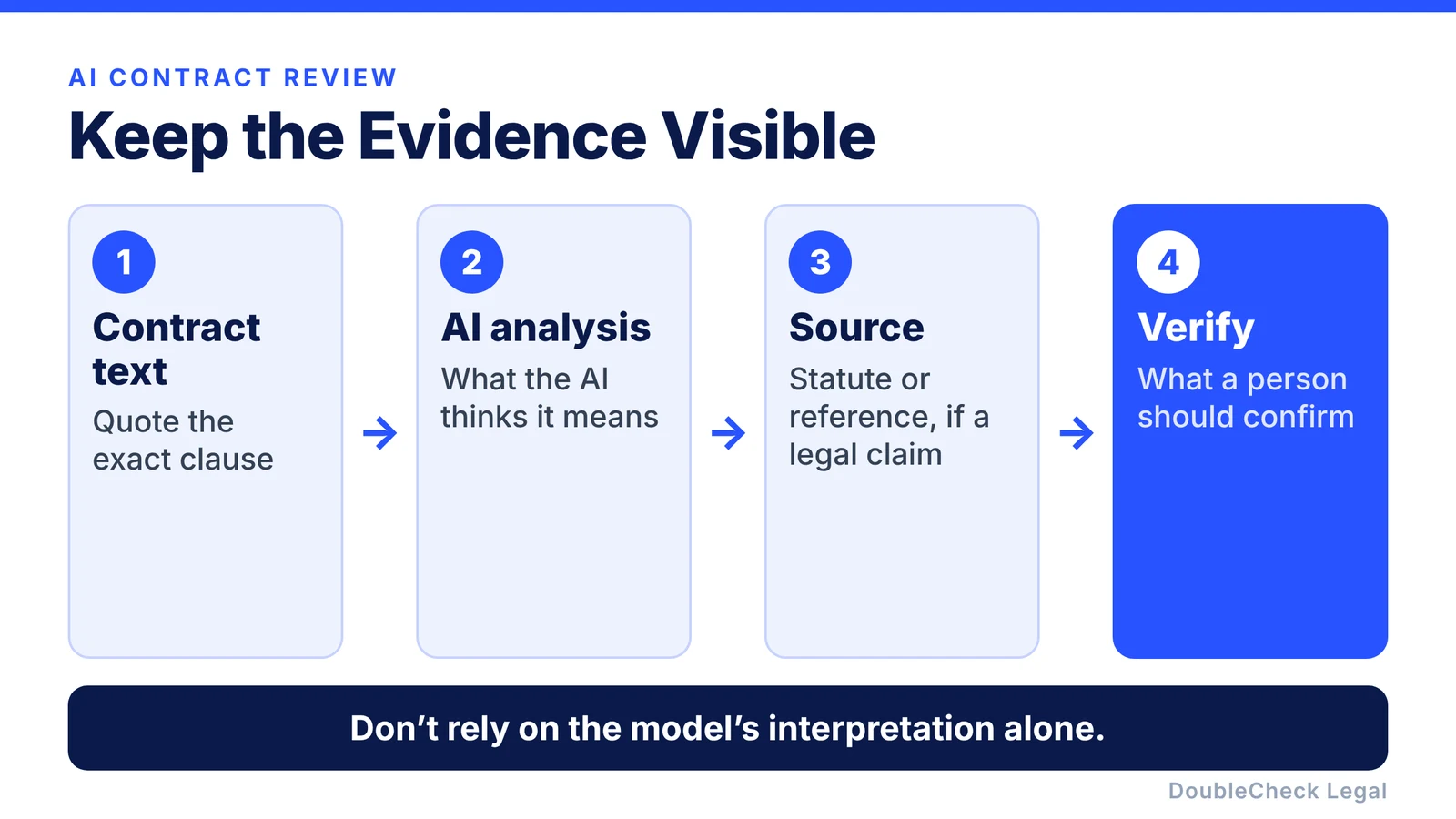
Step 5: Verify outside legal claims
Contract analysis and legal research are not the same thing. If the AI says:
“This clause violates California law.”
that statement requires more scrutiny than:
“This contract contains a 90-day renewal notice.”
Ask: “What authoritative source supports that conclusion?” Then confirm that:
- the source exists,
- it is current,
- it applies to the correct jurisdiction,
- and it actually supports the claim being made.
Step 6: Use AI to compare contract versions
AI is especially useful when a customer, supplier, landlord, or partner sends you a revised agreement. Upload both versions and ask:
“Show me every meaningful change and explain which changes increase our obligations.”
The AI can help identify:
- added clauses,
- deleted protections,
- new payment obligations,
- liability changes,
- modifications to IP rights,
- and changes to termination.
That can turn a complicated redline into a much easier business discussion.
Step 7: Know when another review is appropriate
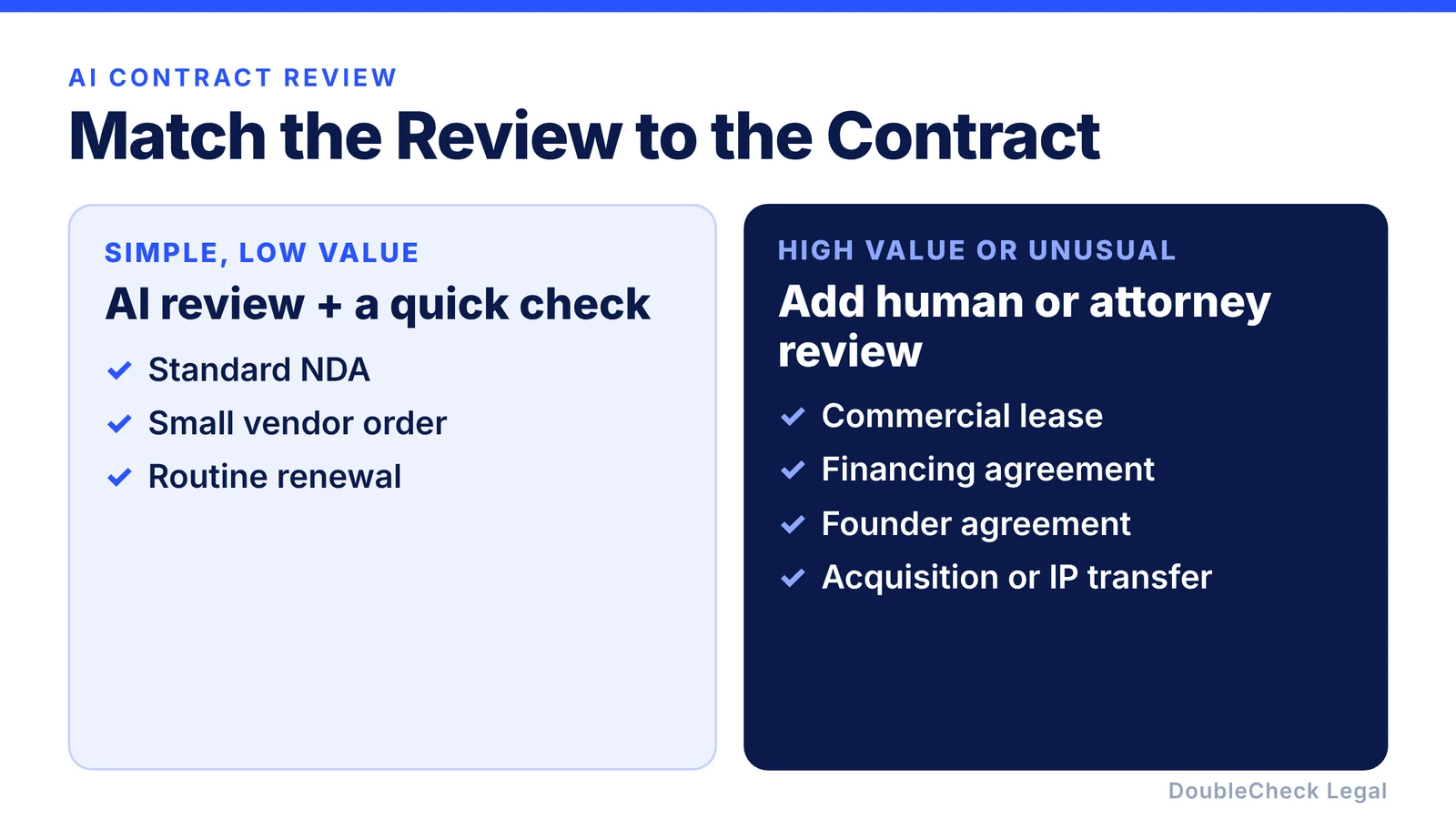
Not every agreement requires the same level of review. A simple low-value agreement may not justify the same process as:
- a major commercial lease,
- a financing agreement,
- a large customer contract,
- a founder agreement,
- an acquisition,
- an IP transfer,
- or a contract involving significant liability.
As the value or consequences increase, consider another verification layer. The workflow can be AI review → evidence → source check → human review → attorney if needed.
Why AI contract review is becoming popular
Contract review is one of the most active areas of legal AI, and it makes sense. Contracts are highly structured documents, and many of the first tasks a business needs, such as summarization, extraction, comparison, and finding relevant clauses, are tasks modern AI can perform well enough to be genuinely useful.
The harder part is verification.
How DoubleCheck improves AI contract review
A normal AI chatbot can review your agreement. DoubleCheck is designed to add the layers that come after the first AI response, including:
- structured contract analysis,
- source-backed information,
- cross-checking important claims,
- identification of missing information,
- visible separation between source material and AI interpretation,
- human verification,
- and optional attorney access.
For example, instead of only seeing “Your contract may have a termination issue,” a richer workflow could show the termination clause with the relevant document language, the AI’s analysis of what it means, any supporting source or reference, and what DoubleCheck suggests should be verified. That is a much more useful workflow for a business owner.
The goal is not to automate every legal decision
AI contract review is valuable because it helps businesses understand more of their own agreements. That can reduce unnecessary work and make professional review more focused when it is needed.
But the goal should not be “AI decides whether I should sign.” The better goal is: AI helps me understand what I am signing and what I should double-check before I decide.
FAQ
What is AI contract review?
AI contract review uses artificial intelligence to analyze agreements, summarize provisions, extract information, compare versions, and identify clauses that may deserve additional attention.
Can ChatGPT or Claude review a contract?
Yes. General-purpose AI tools can summarize and analyze contracts. The quality of the result depends on the model, prompt, context, and contract, and important conclusions should still be verified.
Is AI contract review accurate?
AI can perform many contract-analysis tasks effectively, but no general-purpose model should be assumed to identify every issue correctly. Important provisions and external legal conclusions should receive additional verification.
What clauses should a small business review?
Common areas include payment, termination, renewal, liability, indemnification, confidentiality, intellectual property, warranties, data obligations, governing law, and dispute resolution. What matters most depends on the agreement.
Can AI tell me whether I should sign a contract?
AI can help explain the agreement and identify issues to consider. Whether signing is appropriate can depend on business judgment, negotiation strategy, legal consequences, and facts not contained in the document.
Should a lawyer review an AI-analyzed contract?
For higher-value, unusual, heavily negotiated, or consequential agreements, attorney review may provide an important additional layer of professional judgment.
How is DoubleCheck different from a normal AI contract reviewer?
DoubleCheck is designed around verification: AI analysis plus source checking, cross-referencing, identification of missing context, optional human verification, and attorney access when needed.
General information only. This article is not legal, tax, or accounting advice.