How Small Businesses Can Use AI for Legal Work: 3 Rules for Better Results
AI can now draft contracts, summarize documents, and prepare you for a conversation with an attorney — but a confident-looking AI mistake in legal work can get expensive. This is general workflow information, not legal, tax, or accounting advice.
Key takeaways:
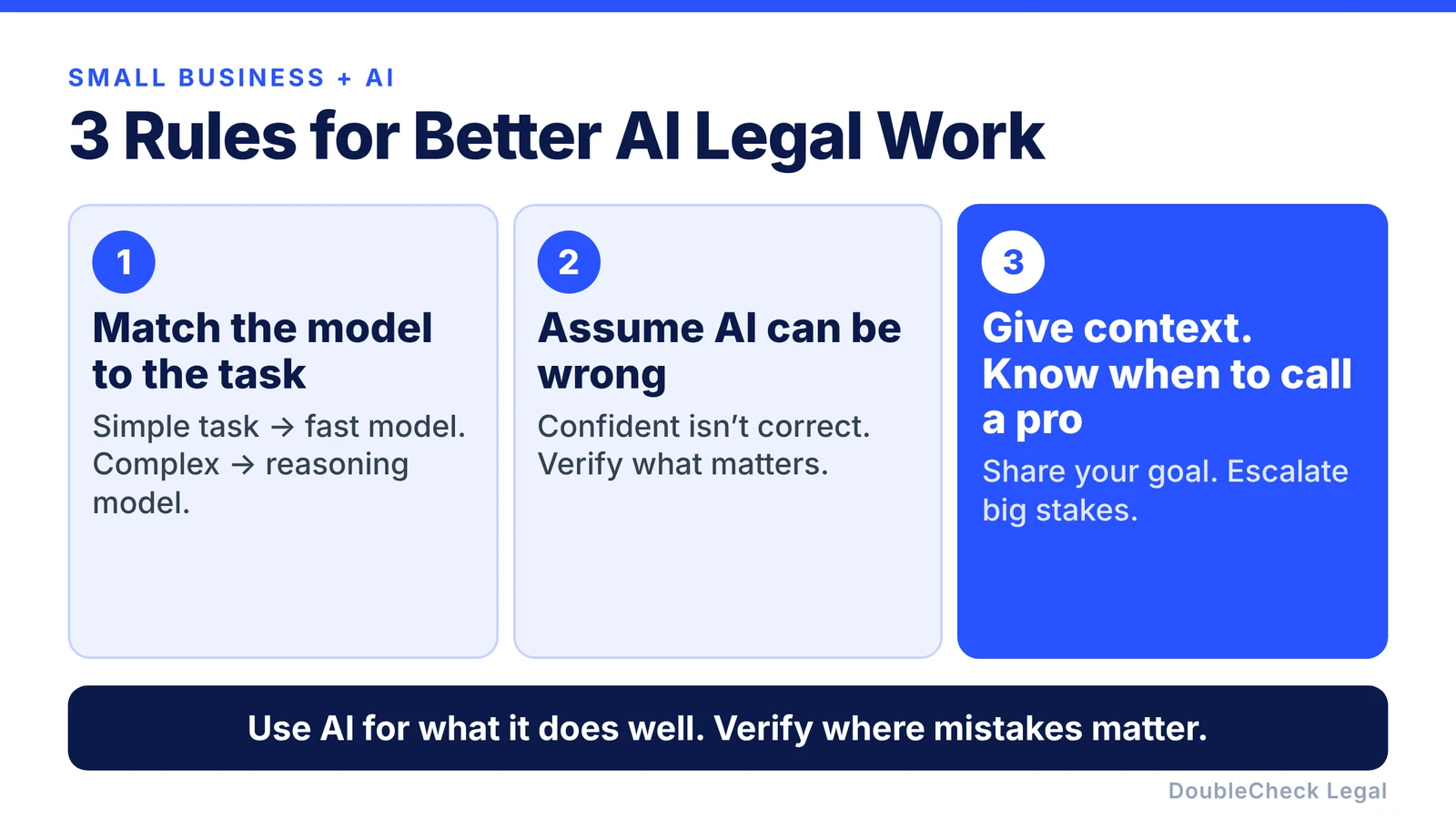
- Match the model to the task — a fast, cheap model is fine for summaries; complex, multi-document analysis benefits from stronger reasoning.
- Treat AI legal output as a draft that needs verification, not automatic truth — confident answers can still be wrong.
- Context changes everything: tell the AI your business, the deal, and what you’re worried about, not just “review this.”
- The workflow that works: AI prepares → you identify what matters → a professional reviews the issues where judgment counts.
AI can now help a small business draft contracts, summarize documents, explain unfamiliar language, organize legal questions, and prepare for a conversation with an attorney.
That can save significant time, especially for founders and small teams that do not have in-house legal departments.
But legal work is also one of the areas where a confident-looking AI mistake can become expensive.
The best approach is not to avoid AI. It is to use it with the right workflow.
Here are three rules that can make AI considerably more useful for your business.
1. Choose the right AI model for the job
Not every AI model performs equally well at every task.
A fast, inexpensive model may be perfectly adequate for summarizing a document, extracting dates, organizing information, or rewriting a paragraph.
A more capable reasoning model may be more appropriate when you are dealing with a complicated agreement, comparing multiple documents, analyzing dependencies between provisions, or working through a more nuanced business problem.
Think about AI models the way you think about other business tools: you do not always need the most powerful option, but you should match the tool to the complexity of the task.
For example, asking AI to summarize a straightforward NDA is different from asking it to analyze several financing documents and explain how they interact.
The more complex the task, the more important model quality, context, and verification become.
2. Assume the AI can make mistakes
Generative AI can produce extremely convincing answers that are still wrong.
This is often called an AI hallucination.
For everyday brainstorming, a small mistake may not matter much. With a legal document, however, the cost can be much higher.
AI might misunderstand a provision, miss an important definition, invent a fact, overlook an inconsistency, or confidently explain something incorrectly.
That does not make AI useless for legal work.
It means you should treat AI-generated legal work as work that needs verification rather than automatic truth.
AI can be excellent for first drafts, summaries, comparisons, checklists, and preparing questions. But when a decision could materially affect your company, ownership, financing, employees, intellectual property, or contractual obligations, the output deserves additional scrutiny.
3. Give AI context—but know when to bring in a professional
One of the biggest differences between a mediocre AI result and a useful one is context.
Instead of asking:
“Review this contract.”
you might explain:
“I run a small software company. This is an agreement with a new enterprise customer. I am most concerned about payment terms, termination, intellectual property, liability, and anything that could create an unusual obligation for us.”
Now the AI understands both the document and your objective.
You can also give it related documents, explain the transaction, identify your priorities, and ask it to tell you what information is missing.
But there should still be a boundary.
AI is particularly useful for helping you understand the problem and prepare the work. When the issue becomes consequential, unusual, highly negotiated, or difficult to verify, that can be the point where an attorney becomes much more valuable.
This creates a productive workflow:
For a small business, that can make professional help more efficient because you arrive better organized and better informed.
AI should make your legal workflow better—not just faster
The biggest benefit of AI for small businesses is not simply producing documents faster.
It is reducing the amount of friction between recognizing a legal issue and understanding what to do next.
You can use AI to read documents, create first drafts, organize information, explain terminology, compare versions, prepare questions, and help determine what kind of professional expertise you may need.
The goal should not be to trust AI with everything.
The goal is to use AI for the work it does well while adding verification where mistakes matter.
That combination can give small businesses access to capabilities that previously required much more time and internal resources.
With DoubleCheck, businesses can work through legal questions and documents with AI, organize the context around the issue, and bring an attorney into the workflow when professional review is needed.
Work through your legal documents with DoubleCheck
FAQ: Using AI for Legal Work in a Small Business
Can I use AI to draft contracts for my business?
AI can help create a first draft, revise language, organize provisions, and compare versions. The more important or customized the agreement is, the more important it becomes to verify the result before relying on it.
What is the biggest risk of using AI for legal documents?
One major risk is that AI can produce plausible but incorrect information. This is why important facts, conclusions, citations, and contractual language should not be accepted solely because the AI sounds confident.
Which AI model should I use for legal work?
It depends on the task. Simple extraction, rewriting, or summarization may not require the most capable model. More complicated analysis involving multiple documents, ambiguous language, or interconnected issues can benefit from stronger reasoning capabilities.
How can I get better legal results from AI?
Give the AI enough context. Explain your business, the purpose of the document, what you are trying to accomplish, and the issues you care about. Then ask it to identify uncertainty or missing information rather than simply producing an answer.
When should a small business involve an attorney?
When the consequences of being wrong are significant, the issue is highly customized or negotiated, or you cannot confidently verify the AI’s output, professional review can become particularly valuable.
This article provides general technology and workflow information and is not legal, tax, or accounting advice.