How to Write a Freelance Contract: 10 Things Every Business Should Include
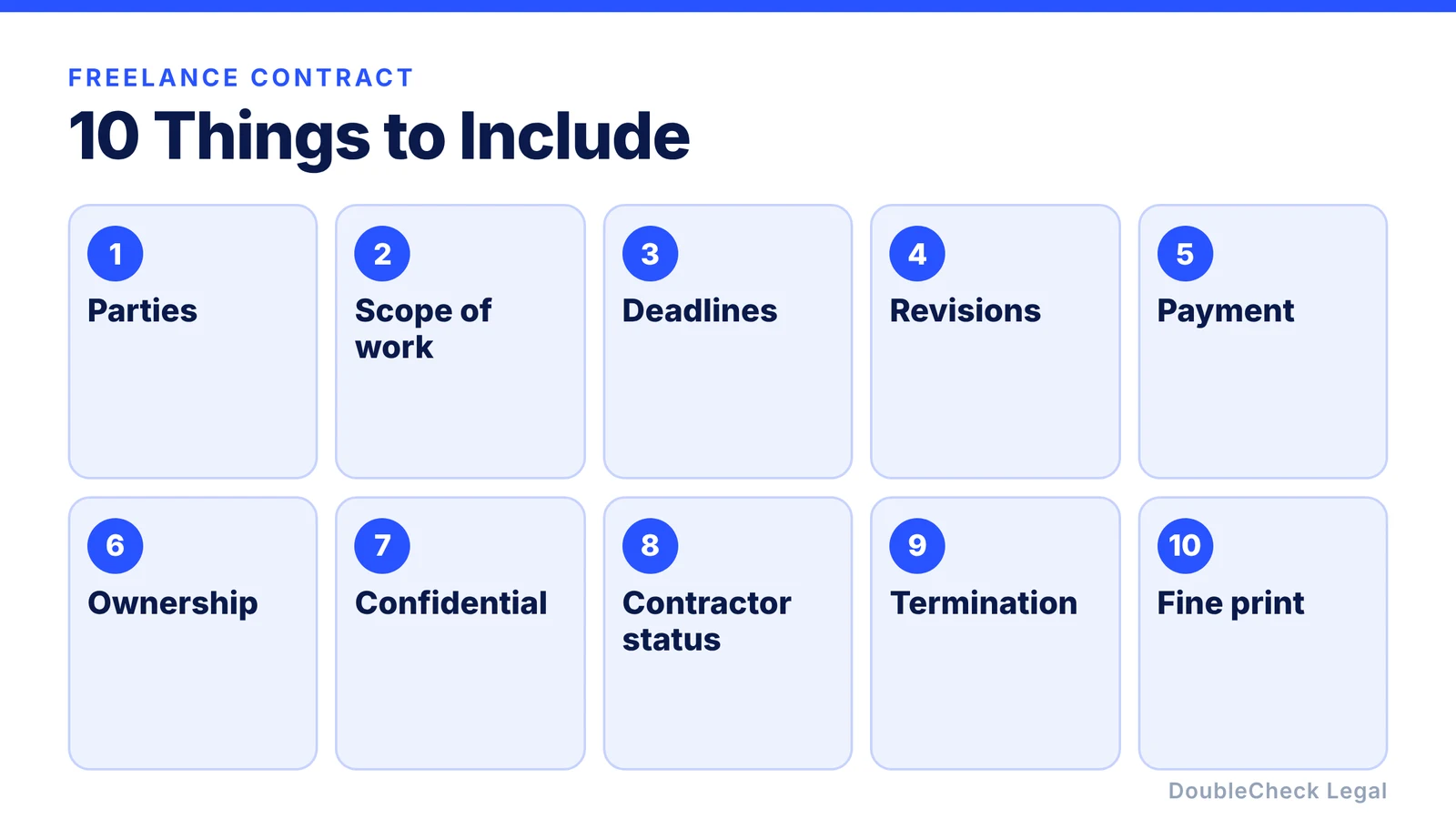
A freelance contract does not need to be 30 pages long to be useful. It does need to answer the important questions before work begins. Here are ten things to include.
Key takeaways:
- Define the scope, deadlines, revisions, and payment terms in plain, specific language.
- Do not assume that paying for work automatically settles who owns it. Address ownership in the contract.
- Calling someone an “independent contractor” in the agreement does not by itself decide how they are classified.
- AI can draft a strong first version, but check that it matches the actual deal.
- The more important the freelancer’s work, the more a professional review is worth.
You find a great freelancer. You agree on a price. They start working. Three weeks later, nobody remembers exactly how many revisions were included, when payment was due, whether the company owns the finished work, or what happens if the project ends early.
That is what a good freelance contract is supposed to prevent. A freelance contract, often structured as an independent contractor agreement, should answer the important questions while everyone still agrees.
What is a freelance contract?
A freelance contract is an agreement between a business or client and an independent professional performing work for that client. The freelancer could be a developer, designer, writer, marketer, photographer, consultant, video editor, researcher, engineer, recruiter, or another independent service provider.
The contract sets the basic rules of the relationship:
- What is being delivered?
- When is it due?
- How much will the freelancer be paid?
- Who owns the work?
- How many revisions are included?
- Can either side end the project?
- What information must stay confidential?
Why you should use a written freelance agreement
Small projects often begin informally. A founder sends a message, “Can you design the landing page for $2,000?” and the freelancer replies, “Sure.” That may feel sufficient until expectations diverge:
- The founder thought the price included mobile designs. The freelancer did not.
- The founder expected unlimited revisions. The freelancer expected two.
- The freelancer expects payment immediately. The founder normally pays vendors net 30.
- The founder assumes the business owns every design. The freelancer assumes some underlying assets remain part of their portfolio or reusable toolkit.
A written agreement forces both sides to resolve these questions before they become disputes.
1. Identify the client and freelancer
Start with the correct parties. If the freelancer operates through a company or LLC, determine which entity is actually providing the services. If your startup is hiring the freelancer, use the company’s correct legal name rather than casually putting the founder’s personal name into the agreement. Include enough information that it is clear who has obligations under the contract.
This sounds trivial, but the first question in any agreement is who actually agreed to what.
2. Define the scope of work
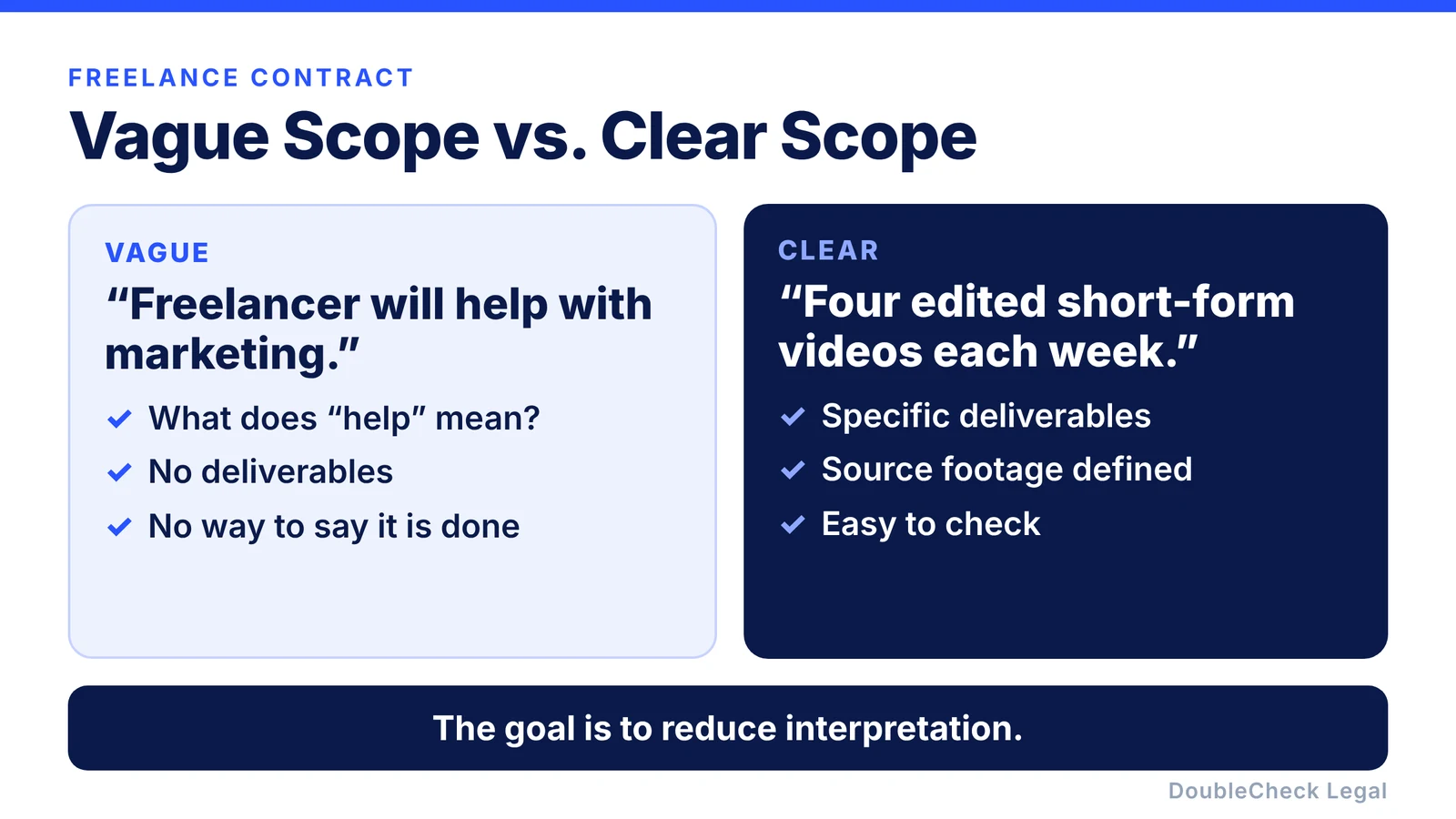
The scope may be the single most important operational part of a freelance contract. Avoid language such as “Freelancer will help with marketing.” What does “help” mean? A stronger scope describes the actual deliverables. For example:
“Freelancer will produce four edited short-form videos each week based on source footage supplied by Client.”
Or:
“Freelancer will design desktop and mobile versions of the homepage, pricing page, onboarding flow, and dashboard.”
The goal is to reduce interpretation. For more complex projects, the agreement can refer to a separate statement of work, or SOW, with project-specific deliverables.
3. Set deadlines and milestones
Think through the timing questions:
- When does work start?
- When should the project be completed?
- Are there intermediate milestones?
- What happens if the client does not provide required information on time?
For a one-week design project, a single delivery date may be enough. For a six-month software project, milestones can be much more useful. A contract can also distinguish between a deadline and an estimate, so if timing matters commercially, make that clear before the project begins.
4. Define revisions and acceptance
This is one of the easiest clauses to overlook. A designer delivers the project. The client asks for a change, then another, then another. At what point does a revision become additional work?
A freelance agreement can define how deliverables are reviewed, how many revisions are included, how quickly feedback must be provided, and when a deliverable is considered accepted. This can prevent scope creep from turning a fixed-price project into an unlimited one.
5. Make payment terms extremely clear
Do not write “Client will pay freelancer $5,000” and assume everything else is obvious. Spell out:
- whether the $5,000 is paid upfront, at completion, half and half, monthly, or by milestone,
- whether payment is due within 15 days of an invoice, within 30 days, or on another schedule,
- whether the freelancer can charge for approved expenses,
- and what happens to work outside the original scope.
For hourly projects, explain the rate and how hours are recorded. For fixed-price projects, make clear what the fixed price includes. For longer projects, milestone-based payments can align payment with completed work. The correct structure depends on the project. The important thing is that both sides understand it.
6. Decide who owns the work
For startups in particular, this is one of the clauses worth reading carefully. Do not assume that paying someone to create something automatically answers every intellectual-property question. Your agreement should explain what rights the client receives in the freelancer’s work.
That matters most when freelancers create software, designs, branding, photography, video, written content, research, or product materials. You may also need to distinguish between newly created work and materials the freelancer already owned before the project. A software developer may use pre-existing libraries, tools, or components, and a designer may have pre-existing assets or processes. The agreement should reflect what the parties actually intend to transfer, license, or retain.
If ownership of the work is important to the company’s value, particularly for a startup expecting financing, acquisition due diligence, or intellectual-property review, professional review of this clause may be worth the cost.
7. Add confidentiality where appropriate
A freelancer may get access to far more than the deliverable itself. A developer may see your source code, a marketer may see customer data, a designer may see products that have not launched, and a consultant may review financial information or strategy documents.
The agreement can establish confidentiality obligations directly or incorporate a separate NDA. (See our guide to how to write an NDA.) For sensitive information, also think operationally:
- Who needs access?
- What systems can the freelancer access?
- What should happen to company information when the project ends?
A contract is one layer of protection. Your actual information-security practices matter too.
8. Clarify the independent contractor relationship
If the person is meant to work as an independent contractor rather than an employee, agreements commonly say so. But there is an important limitation:
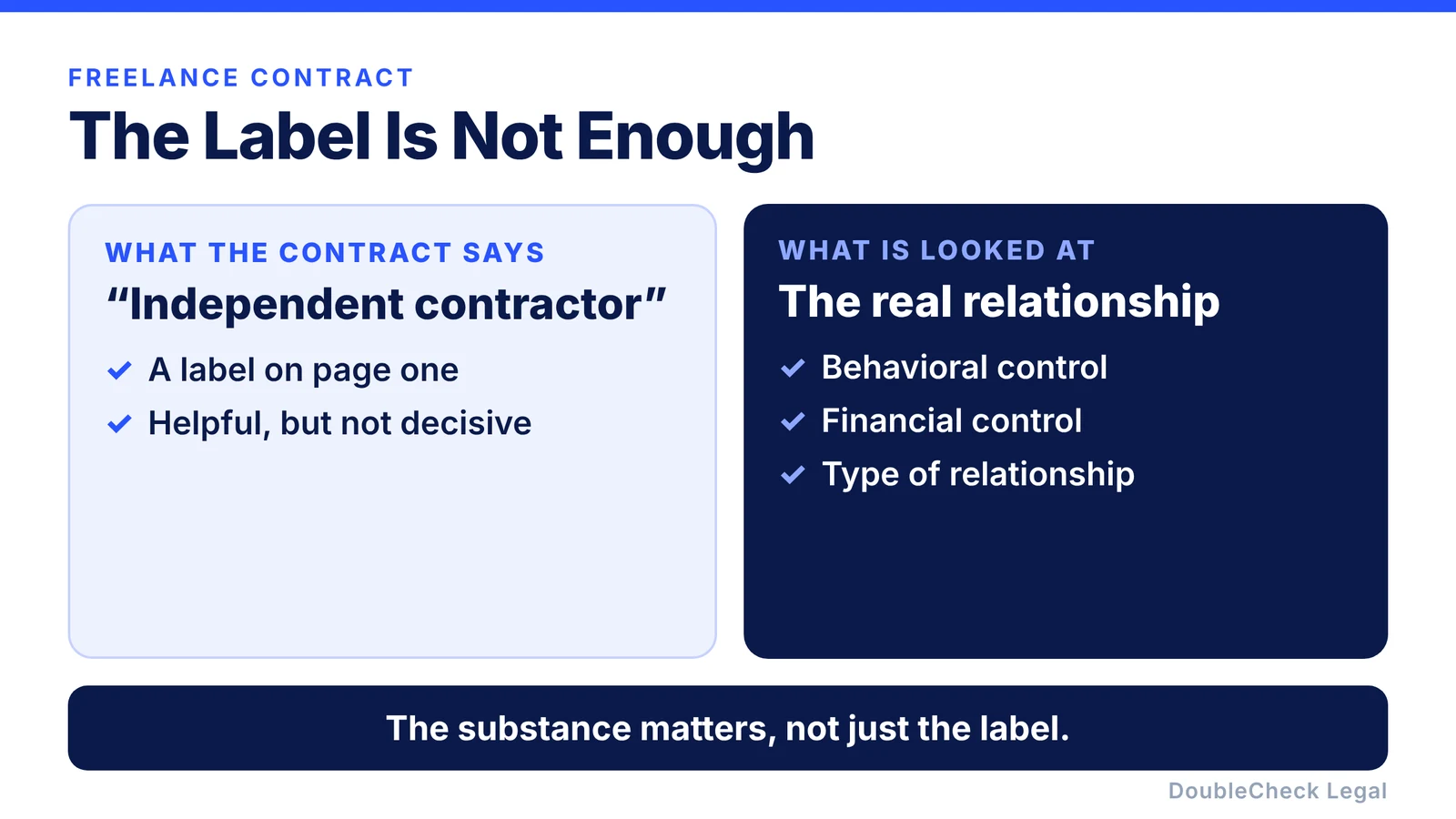
Writing “independent contractor” in the contract does not automatically make someone an independent contractor.
The IRS explains that classification depends on the actual facts and circumstances, including behavioral control, financial control, and the type of relationship between the parties. The substance of the relationship matters, not just the label used in the agreement.
That distinction matters because employee and independent-contractor relationships can have different tax and employment consequences, and classification rules can vary by jurisdiction and legal context. If you treat someone like an employee while labeling them a freelancer in the contract, the contract itself may not solve the underlying classification problem.
9. Explain how the agreement can end
Projects do not always go according to plan. The freelancer becomes unavailable, the client’s priorities change, funding disappears, or the work is not meeting expectations. Your contract should explain how either side can terminate the agreement and what happens afterward:
- How much notice is required?
- Does the freelancer get paid for work already completed?
- What happens to unfinished work?
- What happens to confidential information?
- Which obligations continue after termination?
It is easier to decide these rules before anyone is frustrated.
10. Review the clauses everyone ignores
Freelance contracts frequently contain sections on warranties, indemnification, limitations of liability, dispute resolution, governing law, assignment, notices, amendments, and the entire agreement. These often appear near the end, but that does not make them unimportant. A liability provision, for example, can matter much more than the paragraph describing when an invoice is due.
The complexity of these sections should be proportional to the project. A $500 logo project and a $500,000 engineering engagement do not necessarily need the same agreement.
How to write a freelance contract with ChatGPT or Claude
AI is particularly useful for a first version of a freelance agreement because much of the relevant information can be structured. But the quality of the contract depends heavily on the prompt. Do not simply say “Write a freelancer contract.” Give the model the deal. For example:
“Draft a plain-English independent contractor agreement for a California software startup hiring a freelance product designer for a three-month project. The freelancer will deliver a redesigned onboarding experience and mobile dashboard. Compensation is $6,000 per month, paid monthly after invoice. Include deliverables, deadlines, two revision rounds per major deliverable, confidentiality, intellectual-property ownership, treatment of pre-existing materials, termination, and independent-contractor language. Identify any provisions that depend on jurisdiction or facts I have not provided.”
Then ask the AI to review its own draft:
“What important information is missing?”
Then:
“Which clauses create the biggest risk for the client?”
Then:
“Review the same contract from the freelancer’s perspective. Which provisions are ambiguous or unusually one-sided?”
Then:
“Are there any contradictions between the scope, payment, termination, and IP sections?”
This kind of iterative drafting is much stronger than accepting the first generated agreement.
The biggest freelance contract mistakes
- A vague scope.
- Failing to define revisions.
- Unclear payment timing.
- Failing to address intellectual-property ownership, which can create larger problems later for startups.
- Assuming that putting “independent contractor” at the top of an agreement settles worker classification.
- And, with AI-generated contracts, a new mistake: the agreement looks complete, so nobody checks whether it reflects the deal.
That last risk is increasingly relevant. In DoubleCheck’s 2026 survey, contractor and freelance agreements were the most commonly reported type of AI-drafted legal document, at 57% of the 99 respondents. The document may be generated in seconds, but understanding the deal still matters.
Do you need both an NDA and a freelance agreement?
Sometimes. A freelance agreement can contain its own confidentiality section. In other situations, the company may already use a separate NDA that applies before the full project agreement is signed. The important thing is not the number of documents. It is whether the agreements clearly address the confidentiality obligations that matter without contradicting one another.
Should you use a freelance contract template?
A template can save time, but treat it as a starting point. A generic template does not know what you are building, how the freelancer is paid, whether intellectual-property ownership matters, what state the parties are in, what happens if the project ends, or whether your working relationship raises classification questions. The same is true of an AI-generated agreement.
The best contract is not necessarily the longest one. It is the one that accurately describes the relationship.
When should a lawyer review a freelance contract?
A short, low-value, routine project may justify a very different level of review from a contractor building the core technology of your startup. Professional review becomes more valuable when the freelancer will create important intellectual property, access sensitive information, work with regulated data, receive significant compensation, operate across jurisdictions, perform a core role for a long period, or create a relationship where worker classification is uncertain.
You can also use AI first to make the legal review more focused. Instead of handing an attorney a blank page, arrive with a draft and specific questions:
“Please check the IP ownership provision, contractor classification, liability language, and termination terms. The commercial terms are already agreed.”
That is a much more efficient starting point.
A better workflow for freelance agreements
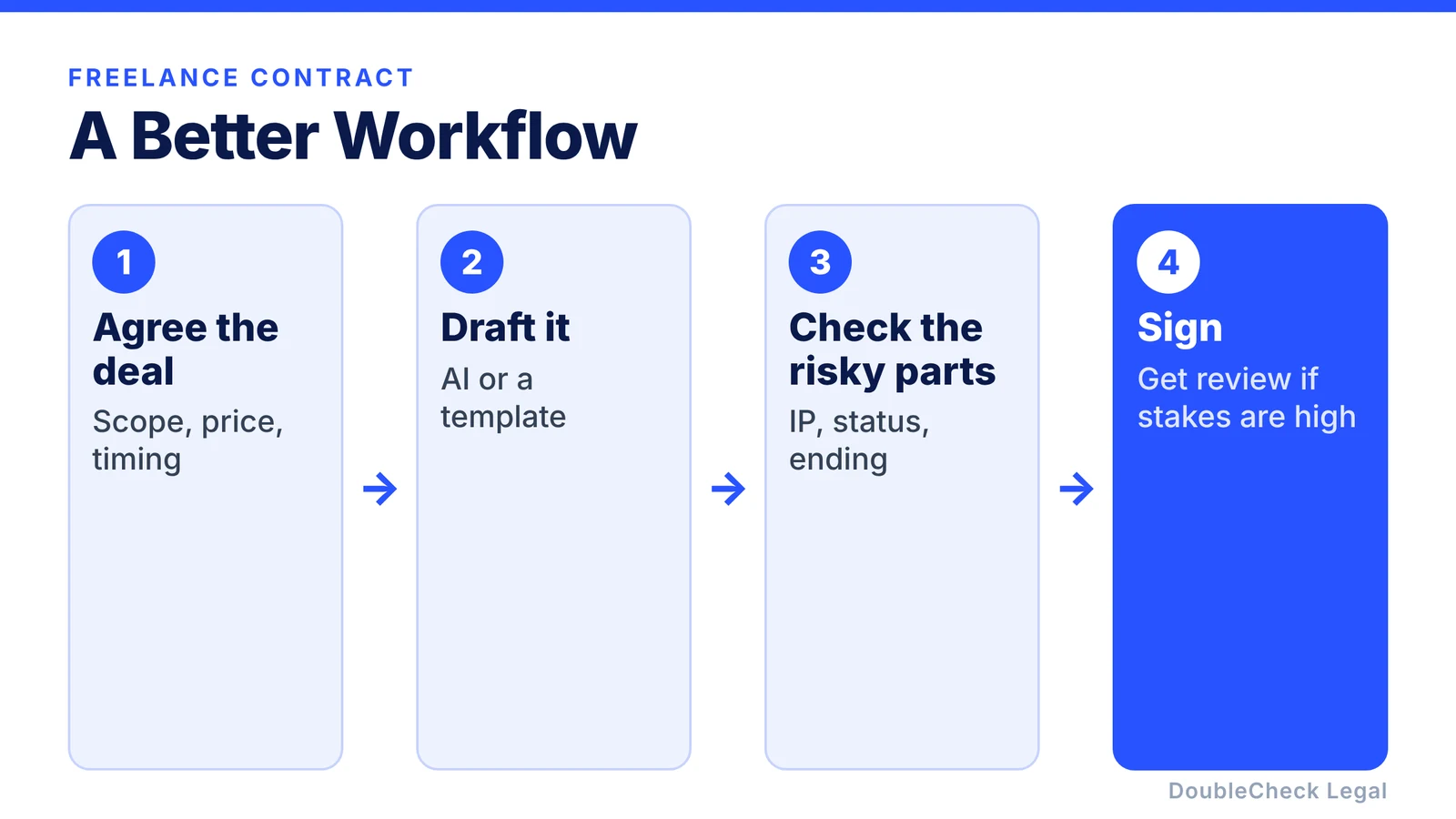
Agree on the business terms → draft the agreement → check scope and payment → check IP and confidentiality → review classification → test what happens if the relationship ends → verify high-risk provisions → sign
AI can accelerate almost every part of that process, but it should not replace understanding what you are agreeing to.
Using DoubleCheck
DoubleCheck is designed around a practical problem: AI makes legal drafting extraordinarily fast, but generated documents still need verification. You can start with an agreement you drafted yourself or created with ChatGPT, Claude, or another AI tool. Then examine the important provisions, identify missing information, understand which questions deserve additional attention, and decide whether professional review is warranted.
When an attorney is needed, you can approach that review with the contract already drafted and the major questions already identified. That can make legal work faster without treating an AI-generated document as automatically correct.
FAQ
What should be included in a freelance contract?
A freelance contract commonly addresses the parties, scope of work, deliverables, deadlines, revisions, compensation, expenses, intellectual property, confidentiality, independent-contractor status, termination, and other provisions relevant to the project.
What is an independent contractor agreement?
An independent contractor agreement is a contract governing work performed by an independent service provider for a client. Depending on the relationship, it may also be called a freelance agreement, consulting agreement, contractor agreement, or services agreement.
Can I write my own freelance contract?
You can prepare a first draft yourself, use a template, or draft one with AI. Make sure the document accurately reflects the deal, and consider additional review when issues such as intellectual property, worker classification, significant liability, or jurisdiction-specific requirements matter.
Can ChatGPT write a freelance contract?
ChatGPT can create a useful first draft when given detailed information about the parties, project, payment, deliverables, intellectual property, confidentiality, termination, and jurisdiction. Check the result for missing information, inconsistent provisions, and jurisdiction-specific issues.
Does a freelancer own the work they create?
Ownership can depend on the circumstances, applicable law, the type of work, and the contract between the parties. Businesses hiring freelancers should not simply assume ownership; the agreement should clearly address the intended intellectual-property arrangement.
Is a freelancer the same as an independent contractor?
The terms are often used interchangeably in everyday business conversation, but legal classification depends on the actual relationship and applicable law rather than the label alone.
Do freelancers need an NDA?
Not every freelancer needs a separate NDA. Confidentiality provisions can be included in the main freelance agreement. If the freelancer will access valuable non-public information, consider how that information will be protected.
Can a freelancer be misclassified as an independent contractor?
Yes. Calling someone an independent contractor in a written agreement does not by itself determine their legal status. Classification can depend on factors such as control, financial independence, the relationship between the parties, jurisdiction, and the applicable legal test.
How long should a freelance contract be?
There is no ideal page count. A simple project may need a short agreement, while a complex or high-value engagement may justify more detail. The goal is to cover the material terms clearly rather than make the agreement long for its own sake.
General information only. This article is not legal, tax, investment, or accounting advice.