How to Write an NDA: A Practical Guide for Startups and Small Businesses
An NDA can be one of the simplest contracts your business signs, and one of the easiest to get wrong. Here is how to write one, what it should contain, and how to check an AI-generated draft.
Key takeaways:
- An NDA should say what is protected, why it is being shared, how it may be used, and how long the duty lasts.
- Choose a one-way or mutual NDA based on who will actually share information.
- Limit how confidential information may be used, not just whether it may be disclosed.
- AI can produce a strong first draft, but check its assumptions, definitions, and jurisdiction-specific terms.
- The more valuable the information, the more a professional review is worth.
Maybe you are showing your product to a potential partner. Maybe you are hiring a freelancer who will see your source code. Maybe you are sharing financial information with an investor, discussing a possible acquisition, or giving a vendor access to information you do not want public.
A non-disclosure agreement, or NDA, sets rules about what information can be disclosed, how it can be used, and what the recipient is expected to keep confidential. You can draft a basic NDA yourself, start from a template, or use ChatGPT, Claude, or another AI tool to create a first version. But before anyone signs it, there are several things worth checking.
What is an NDA?
An NDA, short for non-disclosure agreement, is a contract designed to protect confidential information shared between people or businesses. You may also see confidentiality agreement, confidential disclosure agreement, or proprietary information agreement.
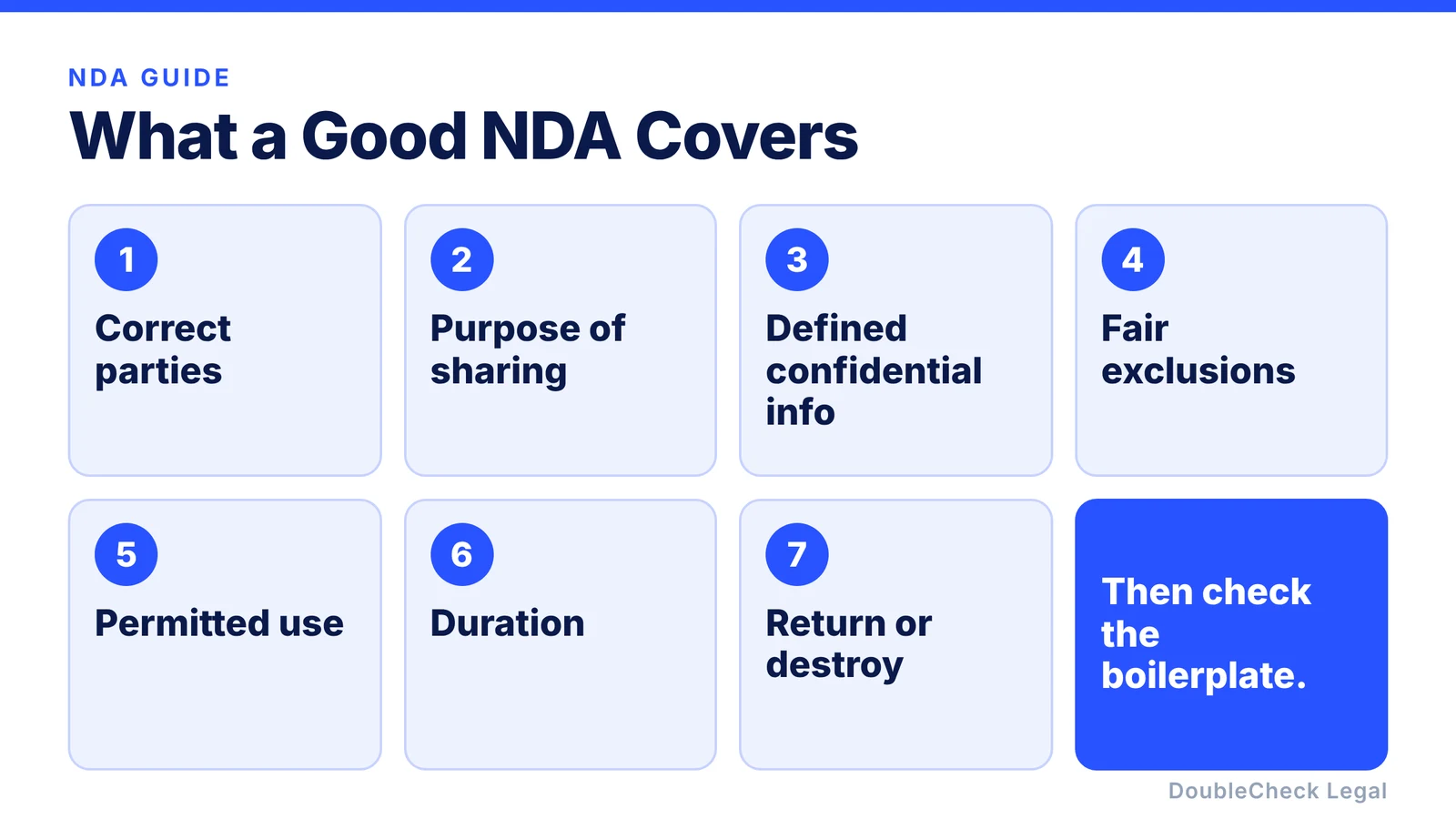
The basic idea is straightforward: one party shares information, and the other agrees not to disclose or misuse it. But the details matter. A good NDA makes it reasonably clear what is protected, why the information is being shared, what the recipient can do with it, how long the obligations last, and what happens when the relationship ends.
When should you use an NDA?
An NDA can make sense whenever your business needs to disclose valuable non-public information to someone outside the group that normally has access to it. For a startup, that could be a freelancer, developer, agency, consultant, potential partner, manufacturer, vendor, customer, buyer, or investor.
It might cover source code, product plans, customer information, pricing, financial projections, internal processes, research, designs, prototypes, or marketing plans.
An NDA can also be part of a broader effort to protect trade secrets, since taking reasonable steps to keep information secret can matter, and confidentiality agreements are one such step. That does not mean every conversation needs an NDA. The goal is to protect genuinely sensitive information without making ordinary business interactions needlessly complicated.
Mutual NDA vs. one-way NDA
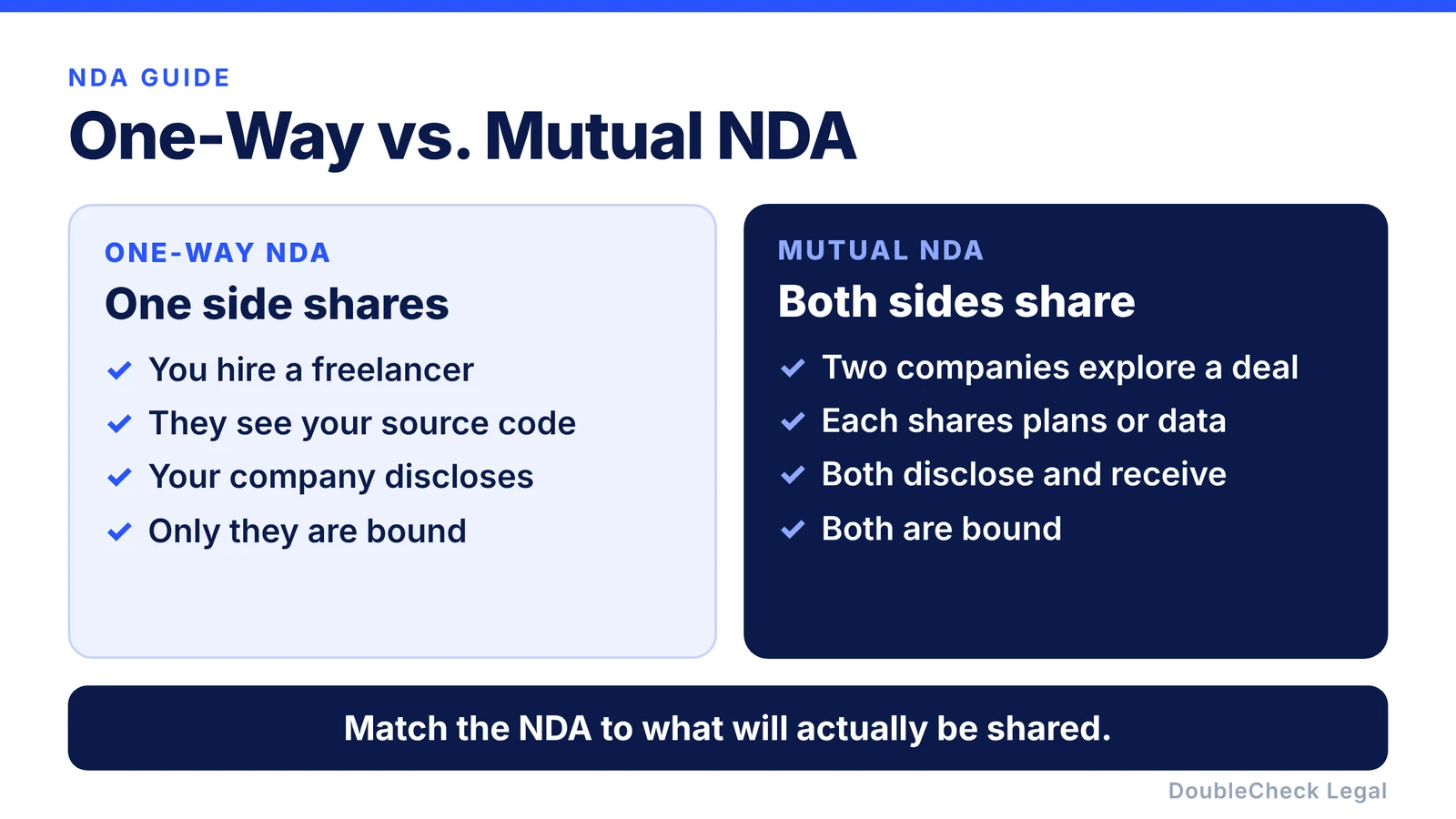
Before drafting anything, decide whether the NDA should be one-way or mutual.
A one-way (unilateral) NDA fits when mainly one side is sharing confidential information. For example, your startup gives a freelance engineer access to private source code and product plans.
A mutual NDA fits when both parties expect to exchange confidential information. For example, two companies discussing a partnership may each share product plans, financial information, or technical details.
The agreement should match what will actually happen between the parties.
1. Identify the parties correctly
Start with something basic that is easy to overlook: who is actually signing? Use the correct legal names of the people or companies involved. If your company is entering the agreement, make sure the company, rather than accidentally just the founder personally, is the named party.
Also make clear who shares information and who receives it. In a mutual NDA, both parties may be both a Disclosing Party and a Receiving Party, depending on who shares a particular piece of information.
2. Explain the purpose of the disclosure
A good NDA usually explains why confidential information is being shared. For example:
- the parties are evaluating a potential business relationship,
- a freelancer is developing a new product feature,
- a consultant is reviewing the company’s internal operations,
- or a potential buyer is conducting due diligence.
This matters because an NDA should do more than say “Don’t tell anyone.” It should also limit how confidential information may be used. If you share information so someone can evaluate a partnership, that does not mean they should be free to use it to build a competing product. The purpose of the relationship helps define what uses are permitted.
3. Define “Confidential Information”
This is one of the most important parts of an NDA. If the definition is too narrow, information you expected to protect may fall outside the agreement. If it is impossibly broad, such as treating virtually everything as confidential forever, the agreement becomes hard to interpret and administer.
The definition can cover categories such as business plans, financial information, customer data, product roadmaps, software, source code, technical information, designs, research, pricing, marketing strategies, processes, and prototypes. It should reflect what your business will actually disclose.
4. Include reasonable exclusions
Not everything should stay confidential just because it came up during the relationship. NDAs commonly address information that:
- was already publicly known,
- the recipient already legitimately possessed,
- the recipient developed independently without using the protected information,
- or was lawfully obtained from another source.
The details matter, but conceptually these exclusions stop the NDA from turning information that is already legitimately available into something permanently secret.
5. Explain what the recipient can and cannot do
The confidentiality obligation should tell the recipient what is expected: protect the information from unauthorized disclosure and use it only for the agreed purpose.
The agreement may also need to address who inside the recipient’s organization can see it. Can it be shared with employees, outside lawyers, accountants, contractors, or potential financing sources? A useful agreement considers how people will actually work with the information rather than simply declaring everything “confidential.”
6. Decide how long the NDA should last
Founders often ask how long an NDA should last. There is no single duration that is correct for every NDA. Different information stays sensitive for different lengths of time. A product launch plan may lose most of its sensitivity after launch, while other information may stay valuable much longer. Trade-secret information can also raise different considerations from ordinary confidential information.
Instead of picking a number of years from a template, ask:
- What information are we actually protecting?
- How long is it likely to remain sensitive?
- Does applicable law affect the appropriate duration?
7. Think about return or destruction of information
What happens when the project or discussion ends? The NDA can address whether the recipient must return or destroy documents, files, copies, and other materials.
In modern businesses this is more complicated than returning a folder. Information may sit in email, cloud storage, backups, collaboration tools, local computers, or systems that automatically retain records. The language should be realistic enough that the parties can actually comply.
8. Address required disclosures
Sometimes someone may be legally required to disclose information despite an NDA, for example by law, regulation, subpoena, or court order. An NDA can address what should happen then, including whether notice should be given when legally permitted. An NDA generally should not assume that confidentiality overrides every legal obligation to disclose.
9. Check the boilerplate too
Founders understandably focus on the confidentiality section, but do not ignore the rest. Your NDA may also contain provisions on governing law, jurisdiction, assignment, amendments, notices, severability, entire agreement language, remedies, and electronic signatures.
These sections can look generic because they appear in many contracts, but they are still part of the contract. If you use a template or an AI-generated NDA, do not assume the boilerplate fits your company.
How to draft an NDA with ChatGPT or Claude
AI can be very useful for a first draft. The mistake is asking:
“Write me an NDA.”
Give the AI context instead. A better prompt might be:
“Draft a simple mutual NDA between two U.S. software startups that are evaluating a potential technical partnership. Each company may disclose source code architecture, product roadmaps, customer information, pricing, financial information, technical documentation, and business plans. The information should only be used to evaluate the partnership. Clearly identify assumptions and any provisions that may depend on jurisdiction. Keep the document readable rather than unnecessarily complicated.”
Then do not stop at the first draft. Ask:
“What information did you have to assume?”
Then:
“Which provisions may change depending on state law?”
Then:
“What important protections might be missing?”
And finally:
“Review this NDA from the perspective of the other party and identify anything ambiguous, unusually broad, or difficult to comply with.”
That turns AI from a document generator into a first-stage reviewer.
Common NDA mistakes
- Using an NDA copied from an unrelated transaction.
- Defining confidential information so vaguely that nobody knows what is protected.
- Protecting information without restricting how it may be used.
- Forgetting the contractors, employees, or advisers who may need legitimate access.
- Accepting an AI-generated NDA simply because it looks professional.
AI can produce very convincing legal language, and that does not mean every clause fits your situation. In DoubleCheck’s 2026 survey, NDAs were among the documents businesses said they draft with AI: 49% of the 99 respondents reported using AI for NDAs. That makes verification increasingly important.
Should a lawyer review your NDA?
Not every NDA needs an expensive legal project. A routine confidentiality agreement for an ordinary business conversation is different from an NDA involving valuable intellectual property, a major transaction, sensitive technology, employment issues, international parties, or substantial trade secrets.
A more useful question than “Do I need a lawyer?” is:
“What happens if this agreement is wrong?”
As the value and sensitivity of the information increase, professional review becomes more valuable.
A better NDA workflow
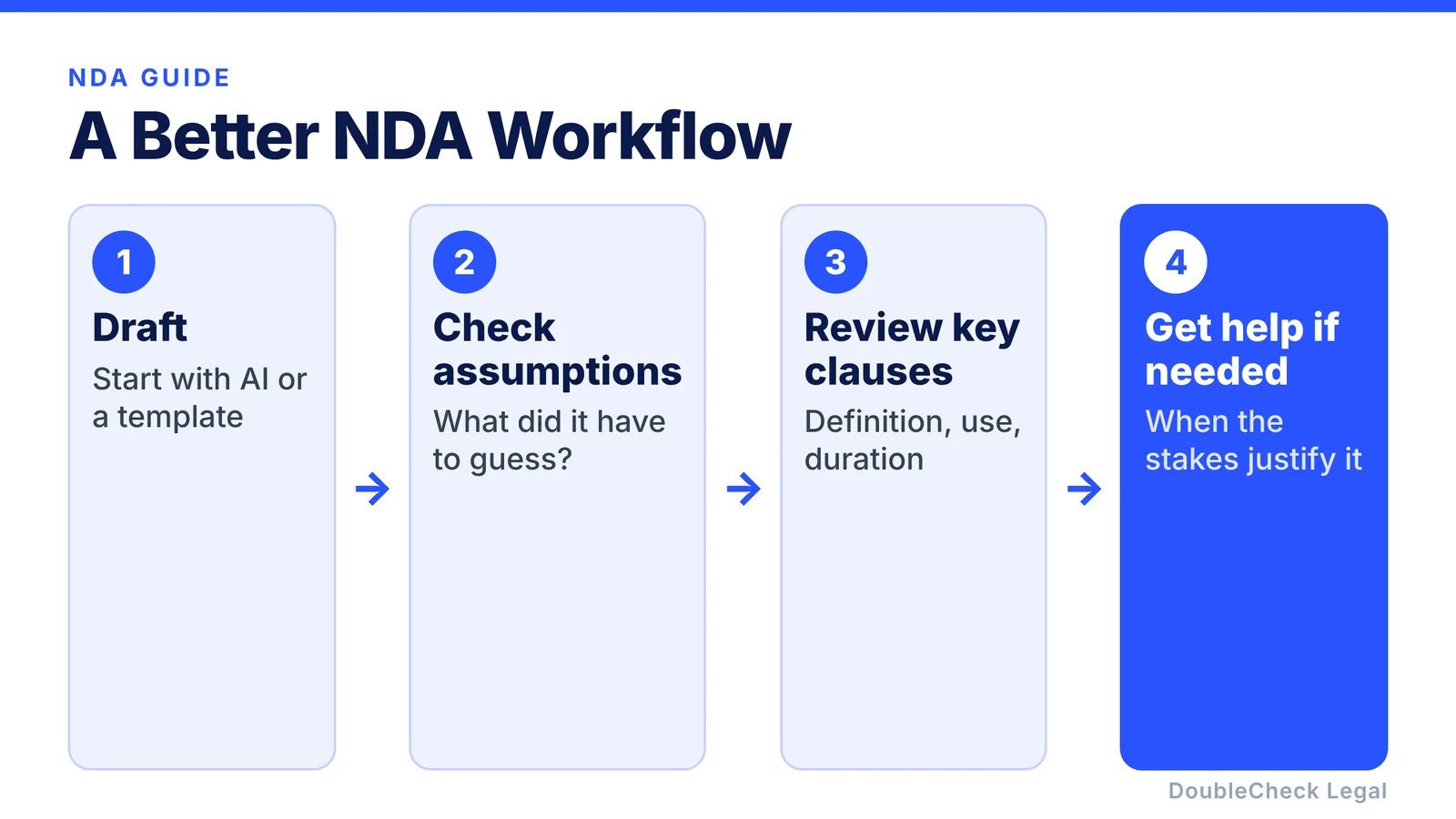
Understand the relationship → draft the NDA → check assumptions → review the important clauses → verify jurisdiction-specific issues → get professional review if the risk justifies it → sign
AI can make the drafting stage dramatically faster. It should not make the checking stage disappear.
How DoubleCheck can help
DoubleCheck is built around the idea that AI-generated legal work should be easier to verify. You can use AI to create the first version of an NDA, identify questions, and understand unfamiliar language. Then use a verification workflow to examine what may be missing, what assumptions were made, and what deserves additional review.
If professional judgment becomes necessary, you can move toward attorney review with a much more developed document and a clearer understanding of the questions you need answered. The goal is not to make a simple NDA complicated. It is to make sure a document that looks finished is ready for the way you intend to use it.
FAQ
What does NDA stand for?
NDA stands for non-disclosure agreement. It is a contract used to establish confidentiality obligations around information shared between parties.
How do I write an NDA?
Start by identifying the parties and the purpose of the relationship. Then define the confidential information, explain how it may be used, specify who may receive it, address exclusions and required disclosures, decide how long the obligations should last, and review the remaining contract terms.
Can I write my own NDA?
You can prepare a first draft yourself, use a template, or use an AI tool. Whether additional legal review is worthwhile depends on the transaction, applicable law, the sensitivity of the information, and the consequences if the agreement does not work as expected.
Can ChatGPT write an NDA?
ChatGPT and other AI tools can generate a useful first draft when given enough context. Review the assumptions, jurisdiction, definitions, confidentiality obligations, duration, exclusions, and other important provisions before relying on it.
What is the difference between an NDA and a confidentiality agreement?
The terms are often used for similar agreements. The actual rights and obligations come from the language of the document rather than its title.
Should an NDA be mutual?
A mutual NDA can make sense when both sides will share confidential information. A one-way NDA may fit better when mainly one side is disclosing protected information.
How long should an NDA last?
There is no universal duration. The answer can depend on the type of information, the relationship, applicable law, and whether trade secrets or other long-lived confidential information are involved.
Does an NDA protect a trade secret?
An NDA can be one part of protecting trade secrets, but businesses may need other reasonable confidentiality measures as well. The right measures depend on the circumstances.
Should I use an NDA template?
A template can be a useful starting point, but adapt it to the actual parties, purpose, information, jurisdiction, and relationship instead of signing it unchanged.
General information only. This article is not legal, tax, investment, or accounting advice.