7 Mistakes Businesses Make When Using AI for Legal Work
AI can make legal work much faster. It can also make mistakes look very convincing. Here are seven mistakes businesses make, and how to avoid each one.
Key takeaways:
- Do not confuse a confident AI answer with a verified answer.
- Give AI the facts, jurisdiction, objective, and relevant documents, not just a vague question.
- Open and inspect important sources instead of trusting citations automatically.
- Think about privacy before uploading documents to any AI product.
- For consequential matters, add another layer of review: a second check, authoritative sources, or an attorney.
AI can summarize a contract, explain unfamiliar language, compare versions of an agreement, draft a first version of a document, and help you prepare questions before speaking with an attorney.
But there is a big difference between using AI to help with legal work and blindly relying on AI for legal work. A polished answer can still be incomplete, based on the wrong jurisdiction, supported by a source that does not say what the AI claims, or simply wrong.
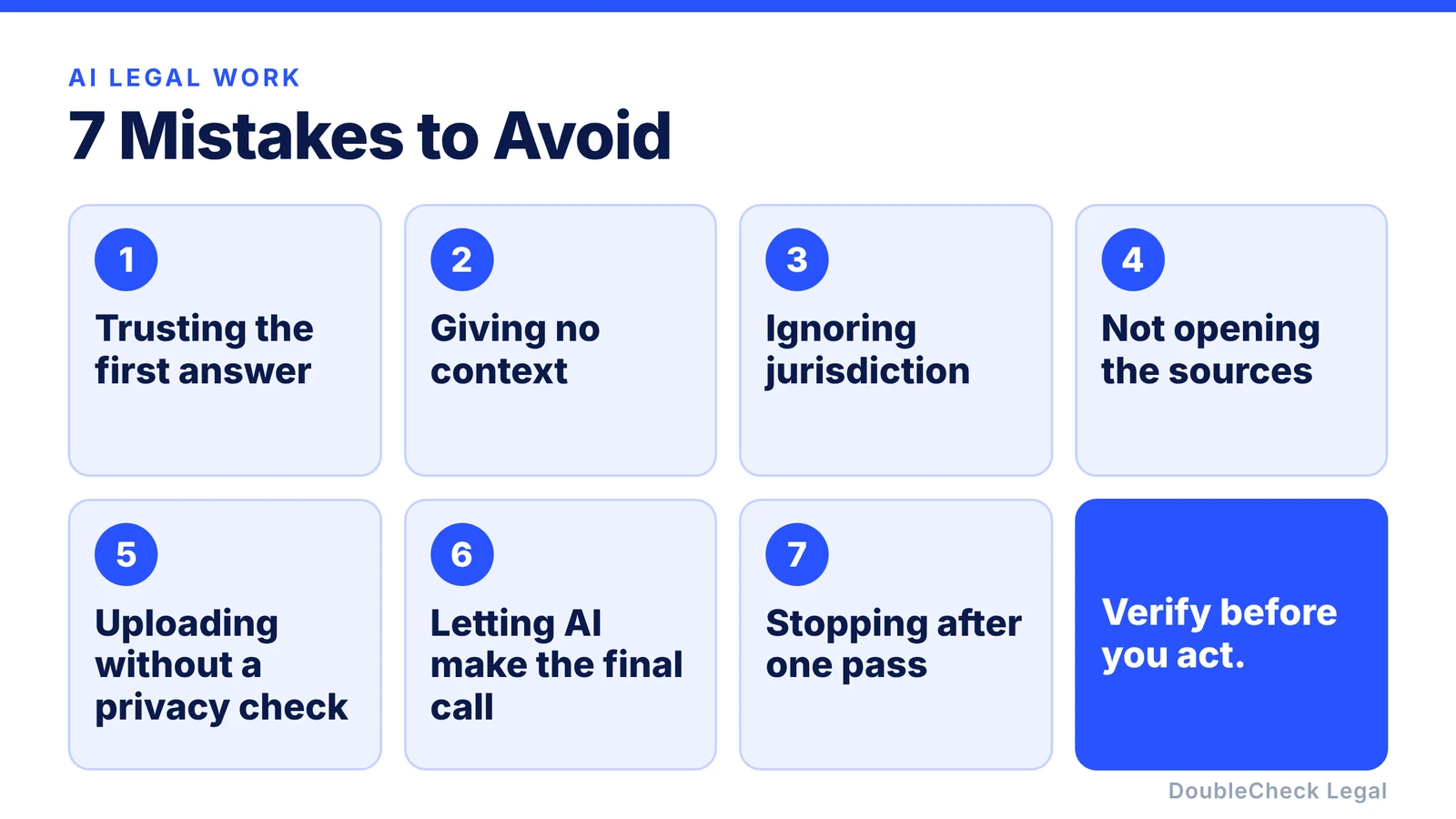
1. Treating the AI answer as the answer
This is probably the biggest mistake. ChatGPT, Claude, Gemini, and other AI systems can produce responses that sound remarkably authoritative. The formatting is good, the explanation is clear, and the language sounds professional. That does not mean the conclusion is correct.
AI can misunderstand a provision, overlook an exception, make an incorrect assumption, or present uncertain information with too much confidence.
Instead of thinking:
“The AI answered my question.”
Think:
“The AI created a useful first analysis that I can now verify.”
For lower-risk tasks such as summarizing a document or explaining terminology, the first response may already be very useful. For questions involving ownership, intellectual property, employees, financing, important contracts, taxes, disputes, or major liabilities, verification matters much more.
2. Giving AI almost no context
Imagine asking an attorney, “Is this contract okay?” without explaining who you are, what the transaction is, what matters to you, or what outcome you want. That would not be a productive consultation. AI has the same problem, and a vague prompt often produces a generic answer.
Instead of asking:
“Review this contract.”
Try something closer to:
“I run a California software startup. This is a contract with an enterprise customer. We are a small team and I am particularly concerned about intellectual property ownership, payment, termination, indemnification, liability, data obligations, and any provision that could create an unusually large obligation. Identify the provisions I should examine most carefully and explain why.”
Useful context can include:
- what your business does,
- your location and jurisdiction,
- the other party,
- the type of transaction,
- your goal and biggest concerns,
- relevant related documents,
- your deadline,
- and what has already been negotiated.
Better context does not guarantee a correct answer, but poor context makes a good answer considerably harder.
3. Forgetting that jurisdiction matters
Legal questions often depend on location. A rule that applies in California may not apply the same way in Texas, New York, France, or another jurisdiction. This matters most for businesses with employees, customers, contractors, or operations in multiple places.
Do not simply ask, “Can I do this?” Tell the AI where the relevant people and businesses are located. For example:
“My company is incorporated in Delaware, operates from California, and the employee works remotely from New York.”
That gives the model a much better framework for identifying what needs to be investigated. You can also ask directly:
“Does the answer change based on jurisdiction?”
That one question can uncover assumptions that would otherwise stay hidden.
4. Trusting AI-generated citations without opening them
Asking AI for sources is a very good habit. The second step is to actually inspect the sources.
An AI system can provide a citation that looks relevant but does not fully support its conclusion. It can refer to an outdated page or misunderstand what a source says. Depending on the system and workflow, it can also provide inaccurate source information.
For an important legal question, do not stop at “Give me the sources.” Continue with:
“Which specific source supports each major conclusion?”
Then open the important source yourself. Whenever possible, prioritize authoritative material such as statutes, regulations, government agencies, court materials, and other primary or official sources.
A citation is evidence to inspect, not a stamp of correctness.
5. Uploading sensitive information without thinking about privacy
AI is convenient for reviewing documents: drag in the agreement, ask questions, get an explanation. But before uploading confidential contracts, employee information, customer data, financial information, trade secrets, or other sensitive material, understand the privacy and data-handling rules of the system you are using. Different products, plans, enterprise offerings, APIs, and company configurations can have different controls.
Before uploading sensitive material, ask:
- What information is actually necessary for this task?
- Can unnecessary personal or confidential details be removed?
- What are the data retention and usage settings of the service?
- Does my company already have rules about which AI systems can be used?
The goal is not to avoid AI. It is to avoid sending more sensitive information than the task requires without understanding where it is going.
6. Asking AI to make the final high-stakes decision
AI can be excellent at helping you understand a decision. That is different from letting it make the decision for you. Consider questions such as:
- Should I fire this employee?
- Should I sign this financing document?
- Do I own this intellectual property?
- Can I ignore this demand letter?
- Should I accept this indemnification provision?
Those questions involve facts, strategy, risk tolerance, negotiation context, and legal consequences that are hard to reduce to a single AI answer. A better use of AI is to ask:
“What issues should I consider before making this decision?”
Or:
“What information is missing that could change the conclusion?”
Or:
“What are the strongest arguments on both sides?”
AI becomes a tool for thinking rather than a substitute for judgment.
7. Using only one pass
One of the easiest ways to improve AI-assisted legal work is to not stop after the first response. Ask the AI to criticize its answer, tell you what it might have missed, and identify its assumptions. Ask for supporting sources. Ask another strong model to review the conclusion. For example:
“Assume the previous analysis is wrong. Find the three strongest reasons why.”
Or:
“Identify every conclusion in this answer that depends on an assumption rather than something stated in the document.”
Or:
“Review this analysis as a skeptical second reviewer. What requires verification?”
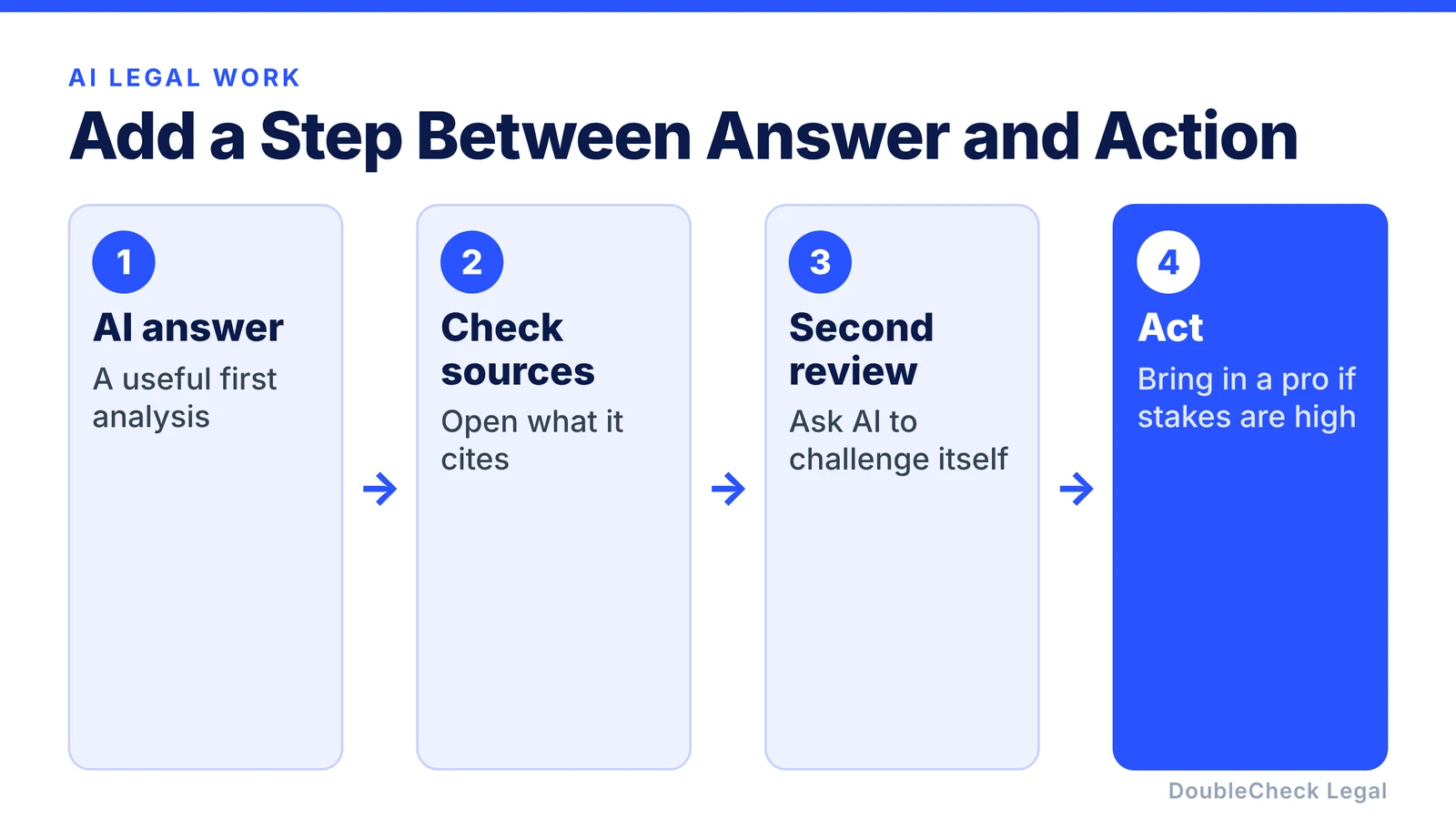
For more important work, extend the process:
AI analysis → source review → second AI critique → professional review when needed
The point is not to make every legal question complicated. It is to increase verification as the consequences of an error increase.
AI should reduce legal friction, not create hidden risk
AI is becoming one of the most useful tools available to founders and small businesses. It can help you understand legal documents before a meeting, draft a first version instead of starting from a blank page, organize complicated information, compare agreements, identify questions, and decide where professional help is worth paying for.
The mistake is not using AI. The mistake is treating generation and verification as the same thing. They are not.
The strongest workflow combines the speed of AI with better context, reliable sources, deliberate verification, and human judgment where the stakes justify it.
How DoubleCheck fits into the workflow
DoubleCheck is being built around a simple idea: legal AI should be easier to double-check.
Instead of treating the first generated answer as the end of the process, DoubleCheck is designed around a workflow where you can ask a question, understand the issue, examine relevant sources, identify missing information, and decide whether additional review makes sense. When a matter needs professional judgment, you can move from AI-assisted preparation toward attorney review.
The objective is not to make every legal question require a lawyer. It is to make it easier to recognize the questions that do.
FAQ
Is it safe to use AI for legal work?
AI can be useful for legal research, summaries, document comparison, drafting, explaining terminology, and preparing questions. The appropriate level of verification depends on the importance and consequences of the task.
What is the biggest risk of using AI for legal questions?
One major risk is relying on a plausible, confident answer without verifying whether the underlying conclusion, jurisdiction, facts, and sources are correct.
Can AI hallucinate legal information?
Yes. Generative AI systems can produce inaccurate information, misunderstand source material, omit relevant issues, or make unsupported claims. Important conclusions should be checked.
Should I use ChatGPT or Claude to review a contract?
Both general-purpose AI systems can be useful for understanding and reviewing contract language. Neither should automatically be treated as the final authority on a consequential legal matter.
How can I make AI legal answers more reliable?
Provide complete context, specify the jurisdiction, include relevant documents, ask the AI to identify assumptions, request supporting sources, inspect those sources, and add a second review layer when the issue is important.
When should I talk to an attorney?
Professional review becomes more valuable when a matter could materially affect ownership, intellectual property, financing, employment, major contractual obligations, regulatory exposure, disputes, taxes, or significant financial liability.
General information only. This article is not legal, tax, investment, or accounting advice.