Co-Founder Vesting Explained: Four Years, One-Year Cliff, and What You Keep
Founder vesting decides who owns what if a co-founder leaves. Here is how the standard schedule works.
Key takeaways:
- The usual schedule is four years with a one-year cliff: 25% vests at month 12, then about 1/48th monthly.
- A founder who leaves at 18 months keeps about 37.5% in the standard example.
- Double-trigger acceleration is generally preferred over single trigger.
- If your stock vests, an 83(b) election must be filed within 30 days with no extensions.
If you are starting a company with a co-founder, decide how vesting works before anyone has a reason to disagree.
1. What founder vesting is
Founder vesting means a founder receives stock up front, but the company can repurchase or the founder can forfeit the unvested portion if the founder leaves early. It protects the remaining team from a situation where someone leaves after a few months and keeps a large stake.
According to Stripe’s guide, investors often require vesting as a condition of funding.
For the broader agreement between founders, see our co-founder agreement guide.
2. The standard schedule: four years with a one-year cliff
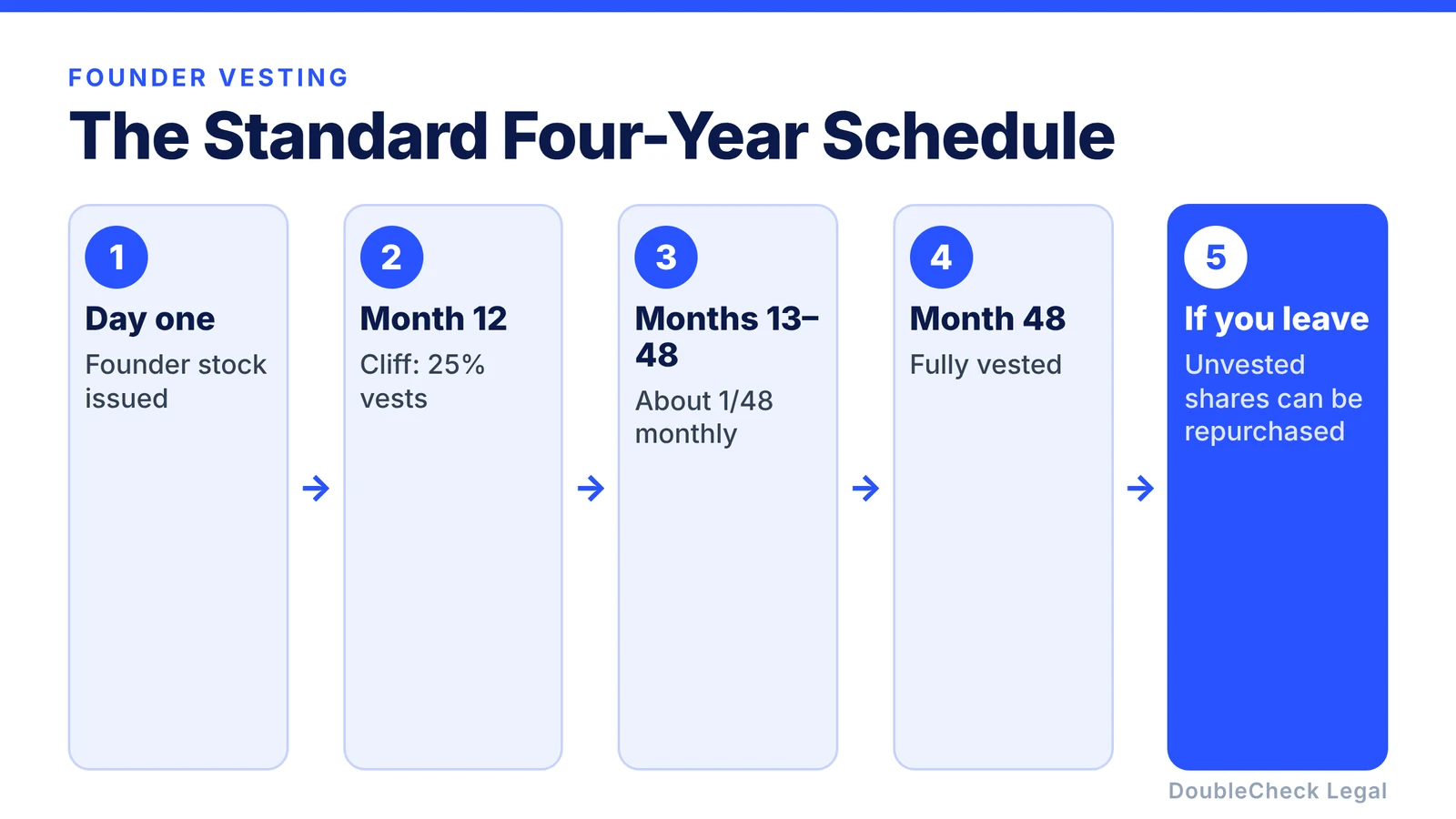
The usual structure is four years with a one-year cliff. Nothing vests in the first year. At month 12, 25% vests. The remaining 75% usually vests monthly, about 1/48th of the grant per month, over the next three years.
Both Stripe’s guide and a WilmerHale founder-stock summary describe this as the usual set of terms.
3. What you keep if you leave
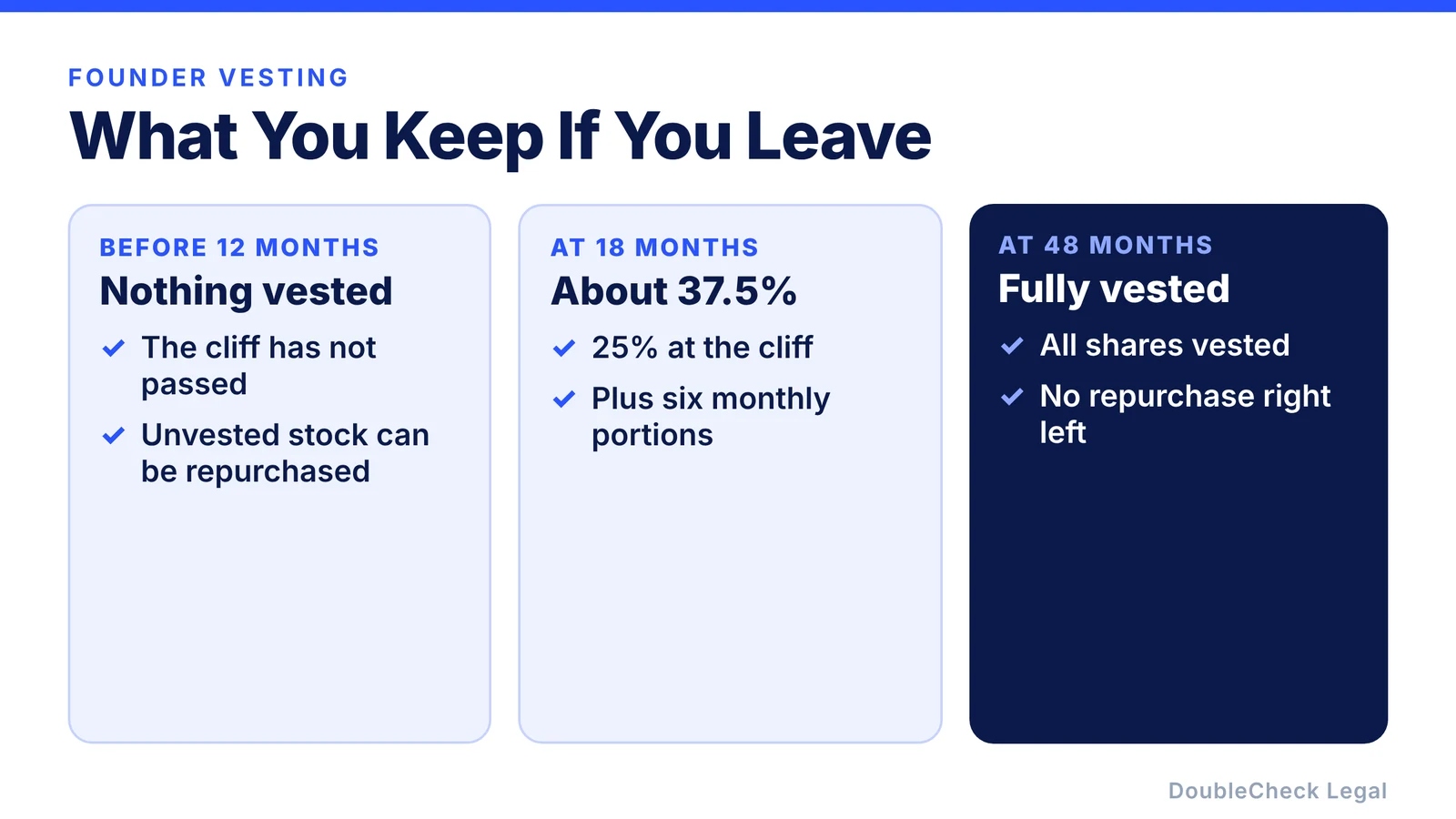
Stripe’s example: a founder who leaves after 18 months would keep about 37.5%. That is the 25% at the cliff, plus six months of monthly vesting.
Leave before the cliff and, under the standard schedule, nothing has vested.
4. The vesting start date
Vesting begins on the vesting commencement date, which is not the same as the cliff date. Schedules can be adjusted, for example to credit work done before incorporation or for a part-time founder. If you worked together for a year before forming the company, discuss whether the start date should reflect that.
5. Acceleration: single trigger vs. double trigger
Acceleration speeds up vesting when the company is acquired.
- Single trigger: unvested shares vest on the acquisition alone.
- Double trigger: vesting accelerates only if there is an acquisition and a qualifying termination, such as being let go without cause, within a set window.
Founder-stock guides generally prefer double trigger, and single trigger is less common now.
6. Vesting and the 83(b) election
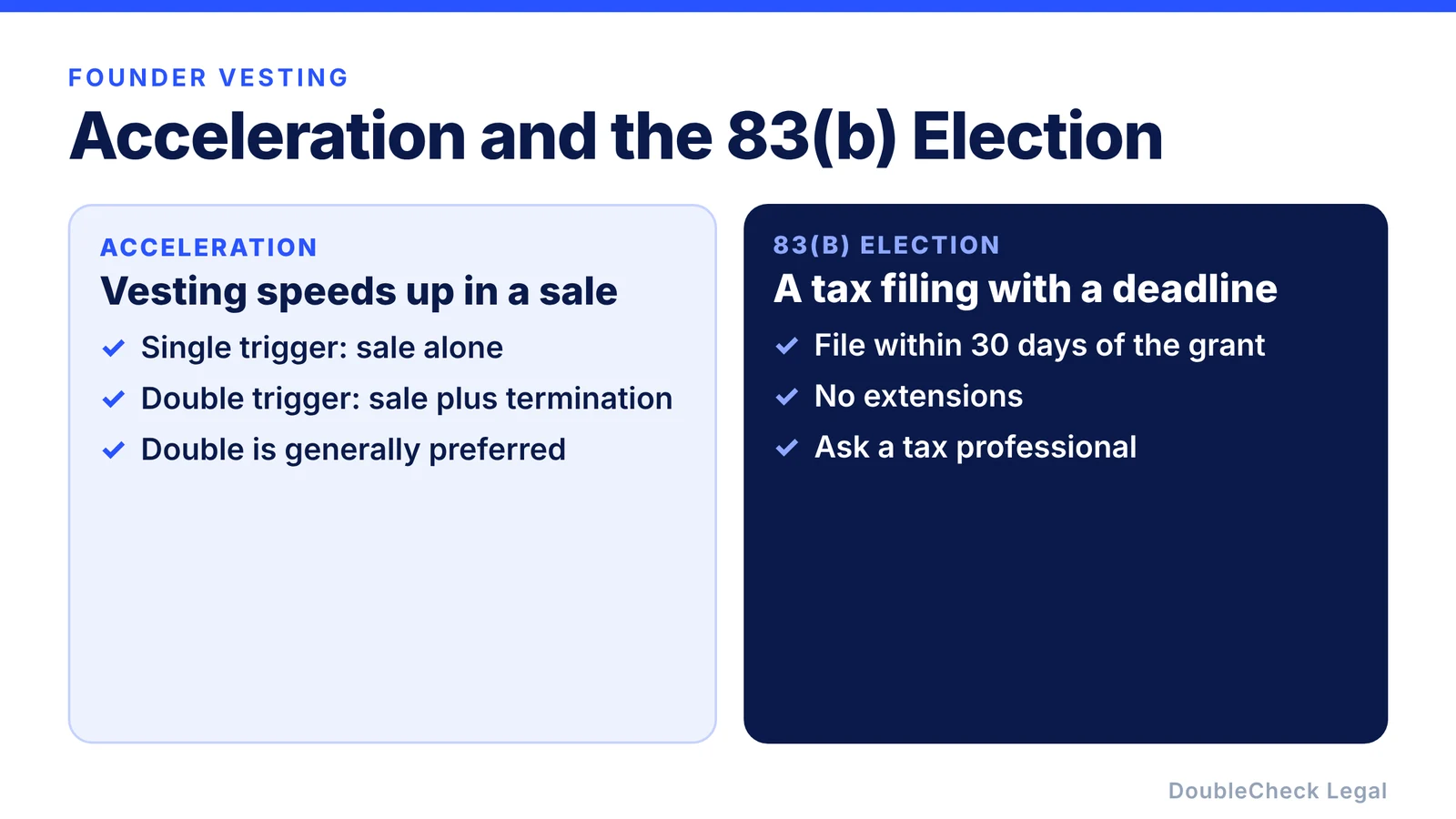
If your shares vest over time, an 83(b) election lets you pay tax on the stock’s value at the grant, when it is typically small, instead of as each portion vests. The deadline is 30 days from receiving the stock, and the IRS does not grant extensions. Read our guide to the 83(b) election for startup founders and speak to a tax professional.
7. Questions to settle with your co-founders
- Will everyone vest on the same schedule?
- Does earlier work count toward vesting?
- What happens on a sale of the company?
- What happens if someone becomes part-time or stops contributing?
- Who files the 83(b) elections, and by when?
Write the answers down. See also LLC operating agreements if you are forming an LLC.
8. Where DoubleCheck fits
DoubleCheck is built for businesses that start legal work with AI. Bring your question or draft, use an AI-first workflow to understand and verify it, and when professional advice is warranted, you can connect with an independent attorney. Attorneys on DoubleCheck are independent professionals; an attorney-client relationship forms only if an attorney accepts your engagement.
Sources: Stripe: Founder vesting; WilmerHale: Five things about founder stock vesting.
FAQ
What is a one-year cliff?
Nothing vests during the first year. At the 12-month mark, 25% vests.
How much do I keep if I leave at 18 months?
In the standard example, about 37.5%: 25% at the cliff plus six months of monthly vesting.
What is double-trigger acceleration?
Vesting accelerates only if there is both an acquisition and a qualifying termination within a set window.
When is the 83(b) deadline?
Within 30 days of receiving the stock. The IRS does not grant extensions.
General information only. This article is not legal, tax, investment, or accounting advice.