How to Use AI for Your Business: The Rise of Agentic Law for Entrepreneurs and Lawyers
Agentic AI is moving legal work from “ask a question, get an answer” toward systems that can plan and execute multi-step workflows — document review, drafting, research, and routing to human review. This is general information about technology and workflow trends, not legal, tax, or accounting advice.
Key takeaways:
- Agentic AI can plan multi-step work, not just answer prompts — organizing documents, drafting, summarizing, and routing uncertain issues to a human.
- Entrepreneurs can use AI to prepare before a consultation, which can make choosing the right attorney more important, not less.
- 69% of surveyed legal professionals already use general-purpose AI for work, per a 2026 ABA-discussed survey — agentic systems extend that into connected workflows.
- The near-term model is AI handling preparation and repetition while attorneys keep judgment, verification, strategy, and final decisions.
Artificial intelligence is moving beyond the chatbot.
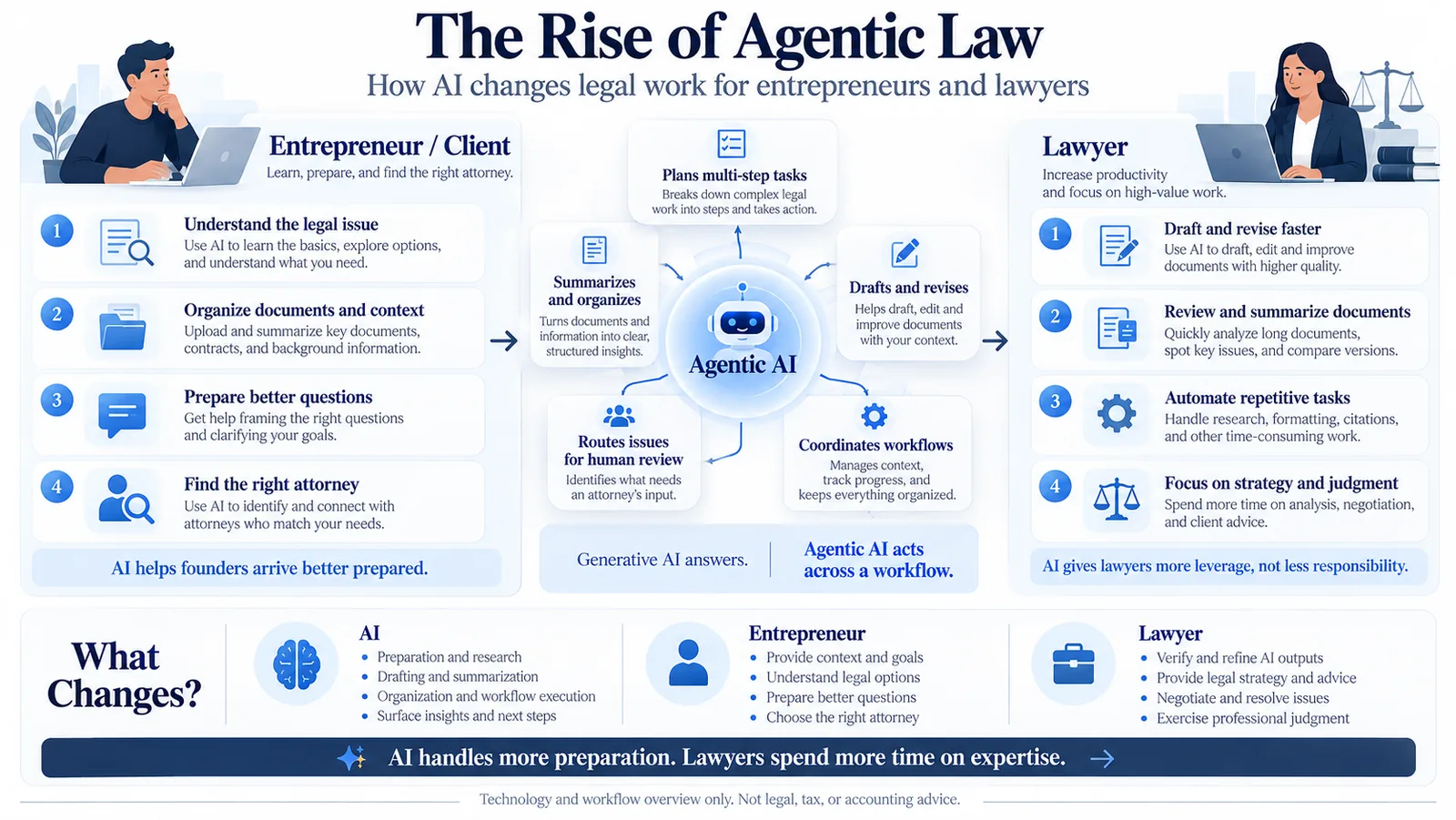
The first generation of generative AI was largely about asking a question and receiving an answer. The next generation is increasingly agentic: AI systems that can understand a goal, break it into steps, work across information and documents, and help execute a broader workflow.
That transition could have a particularly important impact on legal work.
For entrepreneurs, AI can make it easier to understand an unfamiliar legal situation, organize documents, prepare better questions, and identify the type of attorney they may need.
For lawyers, AI can reduce the amount of time spent on repetitive drafting, document review, summarization, research preparation, and administrative work.
The result is not necessarily fewer lawyers. It may instead mean a different relationship between the client, the lawyer, and the technology.
AI handles more preparation. Lawyers spend more time on expertise.
What is agentic AI in legal work?
Traditional generative AI generally follows a simple pattern:
Ask a question → receive an answer.
Agentic AI can go further.
An AI agent can potentially receive a broader objective, determine what steps are necessary, retrieve information, analyze documents, generate work product, check intermediate results, and route uncertain issues back to a human.
Thomson Reuters describes agentic legal AI as moving from systems that simply answer questions toward systems that can plan and execute multi-step workflows. In 2026, Thomson Reuters reported that fewer than 20% of surveyed firms were already implementing agentic systems, but roughly half were planning or considering adoption. (Thomson Reuters)
That difference — between an AI that answers and an AI that can act across a workflow — is what makes agentic law interesting.
How entrepreneurs can use AI before talking to a lawyer
For many business owners, the hardest part of a legal problem initially is not solving it.
It is understanding what the problem actually is.
A founder may know they need help with a contract, incorporation, fundraising, employment issue, intellectual property, or another business matter without understanding which questions matter or what kind of attorney they should contact.
AI can help with that preparation.
An entrepreneur might upload or describe their situation and use AI to understand terminology, organize relevant information, summarize documents, identify missing information, and prepare questions to discuss with an attorney.
Instead of arriving at a consultation saying:
“I think I have a legal problem, but I’m not sure what I need.”
the entrepreneur may be able to arrive with:
“This is the transaction, these are the documents involved, this is what I’m trying to accomplish, and these are the issues I want to discuss.”
That can change what the attorney-client conversation is used for.
AI could make finding the right attorney more important
If AI makes basic legal information easier to understand, finding the right professional may become more important rather than less important.
A founder who has already learned the basics can focus on questions such as whether an attorney has experience with their type of company, transaction, industry, jurisdiction, or financing.
AI can help the entrepreneur prepare.
The attorney provides the professional judgment.
This creates a more efficient division of work:
AI helps the founder understand and organize the problem → the founder identifies relevant attorneys → the attorney focuses on judgment, strategy, negotiation, and execution.
That is a very different model from using the first part of a consultation simply to establish basic context.
Lawyers are already using AI for real work
This transition is already underway.
A 2026 legal-industry survey discussed by the American Bar Association found that 69% of surveyed legal professionals personally used general-purpose AI for work, up substantially from the prior year. Among common uses were drafting correspondence, research, brainstorming, document summarization, and document drafting. (American Bar Association)
Agentic systems extend that idea.
Instead of asking AI to perform one isolated task, an attorney could eventually give an agent a broader workflow.
For example:
“Review these documents and prepare a first-pass analysis for me.”
The system might organize the documents, extract information, summarize them, compare terms, identify missing information, create a preliminary draft, and surface the portions requiring attorney review.
The lawyer remains responsible for the work.
But significantly less of the lawyer’s time is spent manually moving information between steps.
Drafting becomes a workflow instead of a single prompt
Legal drafting is an obvious example.
Today, a lawyer might ask an AI model to draft a clause.
Then the lawyer asks it to revise the clause.
Then compares it against another version.
Then asks for a summary of the differences.
Then checks defined terms and other parts of the agreement.
An agentic workflow can potentially connect those actions.
The attorney might define the objective and the standards, while the AI handles several intermediate steps before returning the result for professional review.
Modern legal AI products are already moving in this direction. In August 2026, Thomson Reuters launched a new version of CoCounsel Legal designed to connect research, analysis, drafting, verification, and matter workflows in a more agentic system. (Thomson Reuters)
That does not remove the lawyer from drafting.
It changes where the lawyer spends their time.
AI agents can handle the boring parts around legal work
Some of the most valuable uses of agentic AI may have very little to do with sophisticated legal reasoning.
Legal work contains enormous amounts of operational friction.
Documents have to be organized. Information has to be extracted. Client context has to be summarized. Files have to be classified. Changes between drafts have to be identified. Research has to be assembled. Follow-up questions have to be prepared.
AI agents can potentially coordinate many of these tasks.
For an independent attorney or boutique firm, that matters because there may not be a large team of associates, paralegals, and operations staff available to handle every intermediate step.
The technology effectively creates more leverage.
The emerging model: AI prepares, lawyers decide
The most compelling version of agentic law is not an autonomous system replacing the attorney.
It is a layered workflow.
AI handles preparation, organization, summarization, drafting, research assistance, document processing, and repetitive execution.
The attorney handles professional judgment, verification, strategy, negotiation, client counseling, and final decisions.
That distinction is increasingly important because AI agents can take actions rather than simply produce text.
Thomson Reuters and the ABA have both emphasized that increased autonomy creates additional requirements around oversight, confidentiality, accountability, auditability, and human review. (Thomson Reuters)
The more powerful the agent becomes, the more important it becomes to define what the agent is allowed to do by itself.
How a boutique law firm can start using agentic AI
A small firm does not need to automate everything at once.
A better starting point is one repetitive workflow.
Imagine contract review.
At first, the workflow might simply be:
Document → AI summary → attorney review
Then it can become:
Documents → AI organization → information extraction → summary → preliminary issue list → attorney review
Eventually, an agent might coordinate much of that preliminary work while escalating uncertain questions to the attorney.
The same progression can apply to research preparation, drafting, due diligence, document organization, or intake.
The objective should not be maximum automation.
It should be maximum useful leverage while keeping appropriate human control.
Agentic law changes both sides of the legal relationship
For entrepreneurs, AI creates greater access to information and better preparation.
For attorneys, AI creates greater leverage and productivity.
That combination could reshape the lawyer-client relationship.
A founder can arrive with a clearer understanding of what they are trying to accomplish.
The attorney can spend less time assembling basic information and more time understanding the business, evaluating alternatives, negotiating, and applying professional judgment.
That may be the most important promise of agentic law.
Not removing humans from legal work.
Removing more of the friction surrounding the work humans are actually needed to do.
For businesses using a platform such as DoubleCheck, that could eventually mean moving naturally from AI-assisted understanding and document preparation to identifying relevant attorneys and bringing a human professional into the workflow when appropriate.
Prepare your legal documents with DoubleCheck
FAQ: Agentic AI for Lawyers and Entrepreneurs
What is agentic AI in law?
Agentic AI refers to AI systems capable of handling multiple connected steps toward an objective rather than simply answering individual prompts. In legal workflows, that can include document analysis, research preparation, drafting, organization, verification, and routing work for human review.
How can entrepreneurs use AI for legal work?
Entrepreneurs can use AI to understand terminology, summarize documents, organize information, prepare questions, and better understand what kind of professional assistance they may need.
How are lawyers currently using AI?
Lawyers are already using AI for tasks including drafting, research, brainstorming, document summarization, and document preparation. Recent survey data indicates that AI usage among legal professionals increased substantially in 2026. (American Bar Association)
How is agentic AI different from ChatGPT?
A standard chatbot primarily responds to individual instructions. An agentic system can potentially plan and execute multiple steps toward a broader goal, interact with tools or information sources, and decide what action should happen next.
Will agentic AI replace lawyers?
Agentic AI can automate more of a workflow, but current legal-industry guidance continues to emphasize attorney supervision, verification, confidentiality, and professional responsibility. The more realistic near-term model is AI increasing lawyer productivity rather than eliminating the need for professional judgment. (Thomson Reuters)
Why could agentic AI be especially valuable for boutique law firms?
Independent attorneys and smaller firms generally have fewer people available to perform research support, document organization, drafting preparation, intake, and administrative work. AI agents can provide additional workflow leverage without requiring a large support team.
What should lawyers be careful about when using AI agents?
Important considerations include confidentiality, verification of outputs, permissions, human approval points, logging, auditability, and controls over actions the agent can perform. The ABA has specifically highlighted monitoring, human oversight, and reliable stop controls as important considerations for agent-based systems. (American Bar Association)
Sources
- Agentic AI in legal settings (Thomson Reuters)
- 8am: The Legal Industry Report (American Bar Association)
- Thomson Reuters launches next-generation CoCounsel Legal (Thomson Reuters)
- ILTACON 2026: Agentic AI and automation (Thomson Reuters)
- How to keep agent-based AI systems in check (American Bar Association)
This article discusses technology and workflow trends only. It is not legal, tax, or accounting advice.