AI Lawyer for Small Business: What AI Can Do, What It Can’t, and How to Use It Safely
More business owners now ask AI legal questions before they ever speak with a lawyer. Here is what that can do for a small business, where it can go wrong, and how to use it safely.
Key takeaways:
- An “AI lawyer” is not a licensed lawyer. A better way to think about it: AI can help you do more legal preparation yourself.
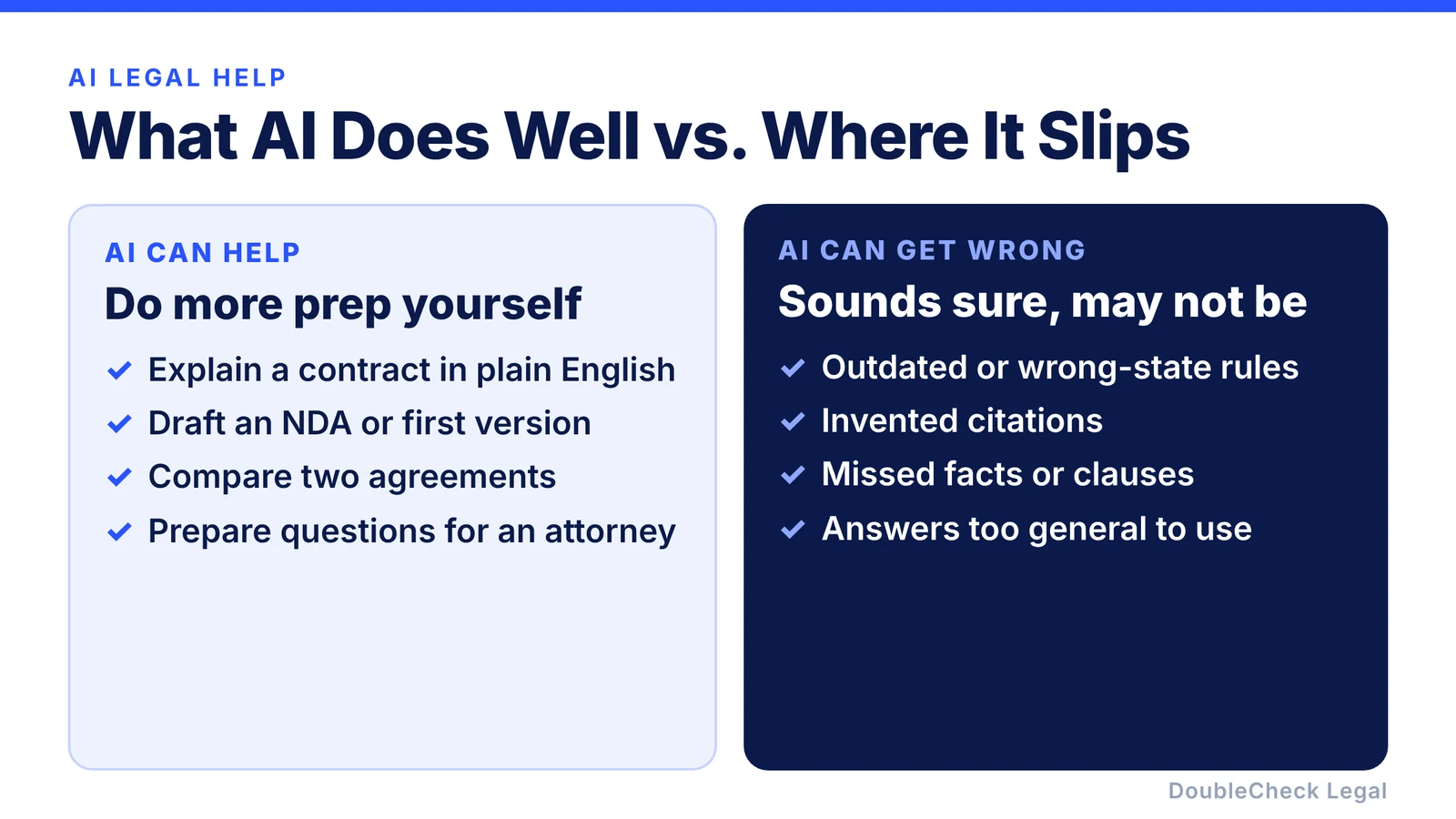
- AI is useful for summaries, first drafts, comparisons, and better questions.
- It can sound confident while being wrong, and many rules depend on your state.
- Give it your location and context, ask for sources, and add more checks as the stakes rise.
The phrase “AI lawyer” has become a popular way to describe tools that explain legal information, review contracts, draft documents, and help people work through legal questions.
But an AI is not literally a licensed lawyer. A better way to think about it is: AI can help you do more legal preparation yourself.
For a small business owner, that can be useful, and can save time and money, if you understand where AI is strong and where it can still make mistakes.
What can an AI lawyer help a small business do?
AI can be useful for everyday tasks such as:
- explaining a contract in plain English,
- drafting an NDA,
- summarizing a lease,
- comparing two agreements,
- creating a first draft of a customer contract,
- identifying questions to investigate,
- organizing company documents,
- preparing questions for an attorney,
- and researching basic legal concepts.
For example, imagine you own a small restaurant and receive a new vendor agreement. You could ask AI:
“Summarize the payment, renewal, termination, liability, and exclusivity provisions in this contract.”
That gives you a much faster starting point than reading the entire agreement without help.
AI can also help you ask better questions
One of the biggest benefits of legal AI is not necessarily getting a final answer. It is learning what you should be asking.
Suppose you are hiring your first employee. You may not know that your questions should involve:
- employment classification,
- intellectual property,
- confidentiality,
- compensation,
- state-specific requirements,
- or company policies.
AI can help surface those categories. Then you can investigate the important ones further.
What are the risks of using an AI lawyer?
The main problem is simple: AI can sound confident while being wrong. Current AI systems can:
- misunderstand your question,
- miss an important fact,
- rely on outdated information,
- confuse one state’s rules with another,
- invent a citation,
- misunderstand a contract,
- or give an answer that is too general for your situation.
This matters especially for small businesses, because many rules depend on location. The answer for a California employer may be different from the answer for a Texas employer.
Always tell the AI your jurisdiction
Instead of asking:
“Do I need to give my employee this notice?”
ask:
“I operate a small business in California and this employee works in California. What rules should I check, and what official sources support your answer?”
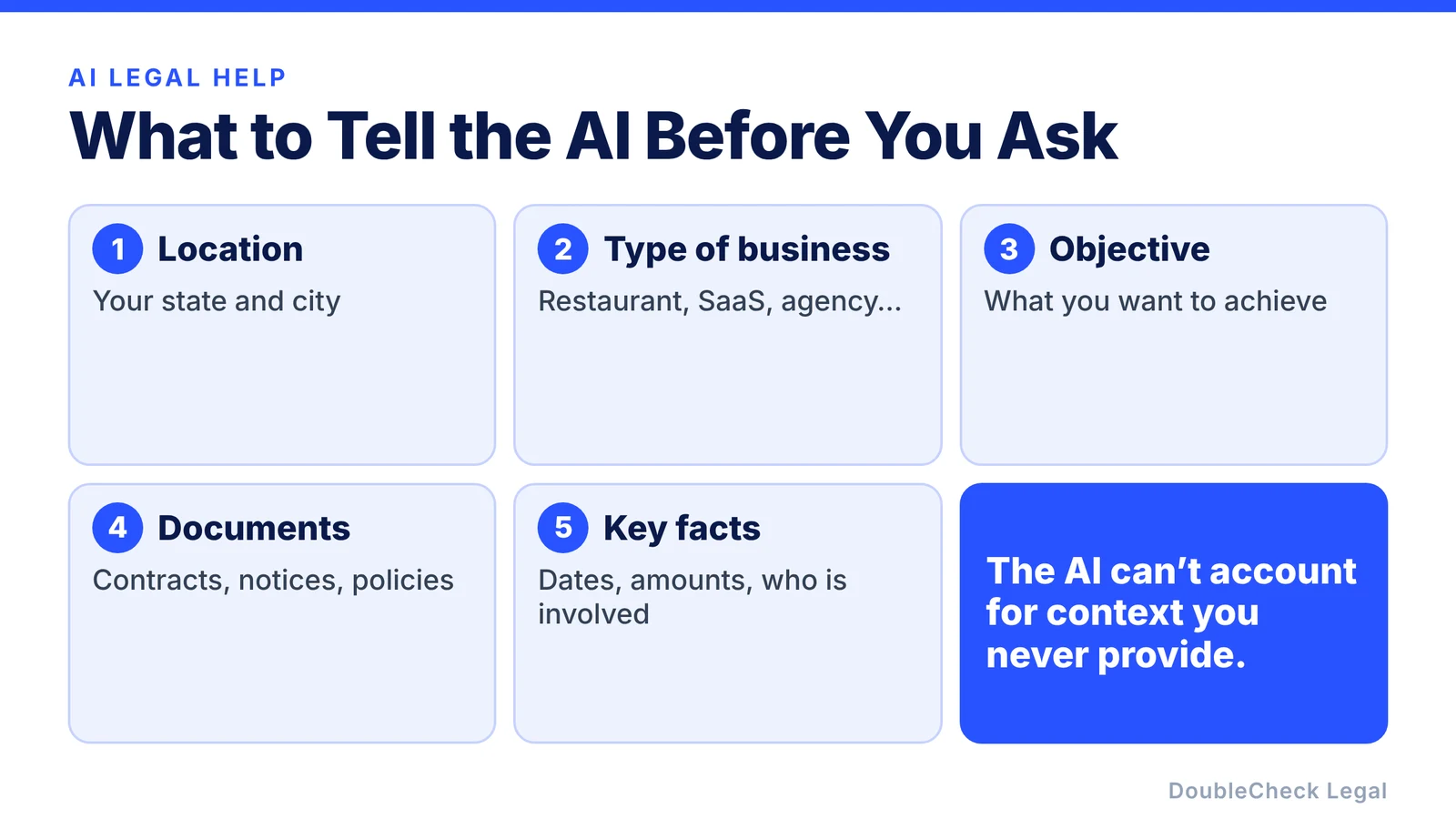
Give the AI enough information to understand the situation: location + type of business + objective + relevant documents + important facts. The AI cannot account for context you never provide.
Ask for sources, not just conclusions
For legal work, this is one of the most useful habits you can develop. Ask:
“What authoritative sources support this?”
Then look at those sources. Depending on the issue, that may include:
- statutes,
- regulations,
- state government websites,
- federal agencies,
- courts,
- or official guidance.
A good legal AI workflow should make the underlying evidence easier to inspect.
Is an AI lawyer enough?
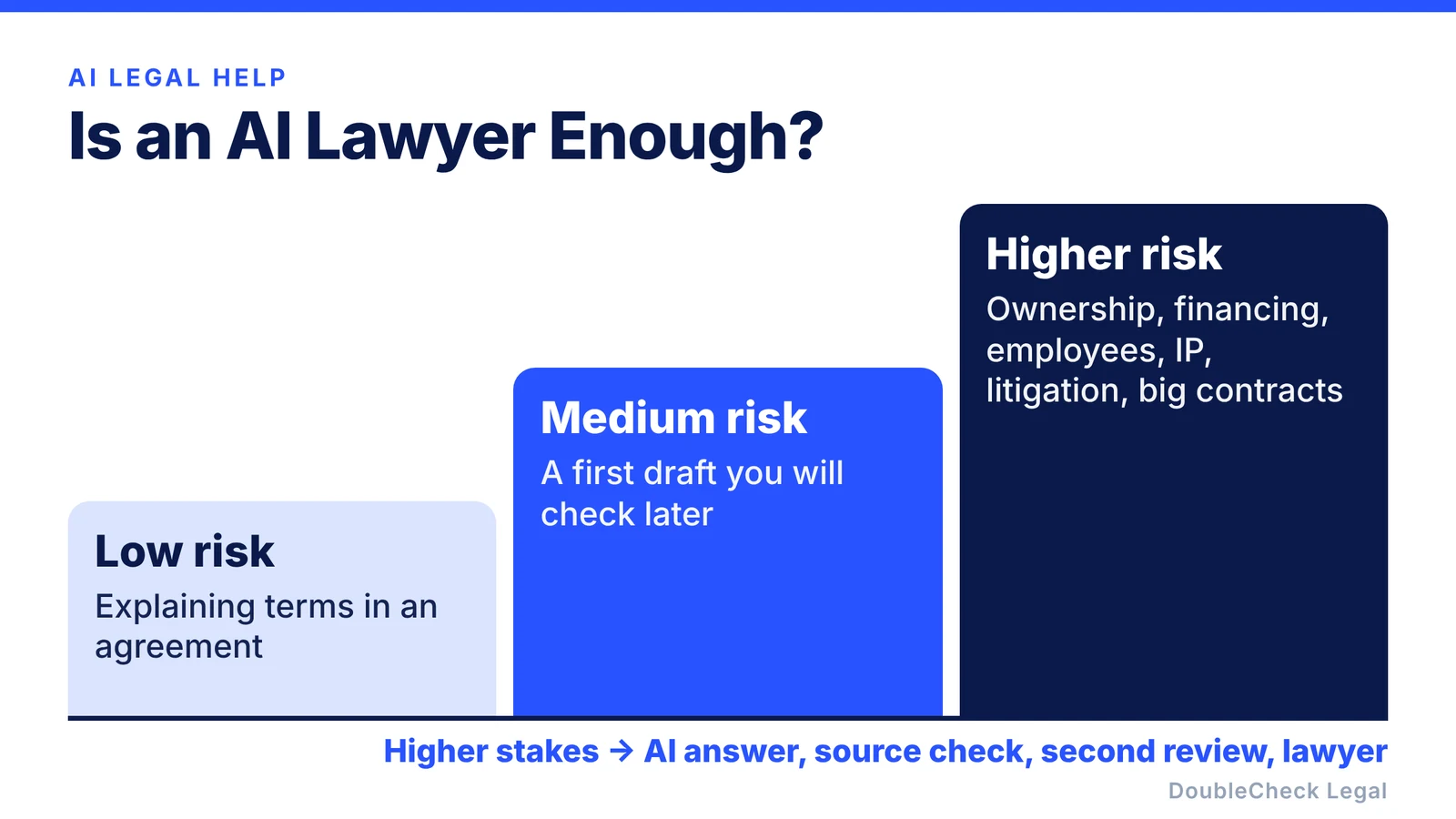
Sometimes AI may be enough for preliminary work. It depends on the risk:
- Low-risk use: explaining terminology in an agreement.
- Medium-risk use: producing a first draft that will be checked later.
- Higher-risk use: making a major decision about ownership, financing, employees, intellectual property, litigation, or a high-value contract.
As the consequences of being wrong increase, the amount of verification should increase too. A useful model is AI → source check → second review → lawyer when needed.
How DoubleCheck approaches AI legal help
This is the problem DoubleCheck is designed around. Instead of treating an AI-generated answer as the end of the process, DoubleCheck helps businesses:
- work through legal questions with AI,
- surface relevant sources,
- cross-check information,
- identify missing context,
- distinguish AI interpretation from source material,
- and understand what deserves another layer of review.
If additional verification is useful, human reviewers can add another layer. And if the issue requires professional legal advice, connecting with a lawyer can remain an option rather than the starting point for every question.
The goal is better AI + better sources + better verification, not simply another chatbot calling itself an AI lawyer.
FAQ
What is an AI lawyer?
‘AI lawyer’ is an informal term commonly used for software that helps perform legal-related tasks such as drafting, research, summarization, and contract analysis. AI systems themselves are not licensed attorneys.
Can AI answer legal questions for my business?
AI can provide useful information and explanations, but important answers should be verified, especially where the outcome depends on jurisdiction or specific facts.
Can an AI lawyer draft a contract?
Yes, AI can create a first draft of many types of agreements. Whether that draft is appropriate for your specific business requires separate verification.
Can an AI lawyer replace a real attorney?
For many preliminary tasks, AI can reduce the amount of manual work required. It does not provide the same professional judgment, responsibility, or representation as a qualified attorney.
How do I make AI legal answers safer?
Give the model complete context, identify your jurisdiction, request authoritative sources, ask it to state uncertainty, and add another review layer when the consequences of a mistake are significant.
What does DoubleCheck do differently?
DoubleCheck is focused on making AI-assisted legal work easier to verify through richer sourcing, cross-checking, structured guidance, optional human verification, and access to attorneys when needed.
General information only. This article is not legal, tax, or accounting advice.