How to Launch an AI Startup in the U.S.: A Step-by-Step Guide for First-Time Founders
Building an AI startup is easier technically than it has ever been. The hard part is still figuring out what to build, who wants it, whether they’ll pay, and how to turn that into a real company. This is general information, not legal, tax, or investment advice.
Key takeaways:
- Start with a specific problem for a specific audience, not “I want to build something with AI.”
- Validate before you formalize: talk to users, build the smallest useful version, and test real pricing before investing in company infrastructure.
- Most AI startups eventually choose between an LLC and a Delaware C corporation — the right one depends on your funding plans, not what another startup picked.
- When you use AI for incorporation or legal work, ask for sources, verify them, and add a second check or a human reviewer for anything consequential.
Starting an AI company is easier technically than it has ever been.
A founder can now build a prototype in days, generate a website with AI, process payments with Stripe, create marketing content, and even use AI to help understand incorporation documents and contracts.
But easier building does not mean easier company-building.
The hard part is still figuring out what to build, who wants it, whether they will pay, and how to turn that demand into a real company.
Here is a practical sequence for launching a new AI or technology business in the United States.
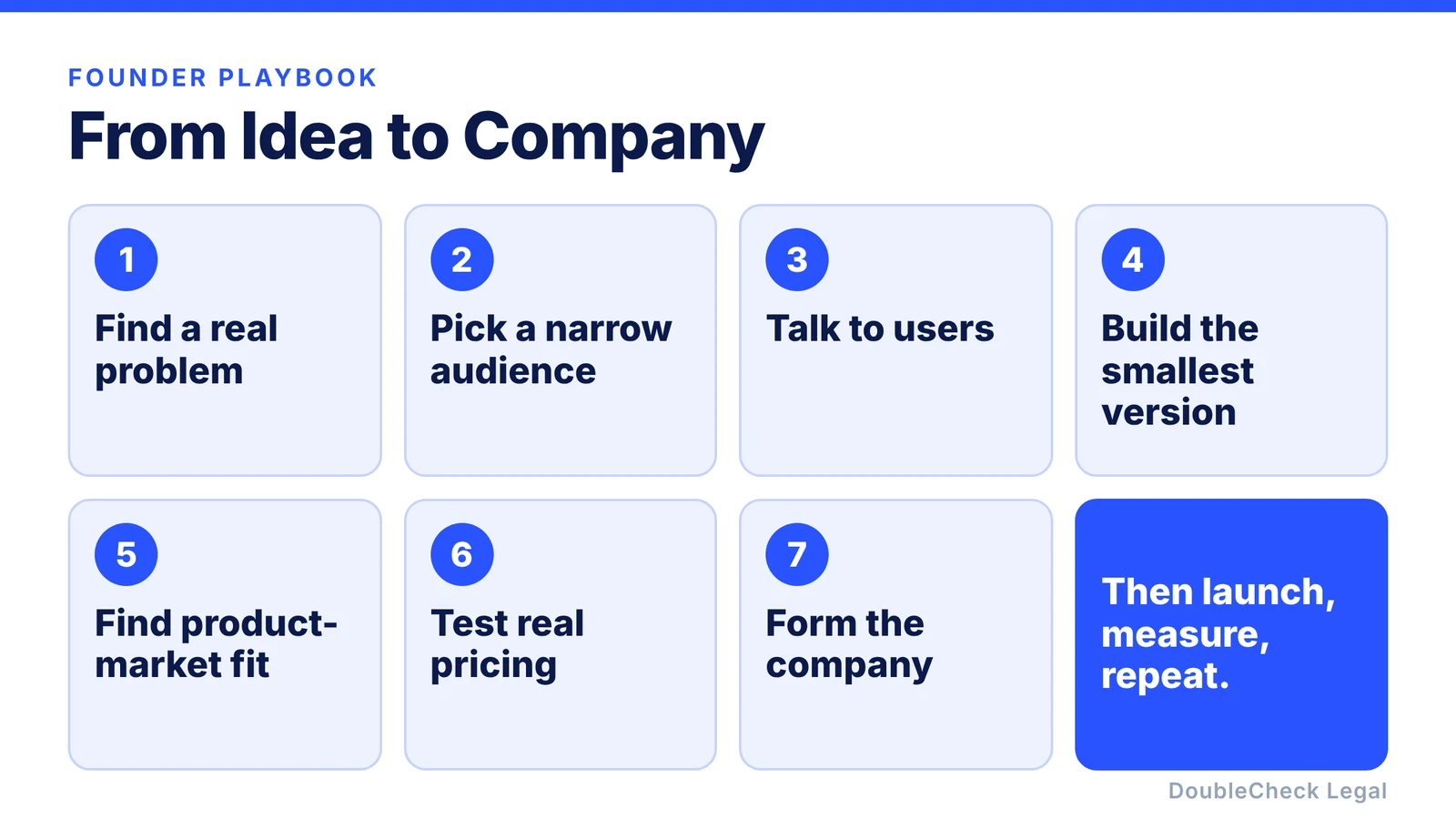
1. Start with a problem, not an AI feature
A common mistake is starting with “I want to build something with AI.” Start instead with “what painful problem am I solving?”
A strong startup usually begins with a specific group of people experiencing a specific problem. For example: accountants spending hours categorizing documents, lawyers reviewing repetitive contracts, sales teams researching prospects manually, developers debugging complicated systems, or consumers repeatedly performing an annoying task.
AI is the technology. The problem is the business.
Ask yourself: Who has this problem? How frequently does it happen? How painful is it? What are people doing today instead? Are they already paying for another solution?
The more precise the answers are, the easier the next steps become.
2. Choose a narrow first audience
Your first product does not need to work for everyone. In fact, it probably should not.
Instead of “AI productivity software for businesses,” you might begin with “AI contract review for early-stage startup founders.” Or instead of “AI for healthcare,” start with “AI that helps independent physical therapists complete a particular administrative workflow.”
A narrow audience helps you understand how customers describe the problem, what features matter, what they already use, how much the problem costs them, and where you can find them.
You can always expand later.
3. Talk to users before building too much
Before spending months developing the product, talk to potential users. You are looking for evidence that the problem is real.
Good questions include: How do you handle this today? What is the hardest part? How often does this happen? What happens when it goes wrong? Have you paid for anything to solve it? What would an ideal solution look like?
Try not to sell too aggressively during these conversations. You are trying to learn.
A founder saying, “This sounds cool,” is much weaker evidence than:
“Can I use this today?”
And even stronger:
“How much does it cost?”
4. Build the smallest useful product
Your first version does not need every feature. It needs to solve the main problem well enough that someone wants to use it again.
For an AI startup, that could mean:
Input → AI process → useful outcome
rather than a giant dashboard with dozens of features.
Today, founders can combine tools such as frontier AI models, coding agents, no-code or low-code platforms, hosted databases, Stripe, analytics, email services, and cloud infrastructure to create an MVP much faster than before.
That is useful — but speed can also tempt founders to build too much. Build the smallest version that lets you test whether people care.
5. Search for product-market fit
Product-market fit (PMF) means, broadly, that you have built something a defined market strongly wants.
You normally will not know that from a single launch. You learn by watching behavior.
Look for signals such as people returning without being reminded, users referring other users, customers complaining when the product breaks, people asking for access, willingness to pay, increasing usage, or customers telling you that the product has become part of their workflow.
You may need to change the audience, the pricing, the positioning, the interface, or even the product itself. That is normal.
Your first idea is a hypothesis. Customer behavior tells you whether the hypothesis is correct.
6. Test whether people will actually pay
Usage and revenue are not the same thing. An AI product can accumulate users who think it is interesting without becoming a sustainable business.
Test pricing early. You might experiment with monthly subscriptions, usage-based pricing, per-seat pricing, transaction fees, premium workflows, or service-plus-software combinations.
You do not need perfect pricing on day one. You need evidence that the problem is valuable enough that someone is willing to exchange money for the solution.
7. Once the idea has traction, start building the company around it
Once you are increasingly confident about the product and audience, you can formalize the business.
This is where company formation, naming, branding, banking, and legal documentation start becoming more important.
You do not necessarily need a perfect brand before testing your idea. But when you are ready to operate as a real business, you should start creating a consistent company identity — company name, domain, logo and visual identity, company email, legal entity, banking, contracts, accounting, and ownership records.
8. Choose your company name
Before investing heavily in a name, check whether it is usable.
At a minimum, consider state business-name availability, domain availability, social handles, obvious trademark conflicts, and whether customers can easily remember and spell it.
A clever startup name is less important than a usable one. Your name should not become an obstacle to people finding, remembering, or recommending your product.
9. Decide how to incorporate
Many technology startups eventually choose between an LLC and a corporation, commonly a C corporation.
The appropriate structure depends on what you are building and how you expect the company to operate.
For example, founders expecting institutional venture funding frequently consider a Delaware C corporation because that structure is familiar to many startup investors. Other founder-led businesses may decide an LLC better fits their circumstances.
This is an area where tax, legal, ownership, and fundraising considerations can intersect, so do not choose a structure simply because another startup used it.
10. Form the company
Once you decide on the entity and state, the typical formation process can include: choosing the company name, selecting the state, appointing a registered agent, filing formation documents, obtaining an EIN, creating internal governance documents, documenting founder ownership, opening a business bank account, setting up bookkeeping and tax systems, and obtaining any licenses or registrations your business requires.
Depending on the company, you may also need founder IP assignments, equity documents, bylaws, an operating agreement, board approvals, or other records.
Creating the entity is only the first part. Keeping the ownership and company records organized matters as the business grows.
11. Use AI carefully when working through legal tasks
Founders increasingly use ChatGPT, Claude, Gemini, and other AI systems to understand business and legal questions. That can be extremely useful.
For example, AI can help you explain unfamiliar terminology, summarize incorporation documents, create checklists, compare contracts, draft first versions of documents, identify questions you should investigate, and prepare for a conversation with a professional.
But you should not treat AI output as automatically correct. A sophisticated model can still hallucinate, misunderstand a document, miss relevant context, invent a source, or produce an answer that sounds much more certain than it should.
Instead of asking:
“How do I incorporate?”
try:
“I am launching a two-founder AI software company in California. We may raise venture capital within the next 12 months. Explain the major entity choices, what information I need to decide between them, and identify anything I should verify with an attorney or accountant.”
Good prompting means giving the model: your situation + your goal + relevant documents + constraints + what you want verified.
12. Ask AI for sources, not just answers
This is particularly important for legal work.
Instead of only asking:
“Is this correct?”
ask:
“What sources support this conclusion?”
Then inspect those sources.
For legal and regulatory questions, preference should generally be given to authoritative materials such as government agencies, statutes, regulations, court materials, and other reliable primary or official sources.
A link does not automatically make an AI answer correct. The source must actually support what the AI claims.
13. Use more than one check for important decisions
The higher the stakes, the more verification matters.
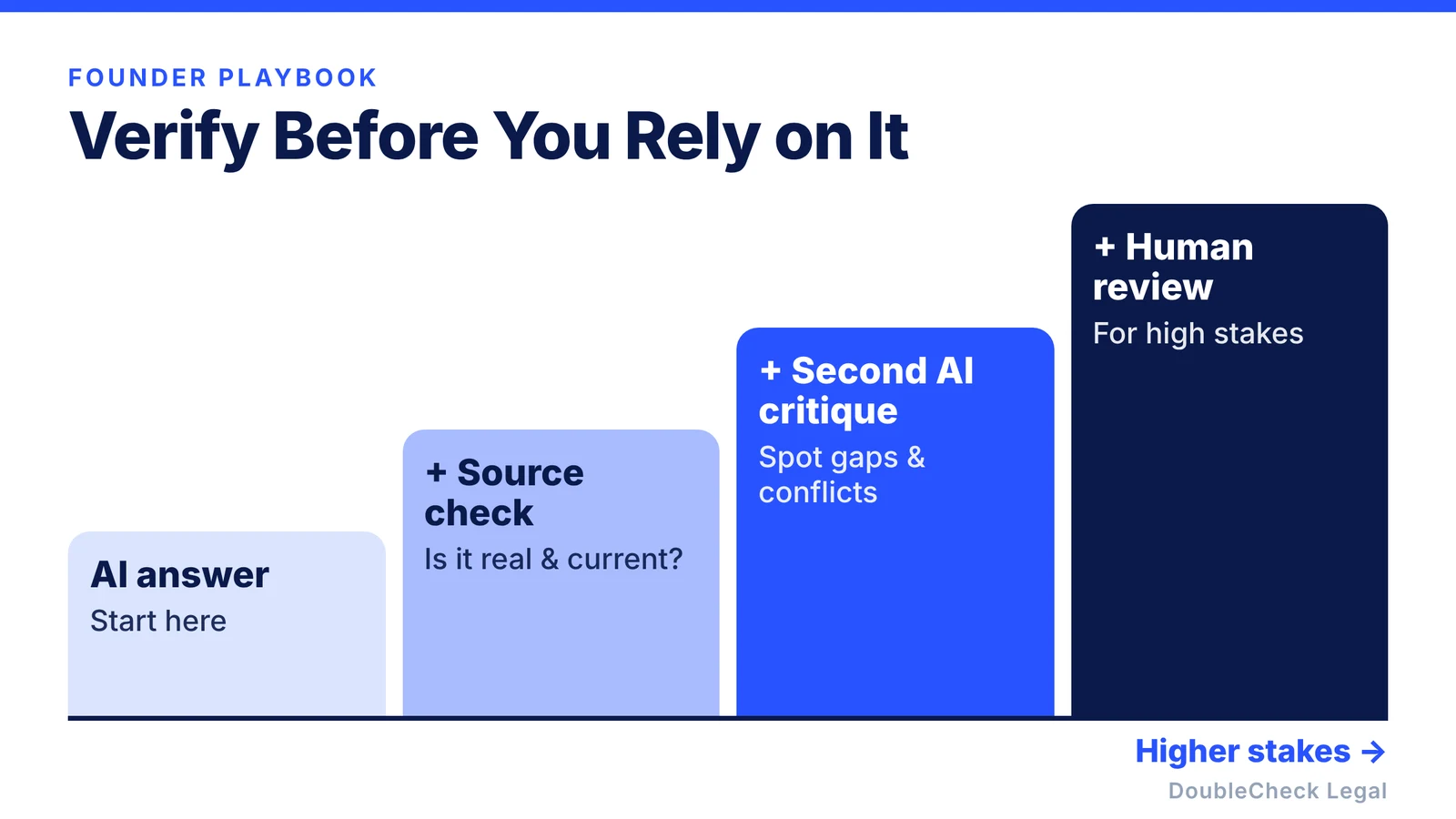
One useful workflow is:
AI answer → source check → second AI critique → human review when necessary
For example, you can ask one model to draft a document and another model to identify possible omissions. Disagreement between models can itself be useful. It tells you:
This is an area worth checking more carefully.
You do not need professional help for every sentence generated by AI. But decisions affecting ownership, intellectual property, financing, employees, major contracts, taxes, or substantial liabilities deserve more caution.
14. Launch before everything feels perfect
Once you have a useful product, a defined audience, basic company infrastructure, a way to collect payment, and the ability to support customers — launch.
Do not wait indefinitely for the perfect logo, website, feature set, or legal stack.
Your customers will teach you more after launch than months of speculation will. A useful startup loop is:
Find problem → talk to users → build → launch → measure → learn → improve → repeat.
15. Keep your legal infrastructure proportional to the company
A two-person startup does not need the same operational infrastructure as a 500-person corporation. But it does need its foundational information organized.
As you grow, keep track of company ownership, founder agreements, IP assignments, contracts, employment documents, customer agreements, financing documents, corporate approvals, compliance deadlines, and tax and accounting records.
The objective is not bureaucracy. It is preventing small inconsistencies today from becoming expensive problems later.
Using DoubleCheck when AI alone is not enough
Founders increasingly begin legal work with AI.
The problem is that a normal AI chatbot can give you an answer without making it obvious which parts are strongly supported, which sources matter, or what might be missing.
That is the problem DoubleCheck is working on.
Instead of simply generating another AI answer, DoubleCheck is designed around a richer legal workflow:
Ask → understand → review sources → identify missing information → double-check the result.
You can use it to work through legal questions with richer source context, compare information across authoritative sources, and understand what deserves additional verification.
And when AI is no longer enough, you can optionally add human review or connect with an attorney.
The goal is not to make every founder hire a lawyer for every question. It is to make it easier to know what the next step should be.
Work through your startup’s legal documents with DoubleCheck
FAQ: Starting an AI Business in the U.S.
What are the first steps to starting an AI startup?
Start by identifying a specific problem and a specific audience. Talk to users, build the smallest useful version, test whether customers repeatedly use it, and determine whether they are willing to pay before investing heavily in the company around it.
Do I need to incorporate before building my startup?
Not necessarily. Many founders validate an idea before completing all company formation work. However, incorporation becomes increasingly important when accepting payments, dividing ownership, signing contracts, hiring people, raising money, or creating significant intellectual property.
Should an AI startup be an LLC or a C corporation?
It depends on the business. Venture-backed technology companies commonly use C corporations, while other businesses may prefer LLCs. Tax, ownership, fundraising, and operational differences should be considered before deciding.
Can I use ChatGPT or another AI to incorporate my business?
AI can help explain the process, organize questions, summarize documents, and prepare drafts. It should not be assumed to be correct automatically. Important information and documents should be checked against reliable sources and, where appropriate, reviewed by a qualified professional.
What is product-market fit?
Product-market fit generally describes a situation where a meaningful group of customers strongly values the product you have built. Strong retention, referrals, increasing usage, customer demand, and willingness to pay can all be signals.
When should a startup hire an attorney?
Professional help can become particularly valuable when dealing with consequential issues such as founder ownership, financing, intellectual property, employment, complex contracts, regulatory requirements, disputes, or transactions where a mistake could materially affect the company.
Can AI replace a startup lawyer?
AI can reduce the amount of basic research, drafting, summarization, and preparation founders need to do manually. It does not guarantee correct legal conclusions, and professional judgment may still be important for significant decisions.
How can founders reduce AI hallucinations when doing legal work?
Ask the AI to provide supporting sources, verify those sources independently, provide the model with complete context, ask it to identify uncertainty, and use another review layer for high-stakes work.
General information only. This article is not legal, tax, investment, or accounting advice.