SAFE Agreement Explained for Startup Founders: What to Check Before Raising Your First Round
A SAFE can look deceptively simple. Here is what founders should understand about caps, discounts, dilution, and conversion before signing one, and how AI can help you check it.
Key takeaways:
- A SAFE (Simple Agreement for Future Equity) is an investor’s right to receive shares later, typically when the startup completes a priced equity round.
- Simple paperwork does not mean simple economics. Several SAFEs at different caps can be hard to reason about.
- Ask AI to explain each economic term and show the exact language, not just “is this okay?”
- Compare the document against the public base form, and model what happens when all SAFEs convert.
Compared with a long financing agreement, a Simple Agreement for Future Equity may contain only a relatively small number of economic terms. That simplicity is one reason SAFEs became so popular with early-stage startups.
Y Combinator created the SAFE in 2013 and publishes its current forms and user guide at ycombinator.com/safe. Its current U.S. forms include post-money SAFEs with a valuation cap, a discount, or an uncapped MFN structure.
But simple paperwork does not necessarily mean simple economics.
What should a founder understand before signing a SAFE?
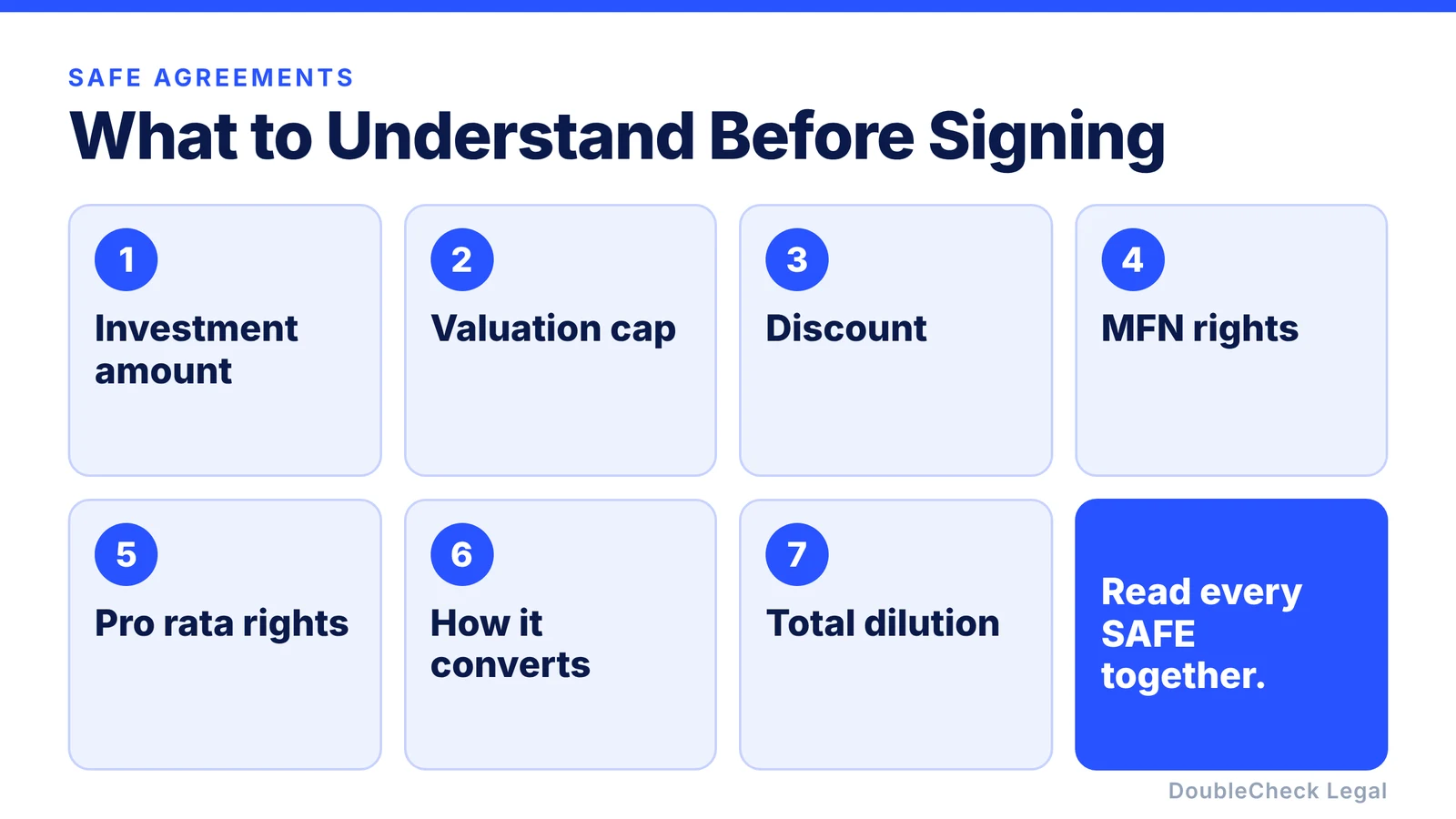
At minimum, understand:
- how much the investor is investing,
- whether there is a valuation cap,
- whether there is a discount,
- whether MFN rights apply,
- whether the investor has pro rata rights,
- how the SAFE converts,
- and how multiple SAFEs together affect ownership.
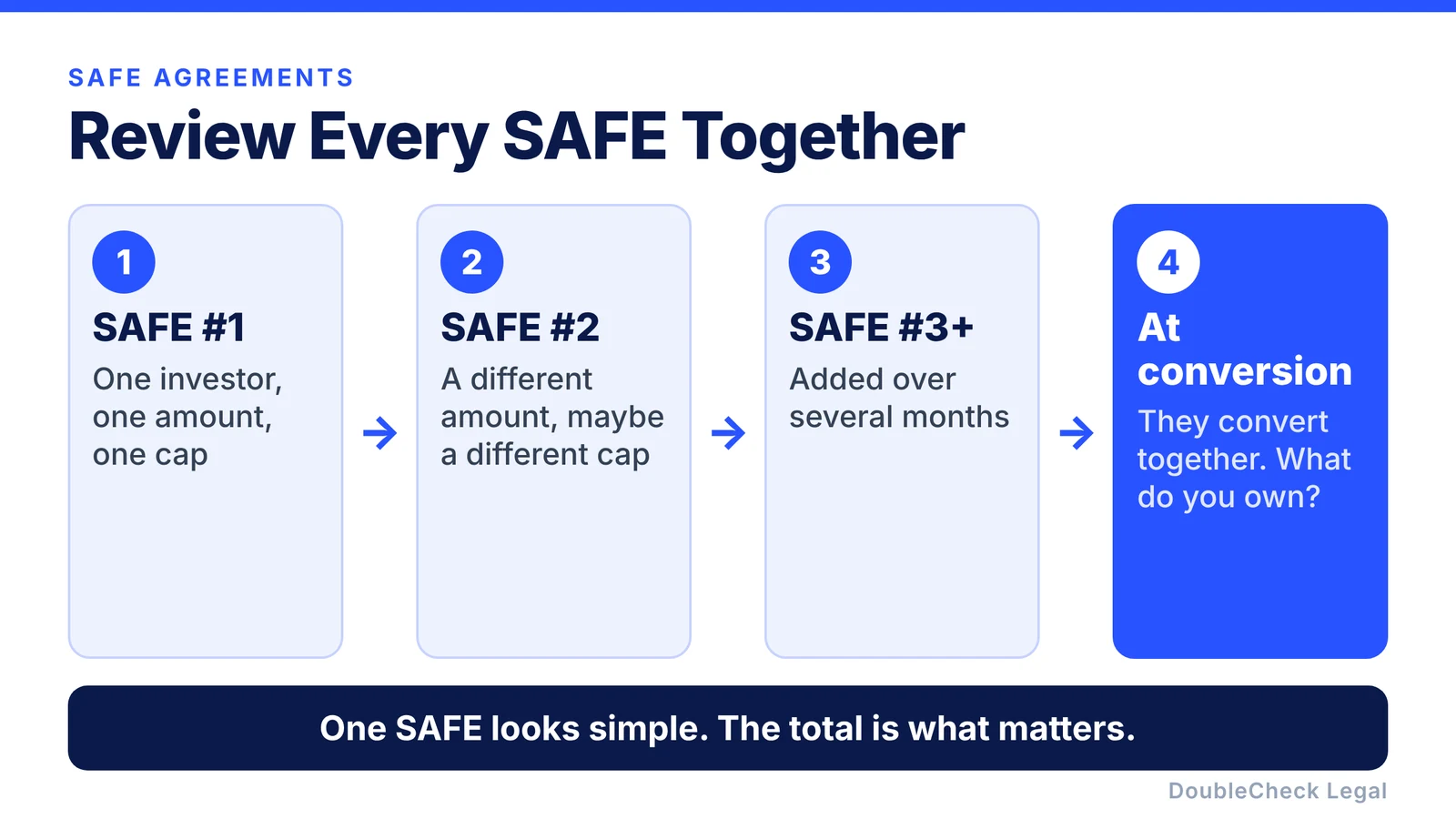
This is where founders can get into trouble. A single SAFE may look manageable. Five SAFEs issued at different caps over several months can become much harder to reason about.
What is a valuation cap?
A valuation cap is a term that sets a valuation used when working out how a SAFE converts into shares. The exact mechanics depend on the SAFE form and the wording in your document, so ask AI to point to the exact language rather than summarize it from memory.
For founders, the practical question is:
How much of the company am I effectively promising across all of these instruments?
That matters more than simply asking whether the document is “standard.”
Do not only ask AI to “review my SAFE”
AI can be extremely useful here, but the prompt should focus on understanding the economics. Instead of:
“Is this SAFE okay?”
try:
“Explain every economic term in this SAFE in plain English. Show me the valuation cap, discount, MFN provisions, pro rata rights, conversion provisions, and any changes from the standard YC form. Do not assume a provision is standard. Show me the exact language.”
Then ask:
“If I issue three SAFEs at these investment amounts and caps, help me model the approximate ownership implications and clearly state every assumption.”
Now AI is helping you reason about the transaction rather than producing a vague “legal review.”
Compare the document against the source template
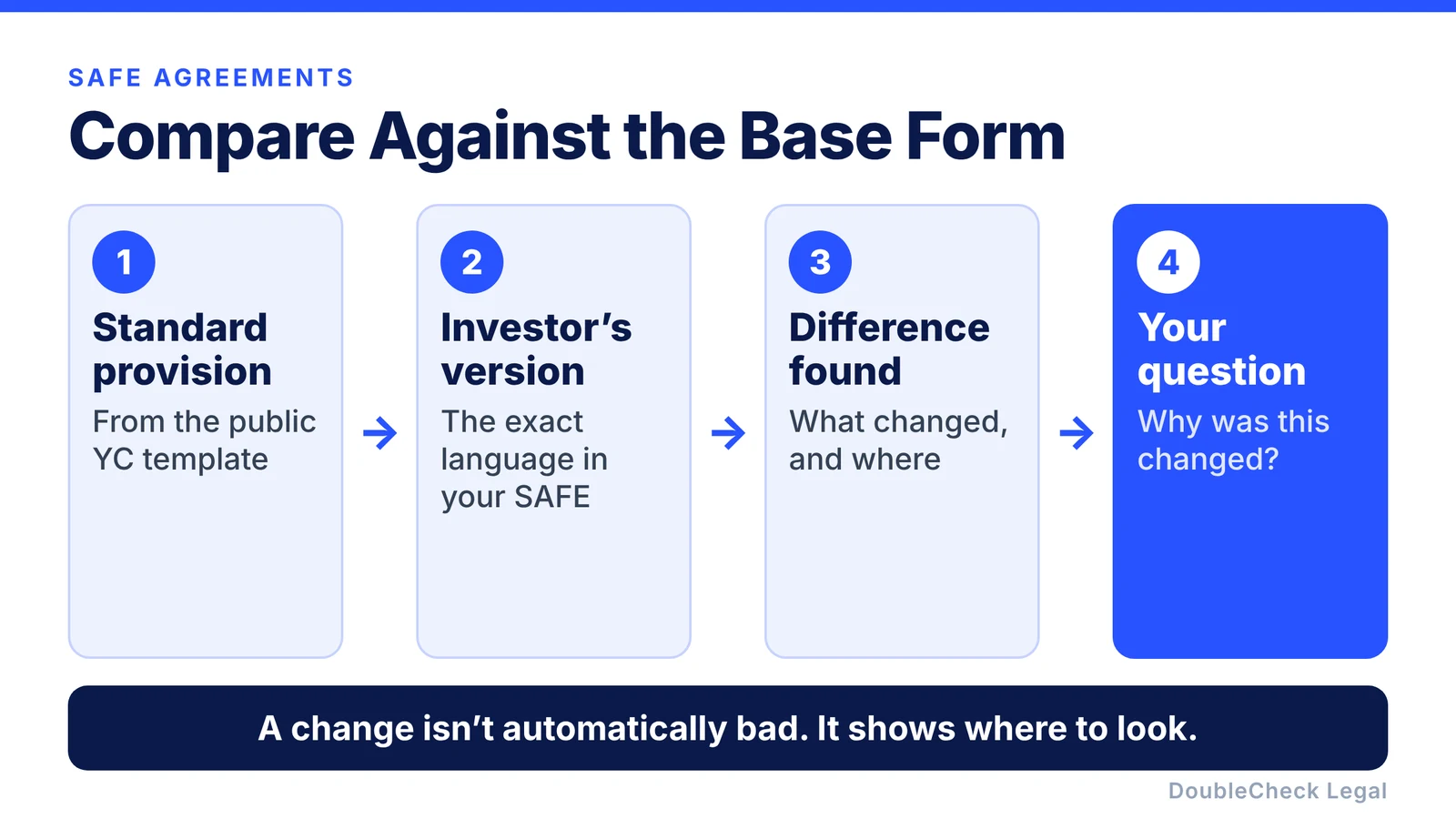
One particularly useful workflow is comparing a document against an authoritative base form. Because YC makes its SAFE forms publicly available, an AI-assisted workflow can set the original YC provision next to the investor’s provision and highlight changes. For example:
- Standard language: the YC template wording
- Your SAFE: the investor’s wording
- Difference detected: investor-added language
- Potential question: why was this changed?
That does not determine whether the change is acceptable. But it tells the founder where to focus.
Watch cumulative dilution
A common founder mistake is reviewing each SAFE individually. The more useful question is:
“What happens when all outstanding SAFEs convert?”
Even standardized instruments can produce an outcome a founder did not expect if enough capital is raised through them. AI can help build an ownership model, but calculations should be checked carefully before you rely on them.
Look beyond the document
A SAFE is more than a signed PDF. Keep your records straight, because the financing involves more than filling out the form:
- signatures,
- cap-table updates,
- side letters,
- investor records,
- and later conversion mechanics.
If you are unsure which approvals or filings your company needs, ask your attorney rather than relying on a general answer.
How DoubleCheck could make SAFE review easier
A normal chatbot can explain a SAFE. DoubleCheck can make the explanation more structured. Imagine uploading the document and seeing something like this (an illustrative example):
- Investment: $250,000
- Valuation cap: $8 million
- Discount: none
- MFN: no
- Pro rata side letter: present
- Base form comparison: 2 modifications detected
- Potential dilution: run scenario
- Records and signatures: verify
Then each item can connect back to the actual document and supporting source. That is much more useful than a long paragraph saying, “This appears to be a fairly standard SAFE.” If something deserves deeper judgment, founders can add human review or speak with an attorney.
FAQ
What does SAFE stand for?
SAFE means Simple Agreement for Future Equity.
Does a SAFE give the investor shares immediately?
No. Under the standard SAFE structure, the investor receives contractual rights that can later convert into shares upon specified events.
Can AI review a SAFE?
AI can explain clauses, compare the SAFE with public templates, identify modifications, and help model scenarios. Important financing decisions should still receive appropriate verification.
What should founders check most carefully?
Valuation cap, discount, MFN rights, pro rata rights, conversion mechanics, changes to standard language, cumulative dilution, and required corporate approvals.
General information only. This article is not legal, tax, investment, or accounting advice.