Are Your AI Chats Privileged? What the Heppner Ruling Means for Businesses
A February 2026 federal ruling held that conversations with a public AI assistant were not protected by attorney-client privilege. Here is what business owners should take from it.
Key takeaways:
- A federal court in New York held a defendant’s chats with a public AI assistant were not privileged and not protected work product.
- The AI is not a lawyer, and the tool’s privacy terms undercut any expectation of confidentiality.
- One ruling does not settle the law everywhere, but treat AI chats as documents that could be requested.
- Keep disputes, lawyer advice, and strategy out of public AI tools unless your lawyer says otherwise.
Many people talk to AI the way they would talk to an advisor: openly, in detail, and in confidence. A recent ruling shows why that assumption can be risky.
1. What the court decided
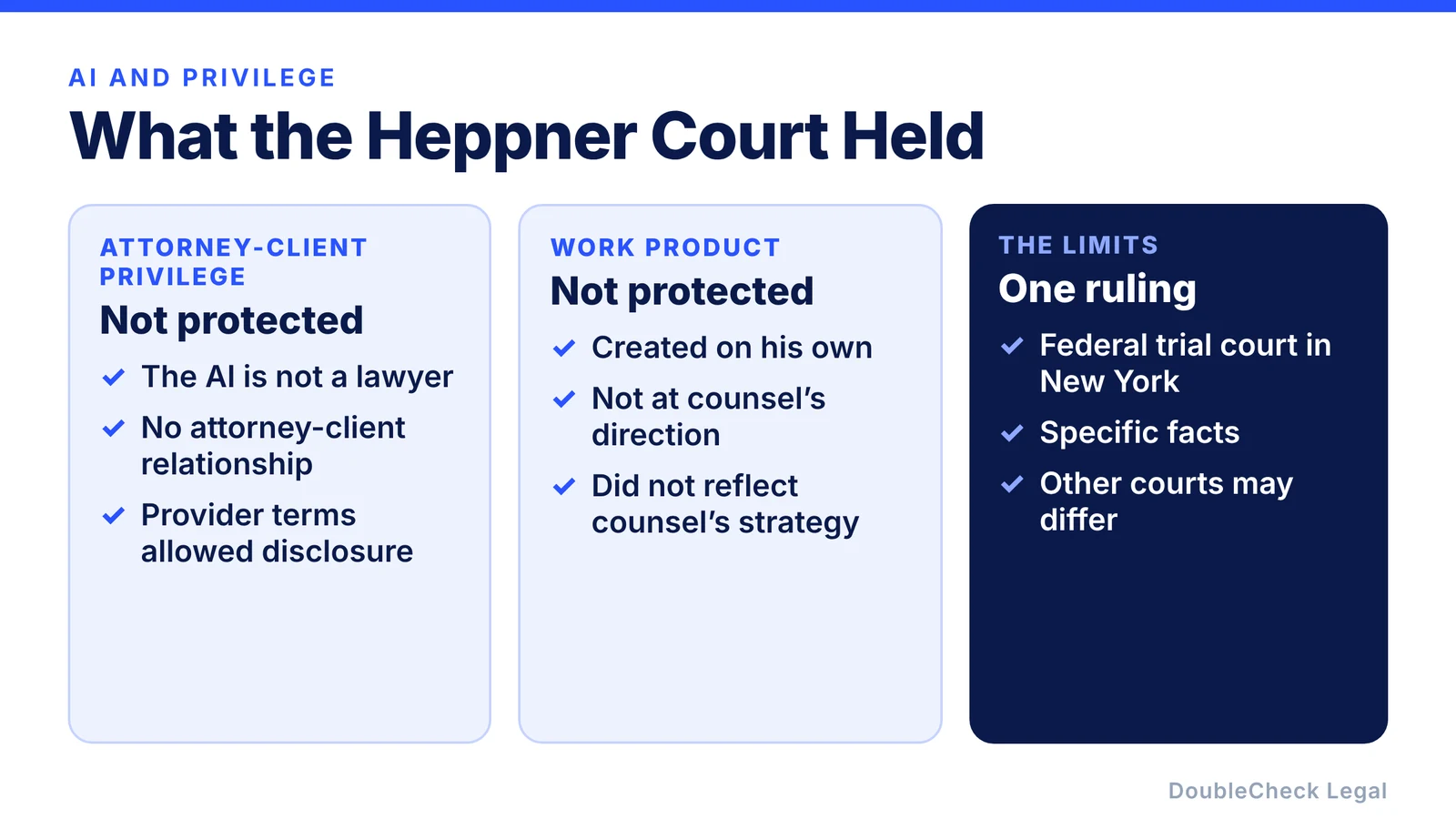
In February 2026, a federal judge in the Southern District of New York, Jed Rakoff, ruled in United States v. Heppner that a defendant’s conversations with a public AI assistant were not protected by attorney-client privilege or the work product doctrine.
The defendant, a financial services executive charged with securities fraud, had used Claude on his own to analyze his situation and think through defense arguments. When the FBI searched his home, agents seized roughly 31 documents recording those conversations. He argued they were privileged. The court disagreed.
This is one trial-court ruling, so it does not settle the law everywhere. But it is a clear warning for anyone who treats an AI chat like a private conversation with an advisor.
2. Why privilege did not apply
According to summaries of the opinion, the court gave several reasons:
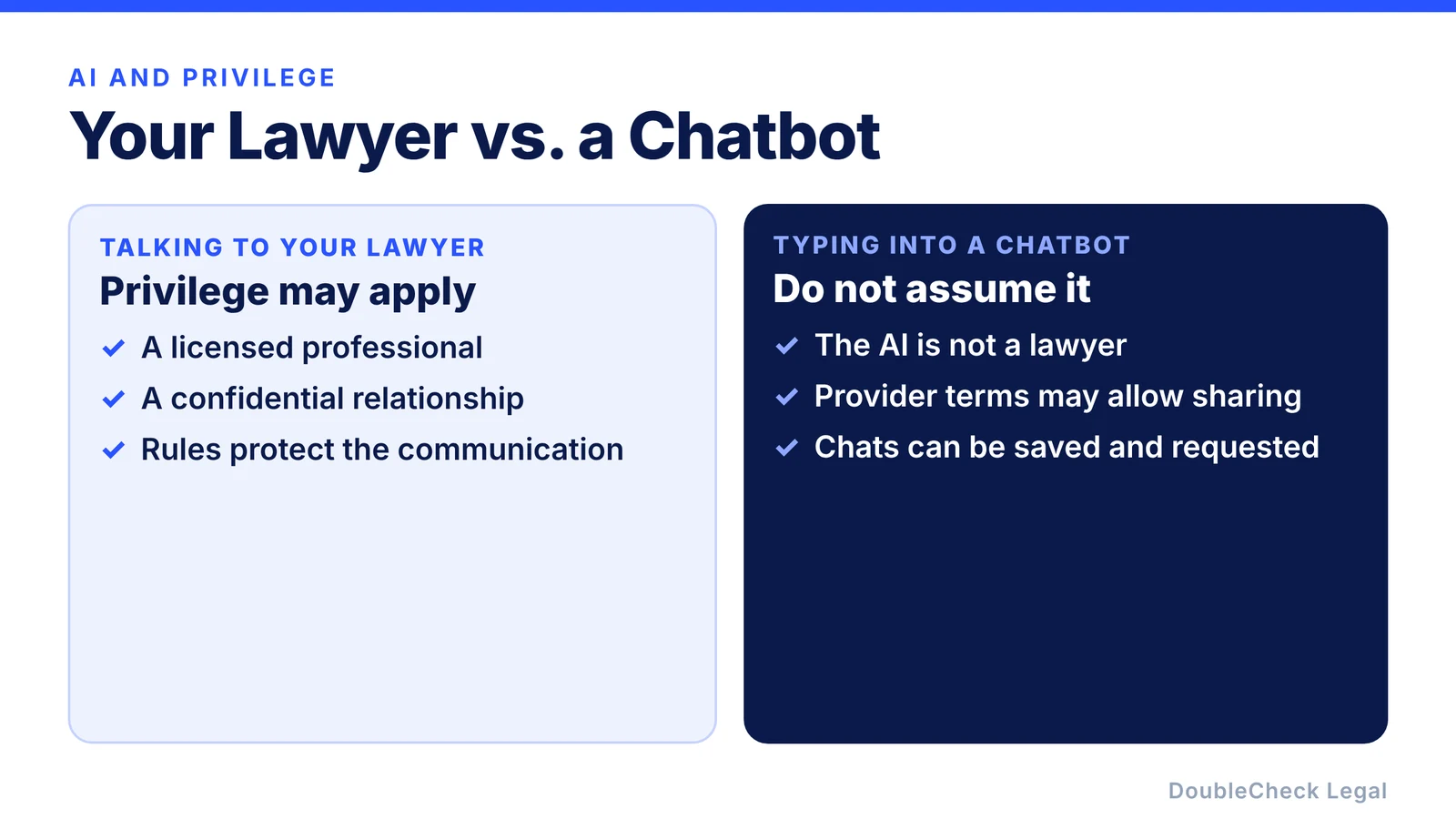
- The AI is not a lawyer. Attorney-client privilege protects confidential communications between a client and an attorney. A chatbot is not an attorney and cannot form that relationship.
- Confidentiality was doubtful. The court pointed to the provider’s consumer privacy policy, which allows collecting inputs and outputs and disclosing them in some circumstances.
- Sharing counsel’s advice with a public tool can be a disclosure. Pasting a lawyer’s advice into a public AI service may waive protection that would otherwise apply.
- Sending the material to your lawyer later does not retroactively make it privileged.
Some commentators say the confidentiality reasoning went further than the case required, but they generally agree with the core conclusion that talking to a chatbot is not the same as consulting a lawyer.
3. Why work product protection did not apply either
The work product doctrine can protect materials prepared by or for a party in anticipation of litigation, especially when they reflect an attorney’s strategy. Here, the defendant created the materials himself, not at his lawyers’ direction, and the AI is not an attorney. The fact that the documents might later inform counsel’s thinking was not enough.
One report notes a federal magistrate judge in Michigan reached a different result the same day for a self-represented litigant’s ChatGPT exchanges, finding them protected as work product. Courts are not uniform on this, and facts matter a great deal.
4. What this means for business owners
You do not have to be a criminal defendant for this to matter. Businesses face disputes, investigations, employment claims, and contract fights. In those situations, documents can be requested, and an AI chat history can be a document.
Practical points that follow from the ruling:
- Do not assume your AI conversations are confidential in a legal sense.
- Do not paste a lawyer’s advice, a settlement strategy, or internal investigation details into a public AI tool.
- If you are already in a dispute, ask your lawyer before using AI to analyze it.
- Saved chats, exports, and shared links can all become evidence.
Our AI policy template for small businesses and guide to safe AI use for legal work cover what staff should and should not put into AI tools.
5. Safer habits with AI chats
This does not mean you should stop using AI. It means matching the tool to the task:
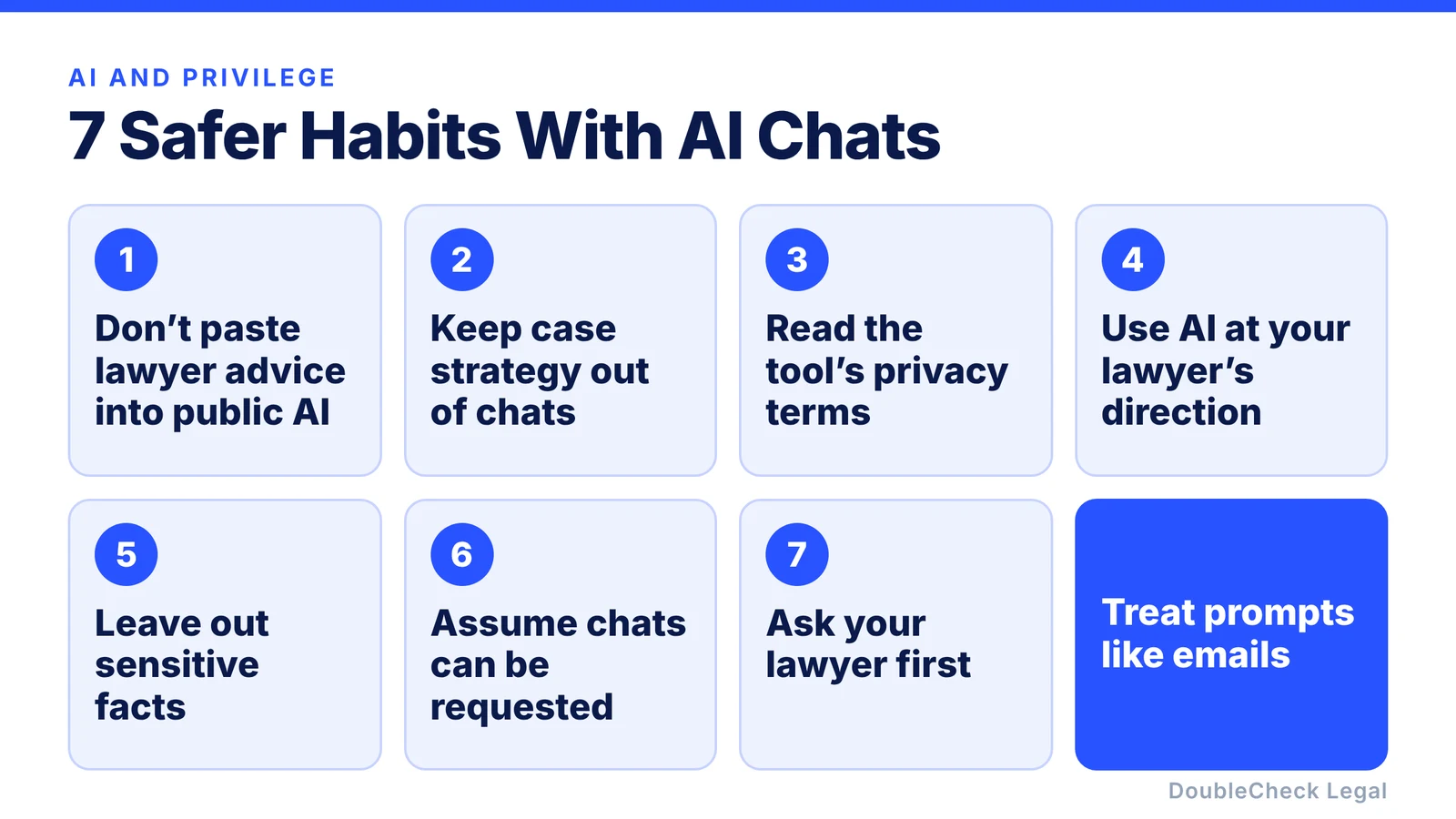
Using AI to understand a general concept, draft a first version of a routine document, or prepare questions for your lawyer is very different from typing out a live dispute in detail. Enterprise tools with negotiated confidentiality terms may be treated differently, but commentators note that has not been tested in court.
6. Where DoubleCheck fits
DoubleCheck is built for businesses that start legal work with AI. Bring your question or draft, use an AI-first workflow to understand and verify it, and when professional advice is warranted, you can connect with an independent attorney. Attorneys on DoubleCheck are independent professionals; an attorney-client relationship forms only if an attorney accepts your engagement.
Sources: Orrick: Court Rules AI Conversations Are Not Privileged; Lawfare: AI and Privilege After United States v. Heppner.
FAQ
Are AI chats protected by attorney-client privilege?
Not automatically. In United States v. Heppner (S.D.N.Y., February 2026), a court held a defendant’s conversations with a public AI assistant were not privileged. It is one ruling on specific facts, but it is a strong warning.
What is work product protection?
It is a doctrine that can protect materials prepared in anticipation of litigation, especially those reflecting an attorney’s strategy. In Heppner, it did not apply because the defendant created the materials on his own, not at counsel’s direction.
Can my AI chat history be requested in a dispute?
It can be treated like other documents. Saved chats, exports, and shared links may be requested or seized, so avoid putting sensitive dispute details into public AI tools.
Should I stop using AI for legal questions?
No. AI can help you understand concepts and prepare questions. Be careful with live disputes and with a lawyer’s confidential advice, and ask your lawyer before using AI on a matter they handle.
General information only. This article is not legal, tax, investment, or accounting advice.