California Just Passed New AI Rules for Lawyers. Here's What Business Clients Should Know
California’s SB 574, signed September 30, 2026, takes effect January 1, 2027. It makes one thing particularly clear: the lawyer is still responsible for the result. This is general information, not legal advice.
Key takeaways:
- Lawyers using generative AI must verify output and personally verify court citations.
- Confidential client information can only go into AI systems with restricted access.
- Ask your attorney about their verification workflow, not whether they use AI.
- The same rule works for you: generation and verification are different tasks.
Lawyers are using ChatGPT, Claude, Gemini, and specialized AI tools for more legal work. For business owners already working with AI, or hiring lawyers who use it, the law offers a preview of where legal work is heading. AI can accelerate the work, but someone still has to check it.
What does the new California AI law require?
SB 574 adds Business and Professions Code section 6068.1 and amends a court-sanctions statute. Based on published summaries, here is what it covers:
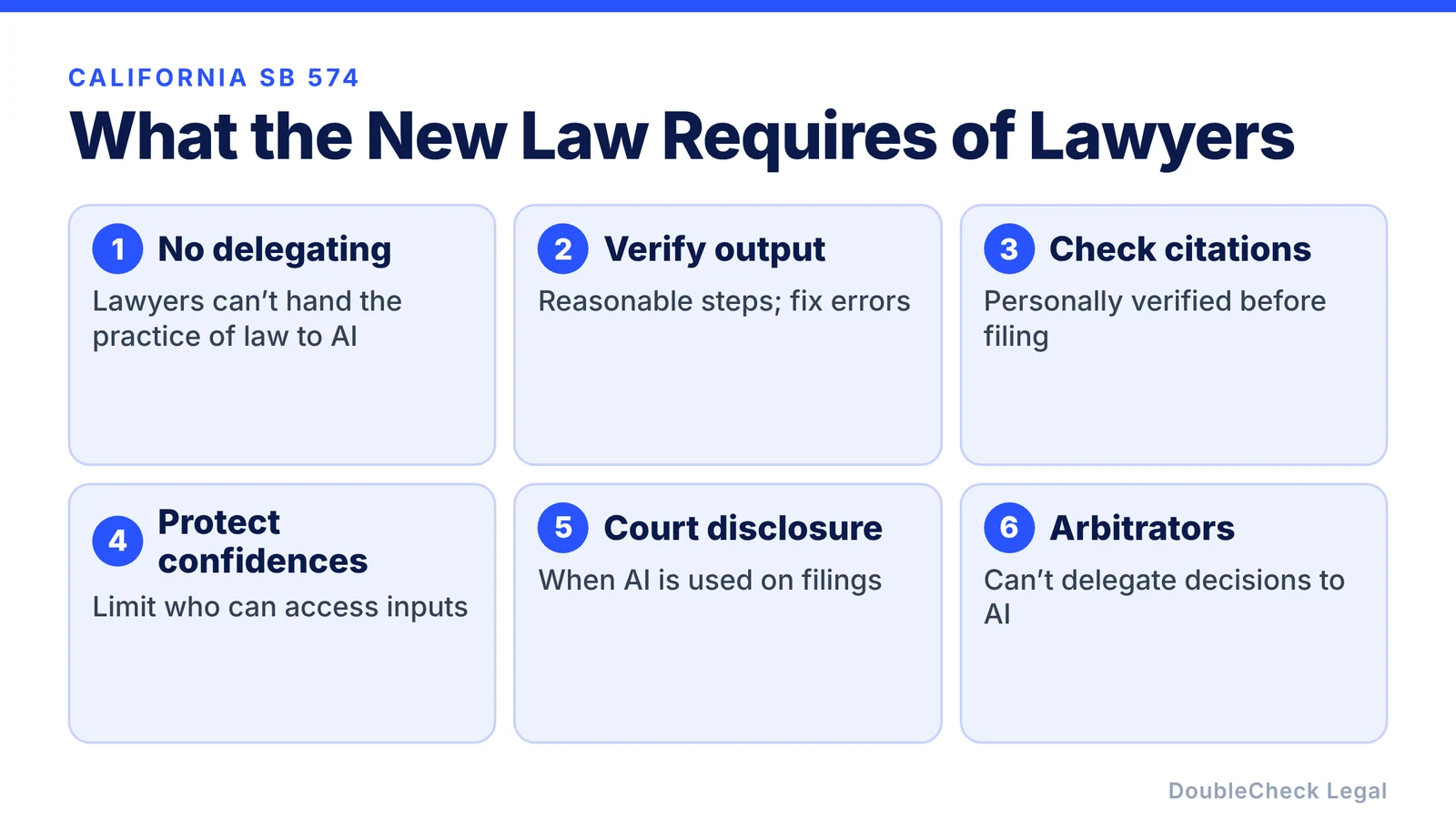
- No delegating the practice of law to AI. The statute does not define “delegate,” so the exact line between assistance and delegation is not yet settled. Published readings suggest AI can still help with research and drafting while the lawyer keeps legal judgment.
- Verify AI output. Attorneys using generative AI must take reasonable steps to verify accuracy and correct erroneous or fabricated material.
- Personally verify citations in court filings. The law bars California court filings containing a citation the responsible attorney has not personally verified. That applies to all citations, not only AI-generated ones.
- Protect confidential information. Attorneys may not enter confidential or nonpublic client information into a generative AI system unless access is limited to the attorney and authorized people bound to keep it confidential.
- Disclose AI use to courts. Attorneys face a disclosure requirement for court submissions. The statute does not prescribe a form, and commentators note the scope is open to interpretation.
- Arbitrators too. Arbitrators cannot delegate any part of their decision-making to AI.
Lawyers have to verify AI-generated work
The practical principle is simple:
Using AI does not transfer responsibility from the lawyer to the model.
If ChatGPT produces research, the lawyer still has to check it. If Claude helps draft an argument, the lawyer still owns the final work. An AI answer can look extremely professional and still be wrong, which is why checking citations against the underlying sources matters.
The message is becoming consistent: AI can research. AI can draft. The professional still has to verify.
Confidential client information matters too
The law also addresses what lawyers put into AI systems. This is relevant far beyond law firms. Before putting a contract, employee dispute, customer information, acquisition document, source code, or confidential strategy into an AI system, ask:
- Which AI product are we using?
- Is this a consumer or enterprise account?
- How is the information retained?
- Can it be used for training?
- Who can access it?
- Does our company allow this information to be uploaded?
If you want the lawyer-side detail, our post on what SB 574 can mean for AI-native law firms digs into the access test. To set these rules for your own company, see our AI policy template and AI vendor contract checklist.
Lawyers may have to disclose AI use in court filings
For the last several years the question was mostly “did a lawyer use AI?” The emerging question is:
“How was AI used, what did the human verify, and who is responsible for the result?”
That shift matters as AI becomes embedded in legal research, drafting, contract review, and litigation tools. AI is becoming less invisible inside professional work.
What does this mean for business owners?
You probably do not need to ask your attorney, “Did you type every sentence yourself?” AI-assisted work can be faster and more efficient. Better questions focus on the quality of the workflow:
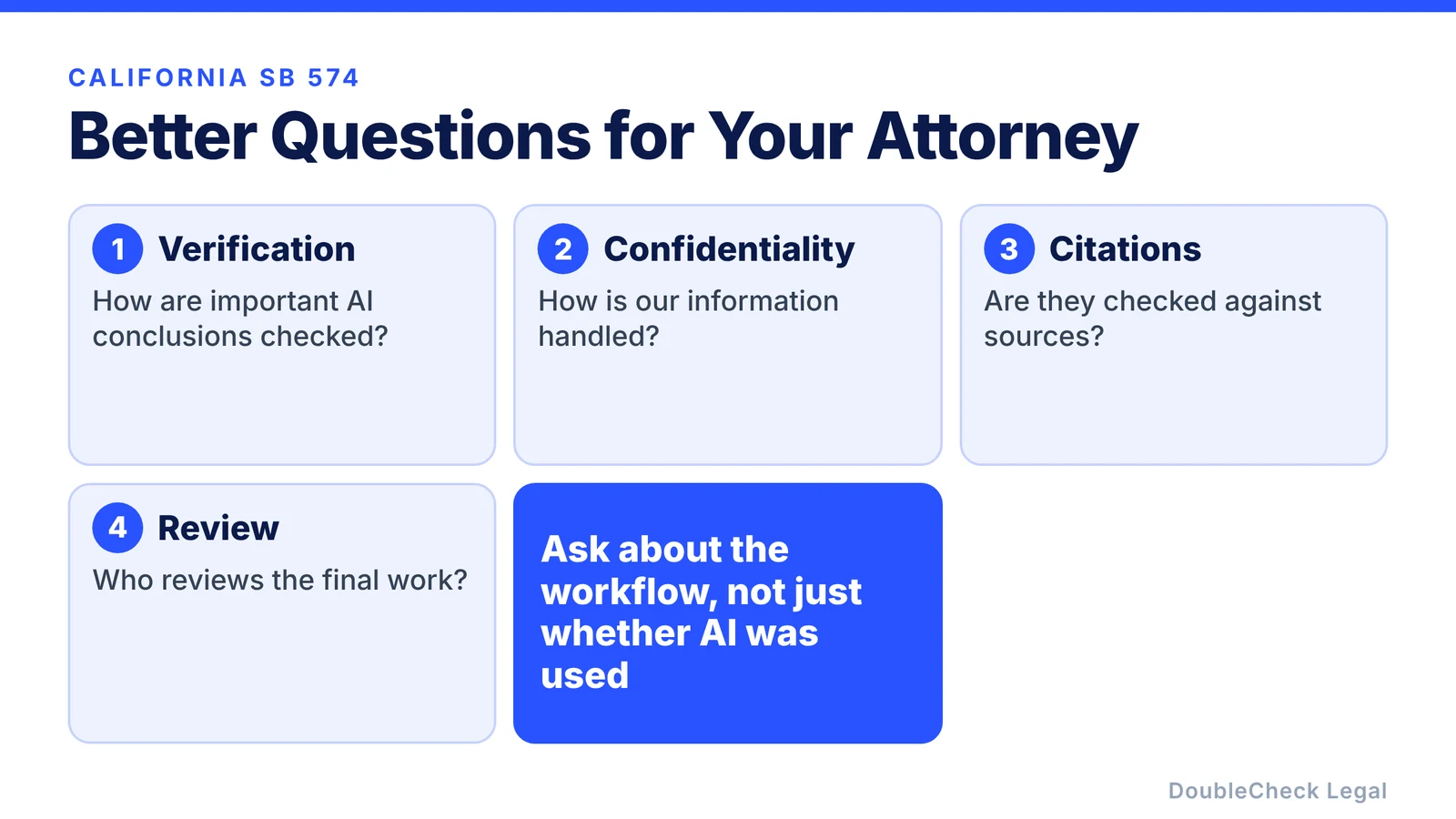
- How are important AI-generated conclusions verified?
- How is our confidential information handled?
- Are AI-generated citations checked against the underlying sources?
- Who reviews the final work?
Clear verification rules can make AI easier to use responsibly. A lawyer can use AI to summarize documents, compare contracts, organize research, draft initial language, identify issues, and search large collections of information, while remaining responsible for the final professional judgment. For ways to turn that into lower costs, see how to save money on legal work with AI.
The same lesson applies when you use AI yourself
Business owners already do much of this work before attorneys see it: an NDA drafted with ChatGPT, a freelancer contract reviewed with Claude, an employment question researched with Gemini. That can save significant time. But the law reinforces a useful principle even for non-lawyers:
Generation and verification are different tasks.
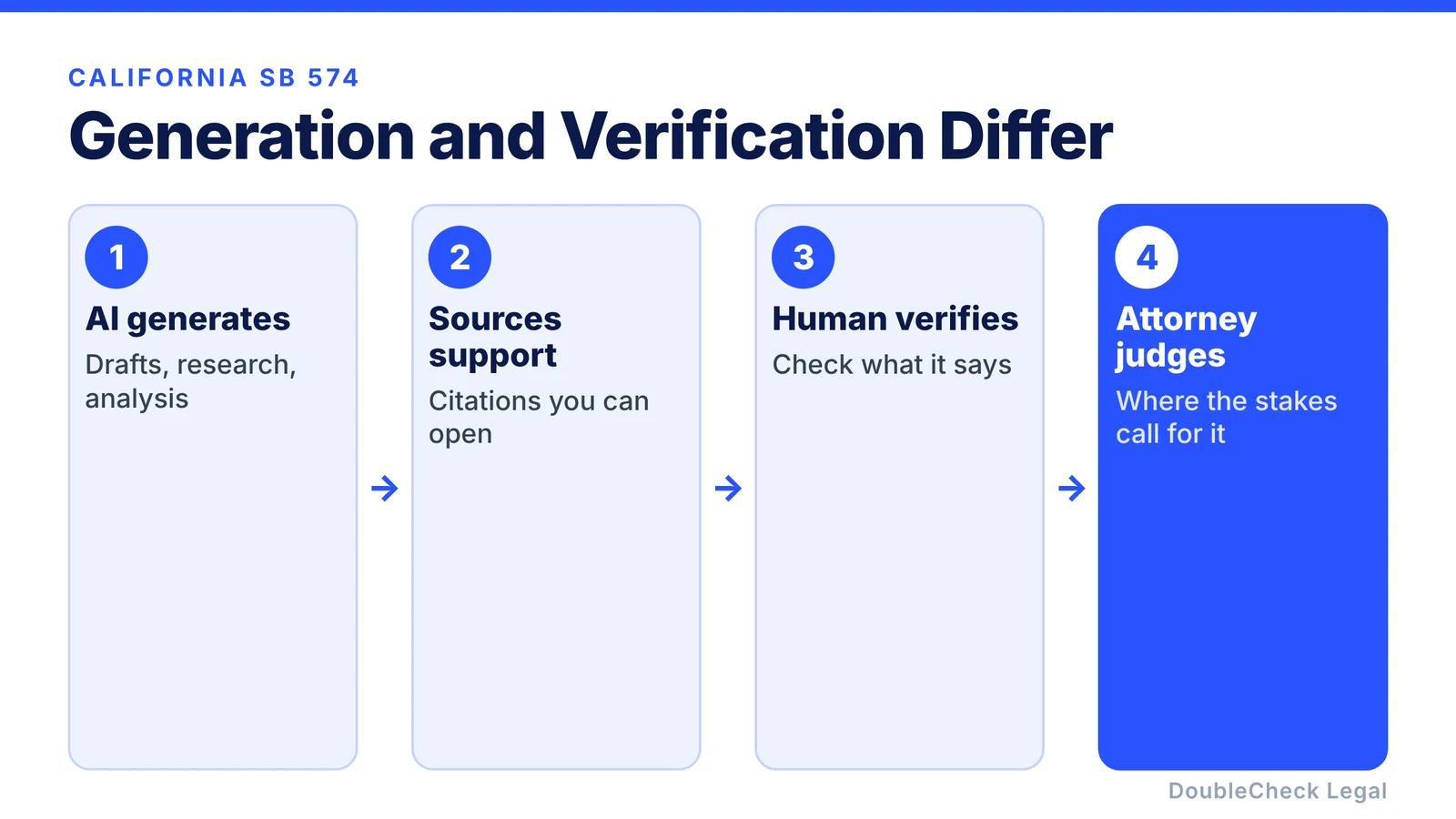
The AI generated something. Now somebody needs to check whether it is correct. Our guide to verifying an AI-generated legal document shows how.
Where DoubleCheck fits
Bring the contract you created with ChatGPT, the analysis Claude gave you, or the question you researched with Gemini. Examine the work, surface sources, identify uncertainty, and decide whether professional review is appropriate. When you need a lawyer, you continue from the work already done instead of starting from zero.
DoubleCheck is built for businesses that start legal work with AI. Bring your question or draft, use an AI-first workflow to understand and verify it, and when professional advice is warranted, you can connect with an independent attorney. Attorneys on DoubleCheck are independent professionals; an attorney-client relationship forms only if an attorney accepts your engagement.
AI generates → sources support → human verifies → attorney applies professional judgment
Sources: Holland & Knight summary of SB 574 (Oct. 1, 2026); S.B. 574 bill text.
FAQ
When does California’s new AI law for lawyers take effect?
SB 574 was signed on September 30, 2026 and takes effect on January 1, 2027.
Can California lawyers use ChatGPT or Claude?
The law does not broadly prohibit lawyers from using generative AI. It sets responsibilities around accuracy, confidentiality, citations, disclosure, and professional accountability.
Does a lawyer have to verify information generated by AI?
Attorneys using generative AI must take reasonable steps to verify AI-generated material and correct inaccurate or fabricated output, and they must personally verify citations in court filings.
Can lawyers put confidential information into ChatGPT?
Lawyers have confidentiality obligations, and the law addresses entering nonpublic client information into generative AI systems unless access is appropriately restricted. The answer can depend on the system, protections, and circumstances.
Does this law apply to business owners using AI themselves?
SB 574 regulates attorneys and arbitrators, not business owners. But its verification and confidentiality principles are useful for businesses using AI for their own legal work.
General information only. This article is not legal, tax, investment, or accounting advice.