How to Get a Lawyer Referral From Your Network
Your first instinct may be to Google “best lawyer near me.” Asking somebody you trust is another powerful option, but there is a right way to do it.
Key takeaways:
- Ask people whose experience is closest to your problem, including lawyers in other specialties.
- Make the request specific: practice area, jurisdiction, type of work, urgency.
- Ask why they recommend the lawyer, and request a warm introduction.
- A referral is a lead, not a hire. Verify the license, scope, cost, and fit yourself.
Despite the rise of search engines, legal directories, marketplaces, and AI, personal referrals remain one of the main ways people find attorneys. A warm introduction can give you information a website cannot.
Why lawyer referrals are valuable
Suppose a lawyer’s website says “Responsive, practical, business-focused legal advice.” Almost every lawyer’s website says something positive. Now imagine a founder you trust tells you:
“We used Sarah for our enterprise contracts. She’s fast, practical, doesn’t over-lawyer things, and understands startups.”
That contains information you probably would not get from a website. A referral can tell you how the attorney actually works: responsiveness, communication, practical judgment, pricing, personality, speed, and how they handle real clients. It does not mean you should automatically hire the person, but it is a much better starting point.
Who should you ask?
Start with people whose experience is closest to your problem.
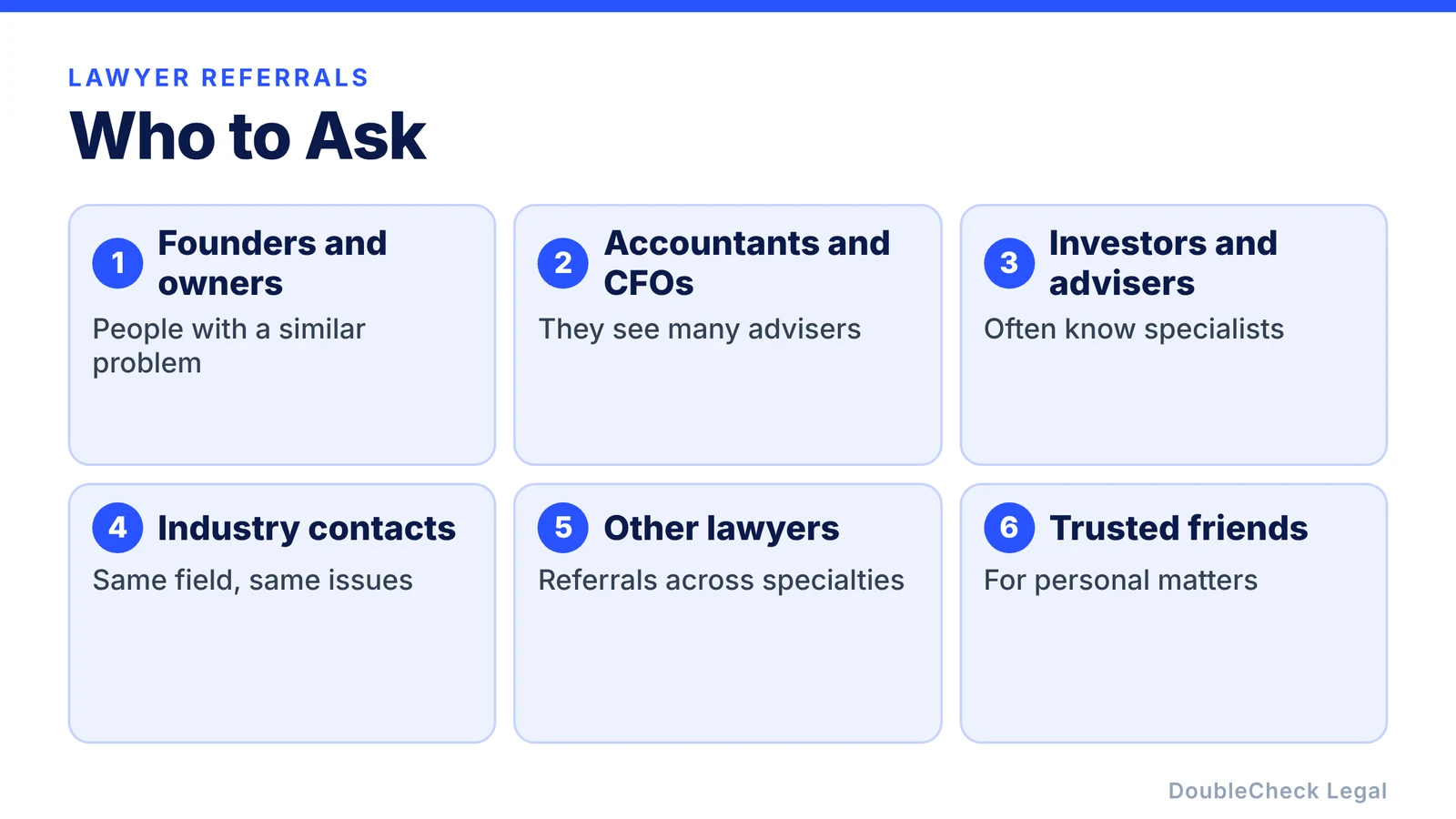
For a business, that could be another founder or business owner, an investor, an accountant, a CFO, a consultant, an executive, someone in your industry, or an attorney you already know. For personal matters, trusted friends or family can help.
Context matters. If you need an immigration lawyer, a friend’s great divorce lawyer is not necessarily useful. If you need help selling your company, ask founders who have been through acquisitions, not somebody who once hired an attorney for a traffic ticket.
Lawyers themselves are excellent referral sources
This is often overlooked. If you know an excellent employment attorney but now need an intellectual-property attorney, ask the employment lawyer. Attorneys regularly know lawyers in other specialties and can often point you to someone more appropriate. One lawyer often has a better sense of another lawyer’s professional reputation than a random online reviewer.
Don’t ask, “Do you know a lawyer?”
Make your request specific. “Do you know any lawyers?” is hard to answer. Try:
“Do you know a good commercial attorney who works with early-stage software companies and regularly reviews enterprise customer contracts?”
“Do you know an employment attorney in California who works with startups?”
“I’m looking for an immigration attorney who regularly handles this specific visa category. Do you know anyone you would personally recommend?”
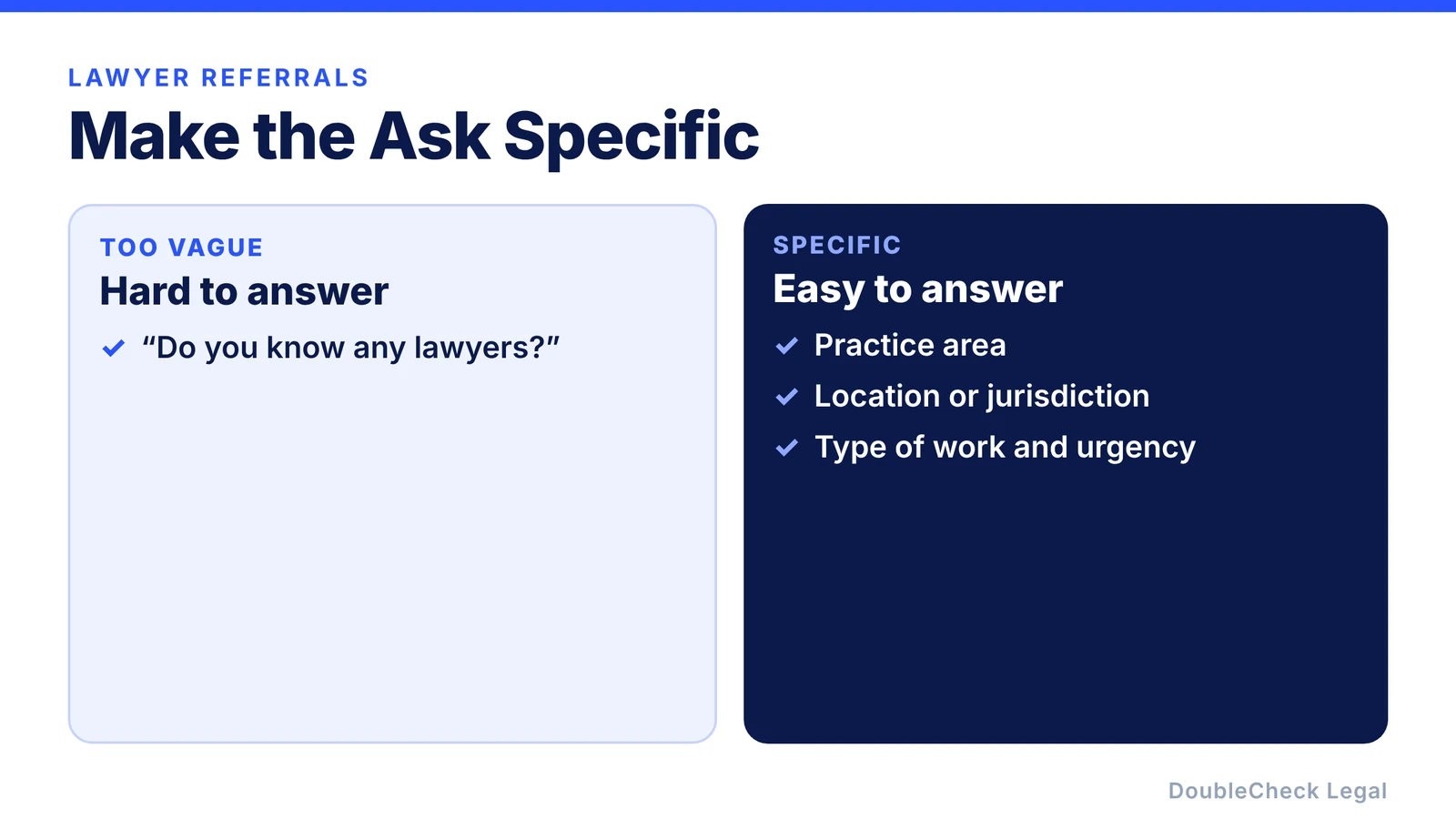
Specific questions produce better referrals.
Give enough context, but not your entire case
Your friend does not need a 30-page explanation. Give them what kind of problem it is, where it is, what type of lawyer you think you need, how urgent it is, and anything unusually important. For example:
“I’m looking for a California startup attorney to review a customer contract. Most of the agreement is done, but I need help with IP ownership, liability, and indemnification. Ideally someone comfortable doing a focused review rather than starting from scratch. Do you know anyone good?”
That is enough for someone to think, “I know exactly who you should talk to.” Keep confidential details out of the request.
Ask why they recommend the lawyer
Do not stop at “Here’s John’s number.” Ask “What did they help you with?” and “What did you like about working with them?” You might learn “Excellent lawyer, but extremely expensive,” or “Really good litigator, but probably not right for contracts,” or “They helped us through our Series A and really understand startups.” That information is often more valuable than the name itself.
Ask for a warm introduction
If the person genuinely knows the lawyer, ask: “Would you be comfortable introducing us?” The lawyer then knows who referred you, why you are reaching out, and a little about the matter. Keep it simple. Your friend might write:
“Sarah — introducing Alex, who runs a software startup. He’s looking for help reviewing an enterprise agreement and I thought you might be a good fit. I’ll let you two take it from here.”
If your friend offers to forward something, give them a short paragraph: who you are, the practice area, the document or issue, and the timeline. Do not ask them to pitch your whole problem for you.
A warm referral is not the same as vetting
Your friend may have had a great experience, but their matter may have been completely different. You still need to evaluate the attorney yourself.
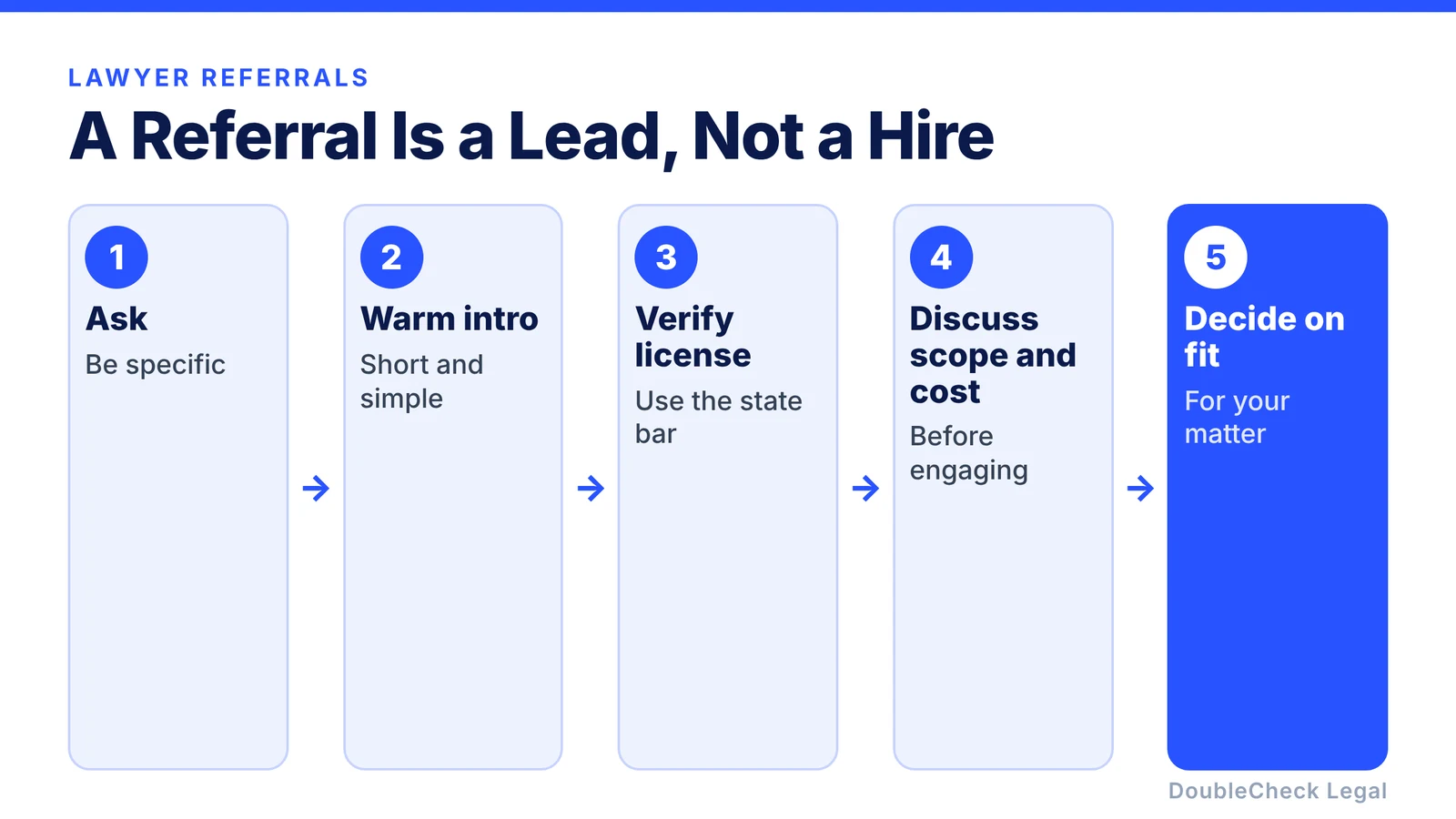
After the introduction: verify the license, check that they work in the relevant practice area, ask about similar experience, discuss cost and scope, have an initial conversation, and decide whether you communicate well. Our guide to choosing a good lawyer has the full checklist. Think of the referral as a high-quality lead, not an automatic hiring decision.
What if nobody in your network knows the right person?
Then expand outward. You can ask another attorney, contact a relevant law firm, use a certified lawyer-referral service, search your state bar, use professional legal marketplaces, search online, or use a platform that connects legal needs with appropriate attorneys. Many state and local bar associations run lawyer-referral services.
If you already have an AI-drafted document, our guide on finding a lawyer to review a contract you drafted with ChatGPT covers where to look and what to send. A friend’s referral is useful, but it is not the only legitimate way to find a lawyer.
Can AI help with a lawyer referral?
At the edges, yes. Before asking your network, tell ChatGPT, Claude, or Gemini about your problem and ask what type of attorney to look for, then ask for a three-sentence description you can send to business contacts. AI can also help prepare consultation questions.
What AI cannot reproduce well is someone you trust saying, “I actually worked with this person and had a good experience.” That is why referrals stay valuable even in an AI-driven legal market.
Where DoubleCheck fits
The ideal scenario is someone you trust knowing exactly the right attorney. But your network may not contain the right specialist, your issue may be unusual, or you may not know many lawyers. DoubleCheck is designed for that: begin with the legal issue you have, provide context, and look for an independent attorney whose practice area fits. If you already used AI to understand or draft something, you do not need to hide it or start from zero.
DoubleCheck is built for businesses that start legal work with AI. Bring your question or draft, use an AI-first workflow to understand and verify it, and when professional advice is warranted, you can connect with an independent attorney. Attorneys on DoubleCheck are independent professionals; an attorney-client relationship forms only if an attorney accepts your engagement.
Whether the attorney comes from your friend’s network or DoubleCheck, use the same principles: verify → understand their experience → discuss scope → discuss cost → evaluate fit.
FAQ
What is the best way to get a lawyer referral?
Ask someone you trust who has experience with a legal issue similar to yours. Be specific about the practice area, jurisdiction, and type of work rather than simply asking whether they know a lawyer.
Who should I ask for an attorney referral?
Depending on the matter: friends, family, other business owners, founders, accountants, investors, executives, advisers, and lawyers working in other practice areas.
Is a referred lawyer automatically better?
No. A referral gives you useful information, but you should still verify licensing, relevant experience, fees, availability, and fit for your specific matter.
Should I ask for a warm introduction?
If the person actually knows the attorney and is comfortable making one, yes. It gives both sides context and makes the first outreach easier.
Can another lawyer refer me to the right lawyer?
Yes. Lawyers frequently refer matters outside their own practice areas to other attorneys, which can be one of the most useful ways to find a specialist.
What if I don’t know anyone who can refer me to a lawyer?
You can use state or local bar referral services, direct attorney outreach, professional marketplaces, online research, or platforms such as DoubleCheck.
General information only. This article is not legal, tax, investment, or accounting advice.