How Do I Know If My Lawyer Is Good? 8 Signs You Have a Good Attorney
You hired a lawyer. Now you have a different question: how do you know whether they are actually good? Instead of judging only by the final result, look at how they handle the work.
Key takeaways:
- Good lawyers understand your specific problem and explain it clearly.
- They keep you informed, give you a strategy, and are transparent about fees.
- They are honest about uncertainty, never guarantee results, and know their limits.
- A second opinion is reasonable when strategy, communication, or costs stop making sense.
You may not know the law yourself, your case may move slowly, and your lawyer may tell you things you do not want to hear. Even an excellent attorney cannot guarantee that you will win. Professional rules provide a starting point: lawyers are expected to act competently and diligently, keep clients reasonably informed, and explain matters well enough for clients to make informed decisions. Here are eight practical signs. This article provides general information, not legal advice.
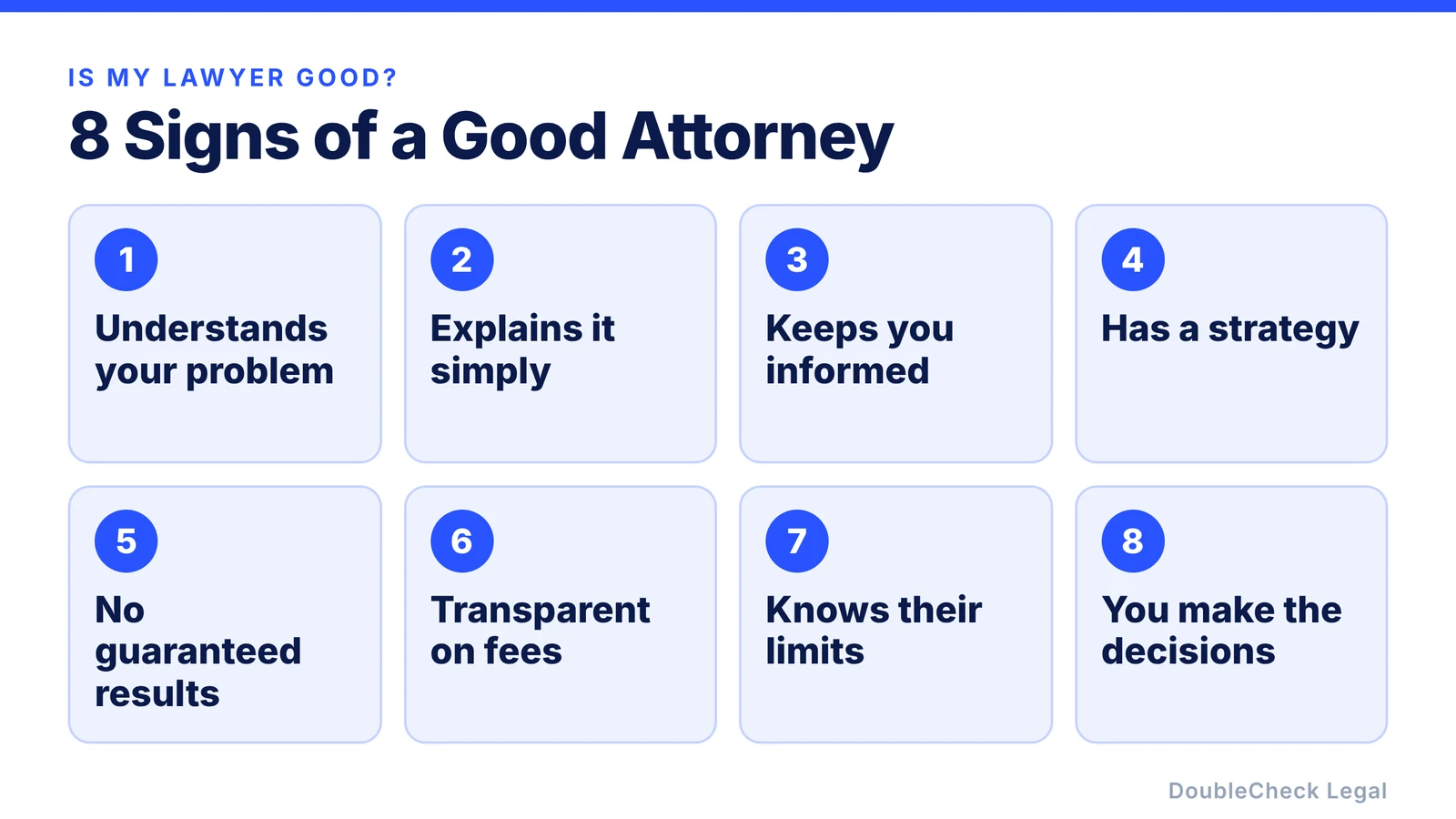
1. Your lawyer actually understands your problem
A good lawyer does not just understand “law.” They understand your particular problem. If you are a startup negotiating an enterprise contract, they should understand the commercial relationship. In an employment issue, they should understand the facts around the employee and workplace. In litigation, they should understand the timeline, evidence, opposing arguments, and what you are actually trying to achieve.
One good sign is that your lawyer asks detailed questions instead of immediately giving a generic answer: what happened, what documents exist, what you want, what matters most, the deadline, the financial risk, and what the other side has already said. Good legal work often begins with good questions.
2. They can explain complicated things simply
After speaking with your lawyer, you should generally understand your situation better, not worse. That does not mean every problem has an easy answer. A good lawyer may say “There isn’t a clear answer here,” but should then explain why:
“There are two possible interpretations. This fact supports your position, but this other fact creates risk.”
Professional rules generally expect lawyers to explain matters well enough for clients to make informed decisions. A lawyer who uses complicated terminology without helping you understand it is not necessarily giving better advice. Complexity and expertise are not the same thing.
3. They keep you informed
You should not discover an important development in your case by accident. Lawyers are generally expected to keep clients reasonably informed about significant developments and respond to reasonable requests for information. That does not mean a reply to every email within five minutes, and different matters have different rhythms. But you should know:
- what is happening,
- what happens next,
- what they need from you,
- and when an important decision must be made.
4. They give you a strategy, not just tasks
A good lawyer should generally be able to explain the plan:
“First we’ll respond to the demand letter. Then we’ll ask for these documents. If they don’t resolve the issue, we have two options.”
Or:
“There are ten changes in this contract, but only three are worth negotiating aggressively. I would accept the others.”
That is legal judgment: separating what is technically possible from what actually matters. You should understand what the lawyer is trying to accomplish and why.
5. They do not promise you a guaranteed result
This may sound counterintuitive, but one of the best signs of a good lawyer is being comfortable saying “I don’t know,” or “You have a good argument, but there is still risk,” or “I would not recommend spending $50,000 fighting over a $20,000 problem.”
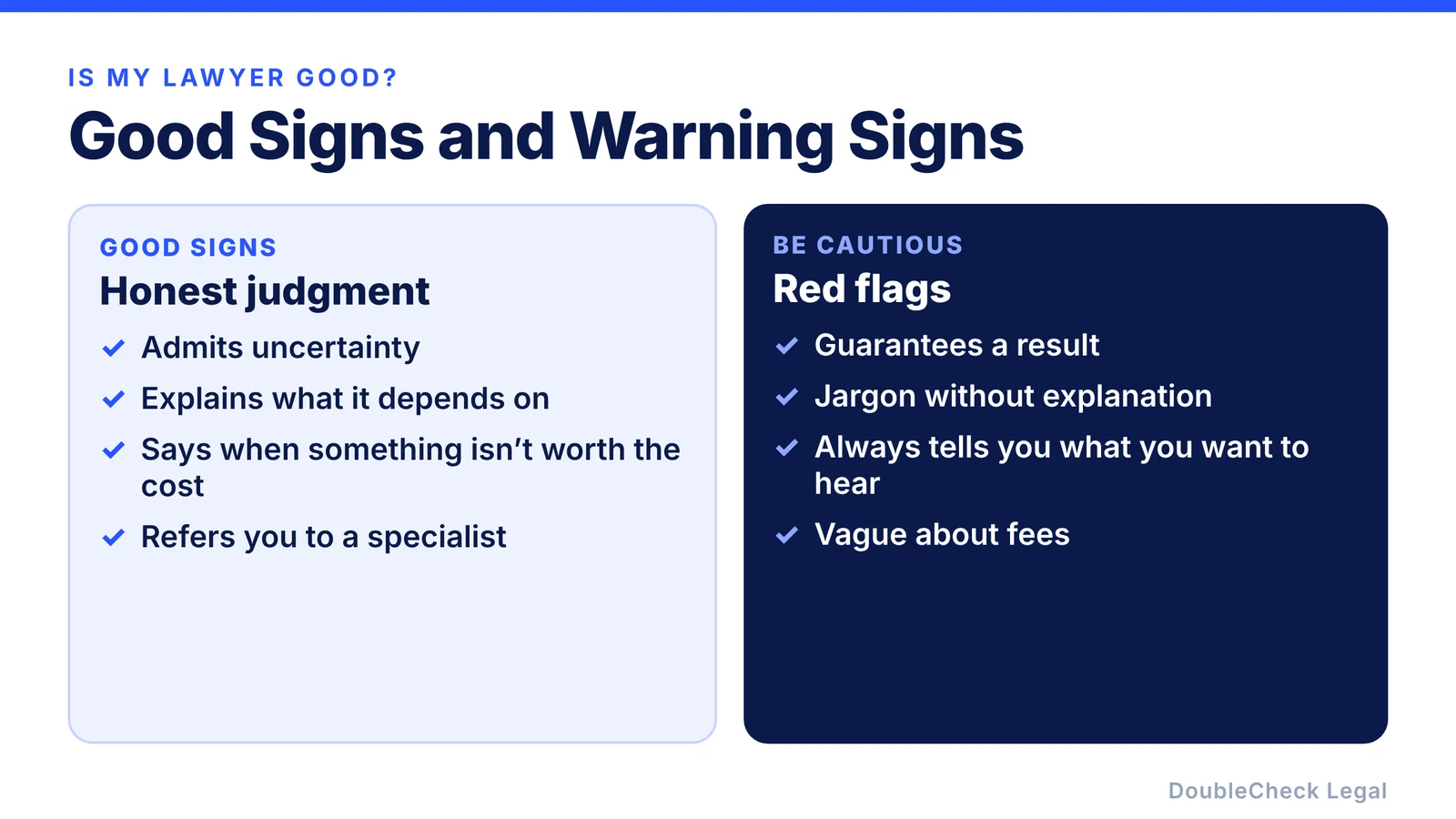
Be careful with a lawyer who guarantees a victory, settlement, or specific outcome. Legal matters involve competing arguments and factors outside one lawyer’s control. Confidence can be good. False certainty is different.
6. They are transparent about money
Good legal service includes understanding what you are paying for. You should know the lawyer’s rate or fixed fee, who else may work on the matter, what is included, what additional costs may occur, and what could cause the budget to rise. Many jurisdictions also require written fee terms in certain situations.
A good lawyer may be expensive, and expensive does not automatically mean bad. What matters is that you understand the cost and why the work is being done. One particularly good sign is when your lawyer tells you that something is not worth paying them to do. For ways to keep scope and cost under control, see how to save money on legal work with AI.
7. They know when another lawyer knows more
Nobody is the best lawyer for every problem. A good corporate lawyer may not handle immigration, a good employment attorney may not prosecute patents, and a good litigator may not be who you want structuring a complex tax transaction. Professional competence rules recognize this: a lawyer who lacks the needed knowledge may need to consult or associate with another competent lawyer, learn the area, or refer the matter.
So if your attorney says, “This tax issue is outside my specialty. I want someone else to look at it,” that can be a good sign. The dangerous attorney is sometimes the one who acts like they know everything.
8. They let you make the important decisions
Your lawyer advises you. They do not own your problem. A lawyer should explain the options, consequences, risks, and strategy, but important decisions about your objectives generally remain yours. A good conversation sounds like:
“Option A is cheaper but gives up this right. Option B gives you a stronger position but may cost more. My recommendation is B because of these three reasons. Ultimately, the decision is yours.”
That gives you advice without taking away your ability to decide.
A good lawyer does not always tell you what you want to hear
Sometimes your lawyer’s job is to tell you “Do not do that,” or “Your case is weaker than you think,” or “That contract term is reasonable,” or “Settling is probably better than fighting.” You are paying for judgment, not agreement. A lawyer who always tells you exactly what you want to hear may feel good in the short term, but that is not necessarily good representation.
When should you consider getting a second opinion?
A second opinion can make sense if:
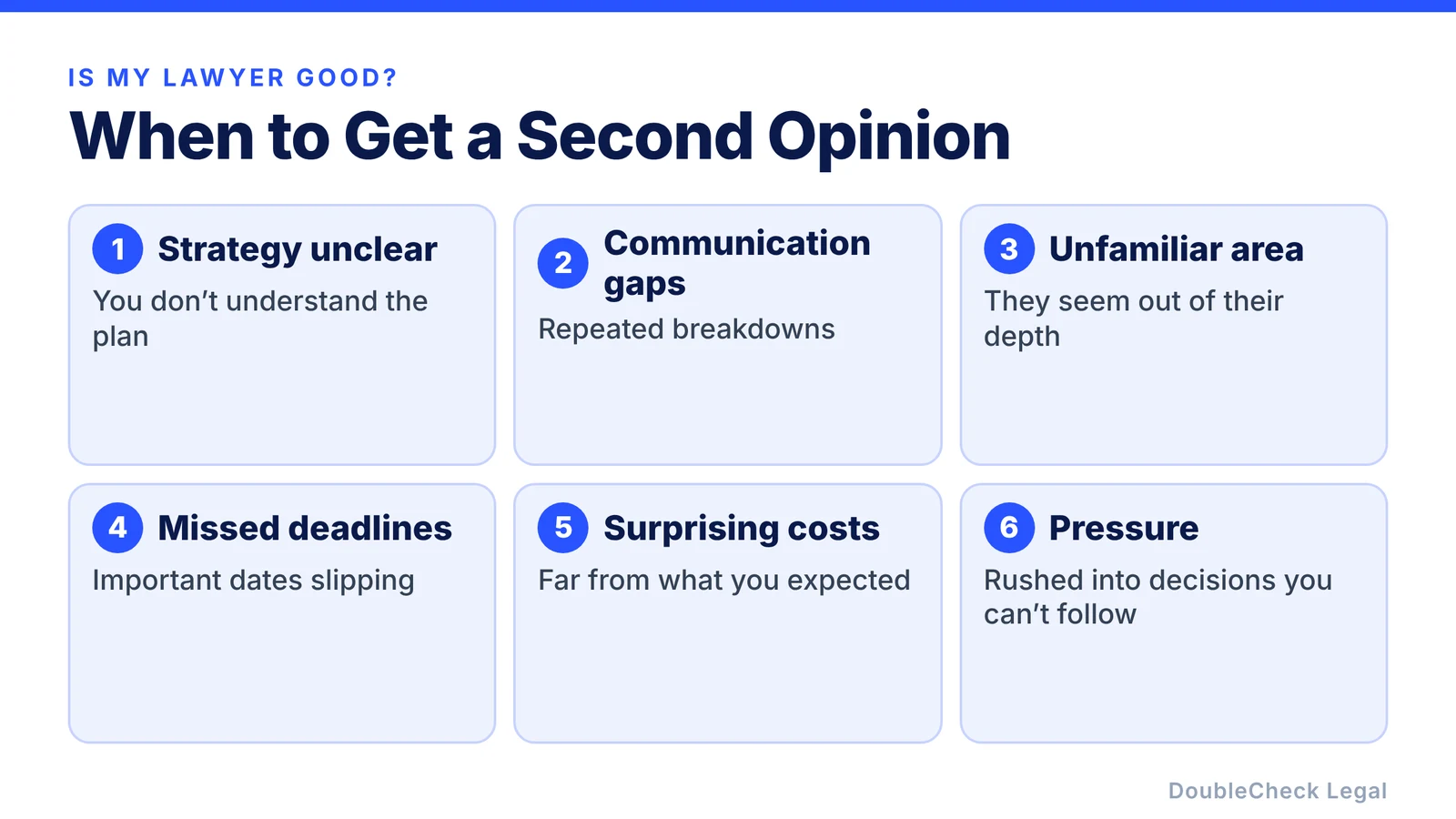
- you do not understand the strategy,
- communication has repeatedly broken down,
- your lawyer seems unfamiliar with the relevant area,
- major deadlines are being missed,
- costs are dramatically different from what you expected,
- you are being pressured into decisions you do not understand,
- or an important recommendation simply does not make sense to you.
Getting another opinion does not automatically mean firing your lawyer. Sometimes it confirms the first lawyer’s advice was sensible. If you do want a second lawyer, see how to choose a good lawyer and how to get a referral.
Can AI help you evaluate your lawyer’s advice?
Yes, as long as you do not treat it as the final judge. Ask ChatGPT, Claude, or Gemini to “Explain this recommendation in plain English,” or “What questions should I ask my attorney about this strategy?” or “What assumptions does this legal argument appear to depend on?”
Be careful with “My lawyer told me X. Is my lawyer wrong?” The AI may not have the full file, facts, jurisdiction, procedural history, or professional context your lawyer has. Use AI to help you understand and question, not to automatically overrule professional advice. Our guide to verifying AI-generated legal work covers how to check what an AI tells you.
A simple good-lawyer checklist
Ask yourself:
- Does my lawyer understand my particular problem?
- Can they explain it clearly?
- Do they keep me informed?
- Is there a coherent strategy?
- Are they honest about uncertainty?
- Do I understand the fees?
- Do they know the limits of their expertise?
- Do I understand my options before making important decisions?
No lawyer will be perfect at every moment. But if you consistently cannot answer these positively, it may be worth a direct conversation, or another opinion.
Where DoubleCheck fits
DoubleCheck is built partly around the idea that people should be able to understand and verify more of their legal work. Use AI to understand an issue, organize documents, examine sources, and prepare better questions. If you want another professional perspective, DoubleCheck provides a path to independent attorneys.
DoubleCheck is built for businesses that start legal work with AI. Bring your question or draft, use an AI-first workflow to understand and verify it, and when professional advice is warranted, you can connect with an independent attorney. Attorneys on DoubleCheck are independent professionals; an attorney-client relationship forms only if an attorney accepts your engagement.
The goal is not to replace the attorney-client relationship with AI. It is to make you a more informed participant in it.
FAQ
How do I know if my attorney is doing a good job?
Look at competence, communication, diligence, strategy, transparency about fees, relevant expertise, and whether the attorney gives you enough information to make informed decisions.
How often should my lawyer update me?
There is no universal schedule, but attorneys are generally expected to keep clients reasonably informed about significant developments and respond to reasonable requests for information.
Is it a bad sign if my lawyer says they don’t know the answer?
Not necessarily. A lawyer who recognizes uncertainty or the limits of their expertise may be exercising good judgment. They can research the issue or consult or refer you to a specialist when appropriate.
Should a good lawyer guarantee that I will win?
No lawyer can control every fact, judge, opposing party, negotiation, or legal interpretation. Be cautious about guarantees of victory or a particular settlement.
Can I get a second opinion while I already have a lawyer?
Generally, yes. If you are uncertain about important advice, another qualified perspective may help you evaluate the situation.
General information only. This article is not legal, tax, investment, or accounting advice.