How to Choose a Good Lawyer: 8 Things to Check Before You Hire One
Finding a lawyer is relatively easy. Finding the right lawyer for your particular problem is harder. Here are eight things to check before you hire one.
Key takeaways:
- Ask whether they are a good lawyer for your specific problem, not a good lawyer in general.
- Verify the license and ask about similar matters.
- Ask what the strategy is, and talk about fees and scope before you engage.
- Use reviews, rankings, and referrals together, never alone.
A lawyer can have an impressive website, excellent credentials, and decades of experience, and still not be the best person for your matter. A lawyer who was right for a friend’s situation may not be right for yours. This article provides general information and is not legal advice.
1. Do they actually work in the right area of law?
Do not simply ask “Is this a good lawyer?” Ask: “Is this a good lawyer for my specific problem?”
Law is specialized. Someone excellent at employment litigation may not be the attorney you want negotiating startup financing, and someone who handles trademarks every day may not regularly draft commercial SaaS agreements. For a business, common areas include corporate law, commercial contracts, employment, intellectual property, tax, privacy, immigration, litigation, startup financing, and mergers and acquisitions.
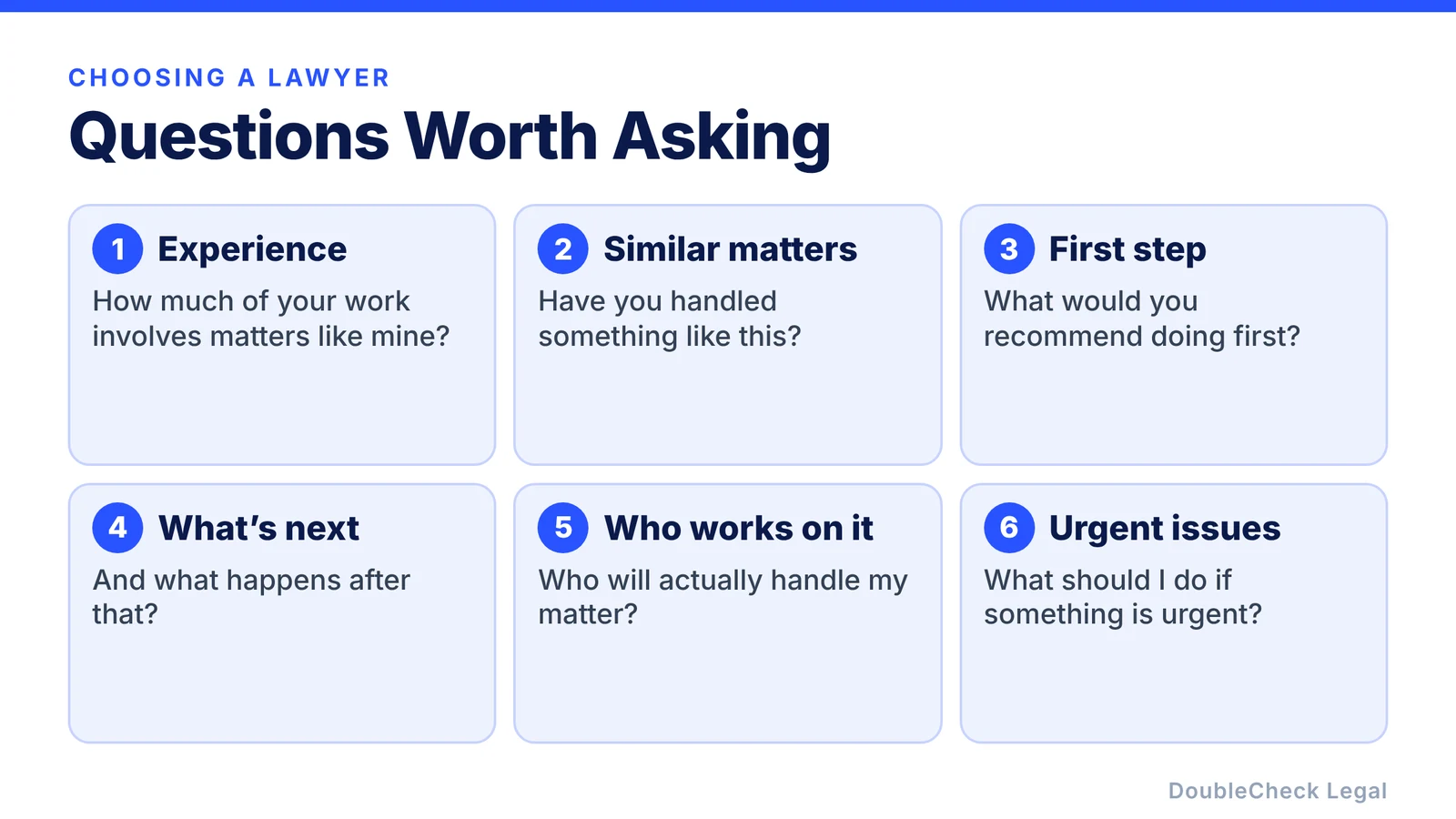
Ask: “How much of your work involves matters like mine?” That is usually more useful than asking how many years they have practiced.
2. Have they handled situations similar to yours?
Two lawyers can practice in the same area and have very different experience. A founder negotiating a first enterprise customer agreement may want someone who regularly works with startups, software businesses, SaaS agreements, IP ownership, and data issues.
Ask: “Have you worked on matters similar to this before?” and “What kinds of issues normally come up?” A lawyer who works in the area regularly should be able to explain the major questions quickly and clearly. You do not need them to disclose another client’s confidential information. You are trying to learn whether your problem is familiar territory.
3. Verify that they are actually licensed
This sounds obvious. Still, check. Every U.S. state has a way to verify attorney licensing. In California, for example, the State Bar’s attorney search lets the public look up an attorney’s license status and disciplinary and administrative history.
If your matter depends on a particular jurisdiction, confirm the attorney is appropriately licensed for the work you need. It takes a few minutes, and you should do it even when someone you trust referred the lawyer. A referral is useful information, but not a substitute for basic verification.
4. Pay attention to the questions the lawyer asks you
Your consultation is also your chance to evaluate them. A useful lawyer generally wants to understand:
- what happened,
- what you are trying to accomplish,
- what documents exist,
- the timeline and jurisdiction,
- how much money or risk is involved,
- what matters most to you,
- and what has already been agreed.
Be cautious if somebody gives a confident answer without understanding the facts. Legal problems are highly dependent on context, and good legal judgment often starts with good questions.
5. Can they explain the problem clearly?
After the call, ask yourself: do I understand my situation better than before? A strong attorney can usually explain complicated issues in terms you understand. Sometimes the right answer is “it depends,” but then the attorney should be able to explain what it depends on:
“This could go in either direction. The two facts that matter most are X and Y.”
That is far more useful than excessive jargon or false certainty.
6. Ask what the strategy actually is
Do not stop at “Can you handle this?” Ask: “What would you recommend doing first?” and “What would happen after that?”
For a contract problem, the answer might be: review the current agreement, identify three high-risk clauses, propose a redline, negotiate those issues, and leave the rest alone. For another matter, the strategy could be completely different. You are trying to tell a clear approach from an offer to bill time.
7. Understand how much it could cost
Talk about money before the engagement begins. Ask:
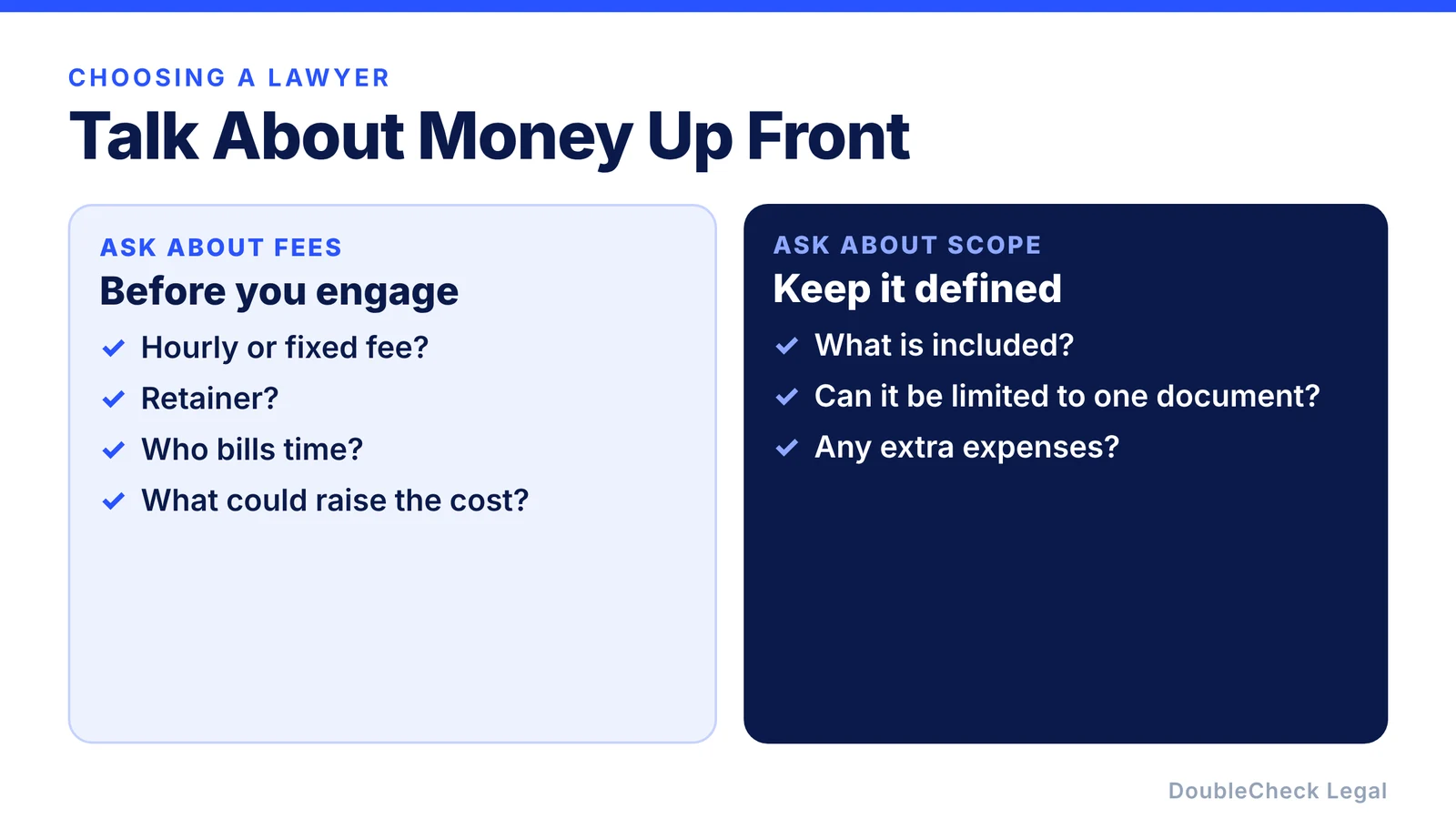
- Is this hourly or fixed fee, and what is the rate?
- Is there a retainer?
- What is included?
- Are associates or paralegals involved?
- Are there additional expenses?
- Can the work be limited to a specific question or document?
- What could make the cost increase?
Some attorneys offer limited-scope or “unbundled” services, handling only part of a matter. That can help if you have already done significant preparation, for example: “I already have the agreement. I only need review of the IP, liability, termination, and indemnification provisions.” The attorney can tell you whether that scope is appropriate. For more on this, see how to save money on legal work with AI.
8. Evaluate communication and availability
The most brilliant attorney is not much help if you cannot reach them when something important happens. Ask: “Who will actually work on my matter?”, “How do we normally communicate?”, “What is a typical response time?” and “If something is urgent, what should I do?”
Notice how the first interaction feels. Did they listen, understand your objective, communicate clearly, and follow through on what they said they would send? The attorney-client relationship often lasts longer than one phone call, so fit matters.
What about reviews, rankings, and awards?
They can be useful, but do not rely on one signal by itself.
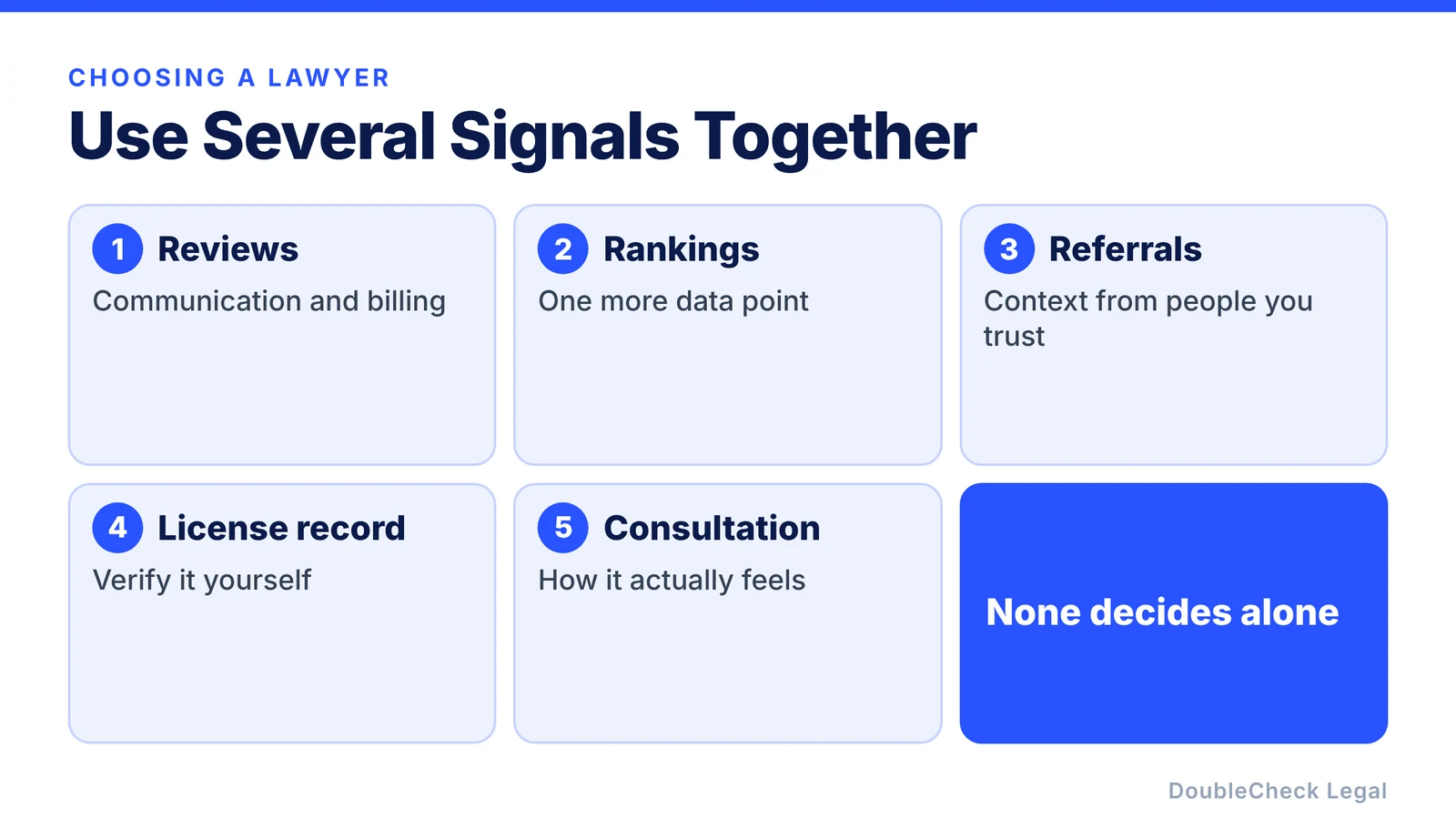
Online reviews can say something about responsiveness, communication, billing, and client experience. Rankings add another data point, and a personal referral adds context (see our guide to getting a lawyer referral from your network). But none of them automatically tells you whether the attorney is right for your specific matter.
Can AI help you evaluate a lawyer?
Yes. Before a consultation, give ChatGPT, Claude, or Gemini a description of your problem and ask “What type of attorney would normally handle a matter like this?” and “Give me 10 questions to ask an attorney during the initial consultation.” Afterward, use it to organize your notes and compare attorneys.
AI should not decide for you that Attorney A is definitely better than Attorney B, because it may not have enough information. Use it to become a better-informed buyer of professional services. If you already have an AI-drafted document, see how to find a lawyer to review it and how to verify it first.
A simple lawyer-evaluation checklist
Before hiring someone, make sure you can answer:
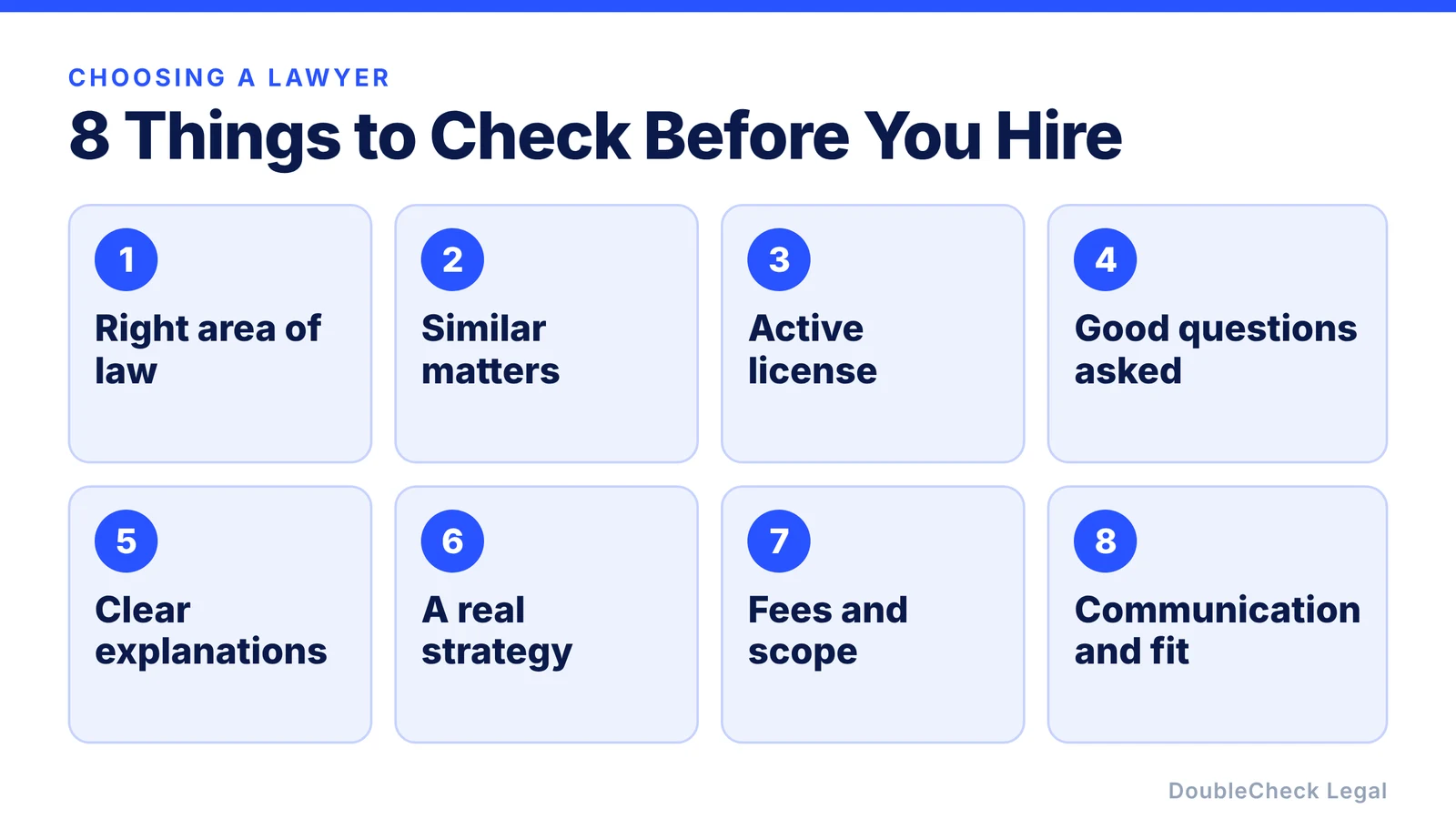
- Do they practice in the right area?
- Have they handled similar matters?
- Is their license active and appropriate for the jurisdiction?
- Did they ask intelligent questions?
- Can they explain the issue clearly?
- Do they have a reasonable strategy?
- Do I understand the fees and scope?
- Can I communicate effectively with them?
You do not necessarily need the most famous attorney. You need someone appropriate for the problem you actually have.
Where DoubleCheck fits
A warm referral from someone you trust is a great way to start, but not everyone has the right lawyer in their network. DoubleCheck gives people another path: begin with the legal issue or AI-generated work you already have, clarify the matter, and connect with independent attorneys whose practice areas are relevant. Then apply the same standards you would use with any attorney: relevant experience, jurisdiction, scope, communication, cost, and fit.
DoubleCheck is built for businesses that start legal work with AI. Bring your question or draft, use an AI-first workflow to understand and verify it, and when professional advice is warranted, you can connect with an independent attorney. Attorneys on DoubleCheck are independent professionals; an attorney-client relationship forms only if an attorney accepts your engagement.
The objective is not simply to find a lawyer. It is to find the right lawyer for the work you actually need.
FAQ
How do I know if a lawyer is good?
Look beyond years of practice. Evaluate their experience with your specific type of matter, license status, communication, strategy, fee structure, availability, and ability to explain the problem clearly.
Should I hire the first lawyer I talk to?
You do not have to. When time permits, speaking with more than one attorney can help you understand different approaches, scopes, and pricing.
How do I verify a lawyer’s license?
Attorney licensing is generally handled at the state level. Search the relevant state bar or attorney-licensing authority. In California, for example, the State Bar’s attorney search shows license status and disciplinary and administrative history.
Does a good review mean someone is a good lawyer?
Reviews can be one useful signal, particularly about communication and client experience, but consider them alongside relevant experience, credentials, referrals, and your consultation.
What is the most important thing to look for in a lawyer?
Relevant experience is one of the most useful starting points. The attorney should understand the type of issue you have and be able to explain how they would approach it.
General information only. This article is not legal, tax, investment, or accounting advice.