Received a Cease-and-Desist Letter? 7 Things to Do Before You Respond
You open your email and see a letter from a lawyer: CEASE AND DESIST. Your first thought may be “Am I being sued?” Not necessarily, but do not ignore it. This is general information, not legal advice.
Key takeaways:
- A cease-and-desist letter is a demand, different from a binding court or agency order.
- Do not admit anything before you understand the claims.
- Preserve evidence, and use AI to understand the letter, not to fire back.
- Get an attorney when money, your brand, or litigation threats are involved.
A cease-and-desist letter is generally a demand asking someone to stop alleged conduct and warning that legal action may follow. A cease-and-desist order can be a legally binding directive from a court or government agency. Here are seven things to do before you respond.
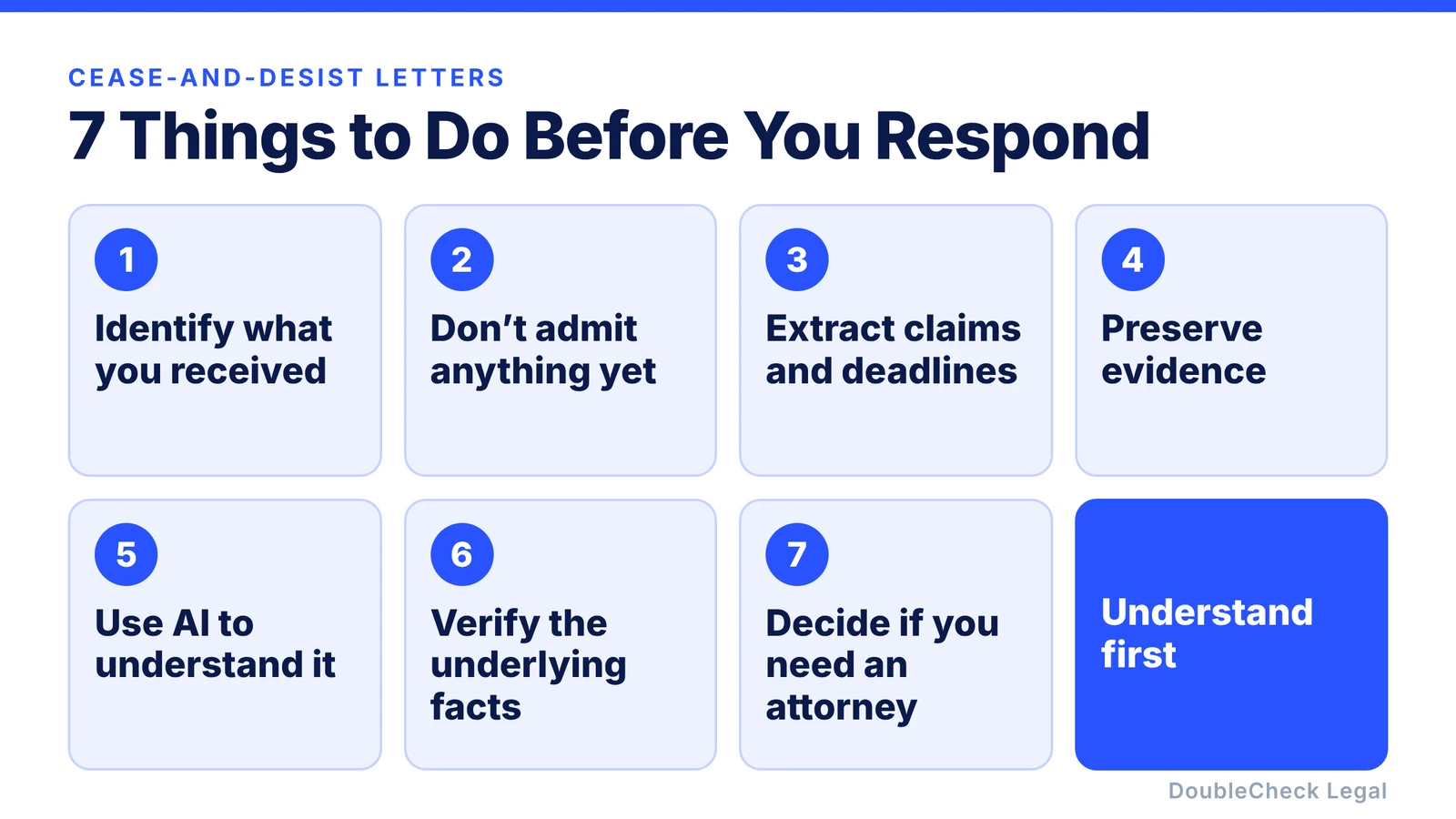
1. First, determine what you actually received
Look carefully at the document. Is it a letter from another person, a letter from a law firm, a demand letter, a cease-and-desist letter, a court document, a government order, a subpoena, or something else? These are not interchangeable.
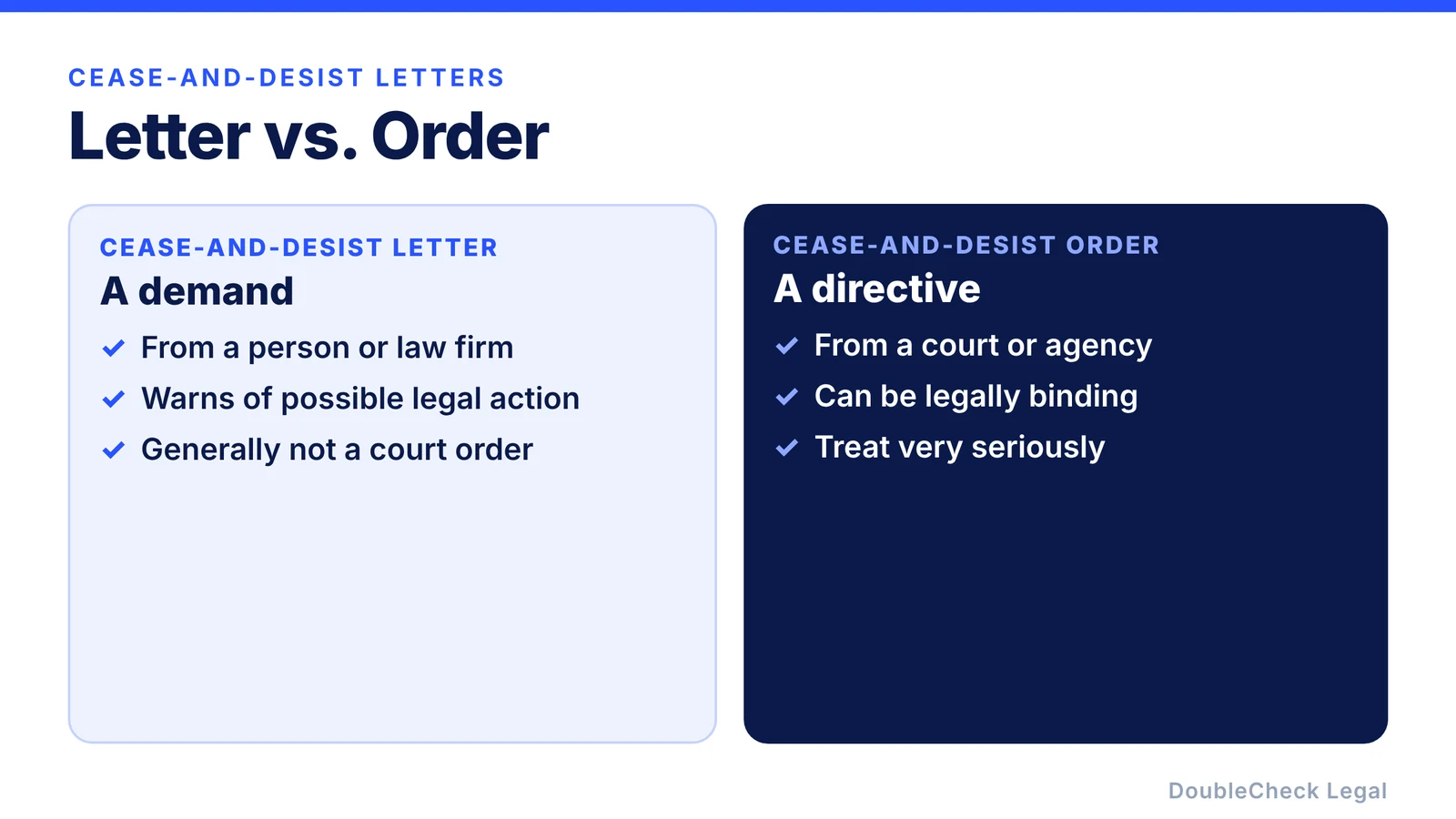
A private cease-and-desist letter is generally a demand and does not itself carry the force of a court or administrative order. But it may signal that the sender is considering litigation. Identify exactly what you received before deciding what to do.
2. Do not immediately admit anything
You may be tempted to reply “Sorry, I didn’t realize I was infringing your trademark,” or “Yes, we copied that,” or “You’re right. We’ll stop immediately.” Be careful. You may not yet understand whether the accusation is correct, what rights the sender actually has, what your defenses might be, whether the facts are incomplete, or whether the demand is broader than necessary.
That does not mean being hostile. It means understanding the situation before making factual or legal admissions.
3. Identify exactly what they say you did
Turn the letter into a checklist. What conduct are they complaining about?
- Trademark: your name, logo, ad, product, or domain allegedly infringes theirs.
- Copyright: you allegedly copied an image, video, article, software, or design.
- Contract: you allegedly violated an NDA, employment agreement, customer contract, non-solicitation clause, or license.
- Defamation: something you published is allegedly false and damaging.
- Harassment: they want communications or behavior to stop.
- Trade secrets: confidential information was allegedly obtained or used improperly.
Then identify what they want you to stop, what they want removed, whether they demand money, whether they want written confirmation, what deadline they set, and what they say will happen if you do not comply. Do not just react to the words CEASE AND DESIST at the top. Understand the actual claims.
4. Preserve the relevant evidence
Do not panic and start deleting everything. Keep the letter, relevant emails, contracts, screenshots, versions of webpages, invoices, and communications with the other party: anything that may help establish what actually happened.
If the dispute is about a logo, save records showing when and how you created it. If it concerns a contract, find the signed agreement and all amendments. If it concerns content, preserve the original and information showing where it came from. The goal is a factual record before memories change and information disappears.
5. Use AI to understand the letter, but not to automatically respond
This is a good place for ChatGPT, Claude, or Gemini. Upload the letter and ask:
“Explain this cease-and-desist letter in plain English. Do not tell me who is legally correct. Identify each claim, demand, deadline, and factual assertion.”
Then: “What facts would I need to verify before responding?” “Separate statements of fact from legal conclusions.” “Create a timeline based only on the documents I provided.” “What questions should I ask an attorney?”
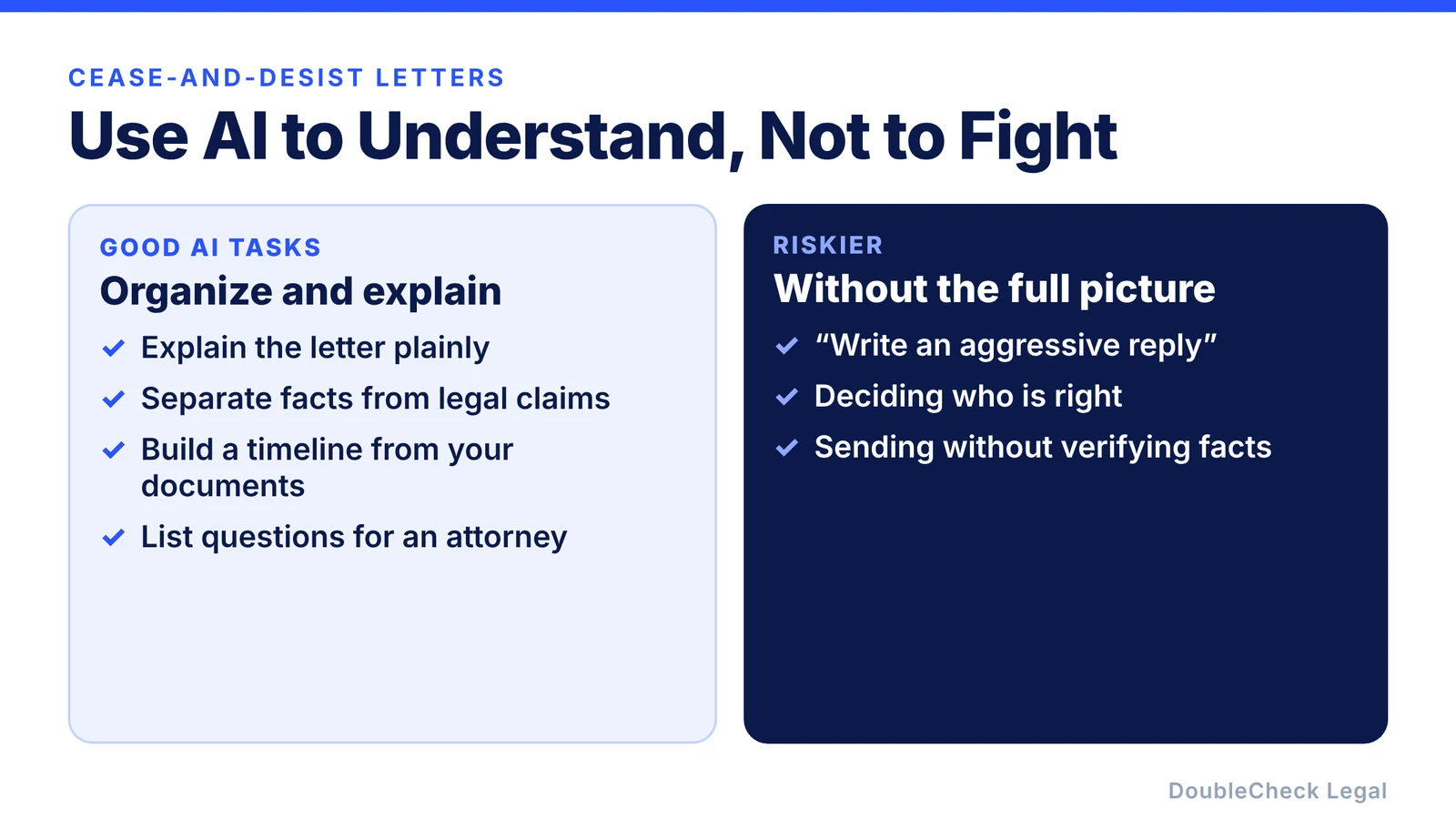
A much riskier prompt is “Write an aggressive response telling them they have no case.” The AI may not know whether they have a case. It may lack the facts, the jurisdiction, evidence held by the other side, related contracts, procedural history, or strategic context. Use AI to understand and organize before using it to communicate. Our guide to verifying AI-generated legal work covers how to check what it tells you.
6. Investigate the underlying claim
Now ask whether the letter’s basic factual assertions appear accurate. For a contract dispute, find the signed contract, check the relevant provision, look for amendments, and check dates. For intellectual property, identify exactly what rights the sender claims. For a business relationship, review the communications and history.
You can also ask AI: “What authoritative sources would be relevant to checking this type of claim?” and then inspect those sources yourself. A trademark issue may involve official trademark records, an employment issue state and federal employment sources, and a corporate issue state records. The goal is not to become your own litigation attorney. It is to understand enough to recognize what is actually disputed.
7. Decide whether this deserves an attorney
Some cease-and-desist letters are relatively minor. Others are the first step toward expensive litigation. Professional review becomes especially valuable when:
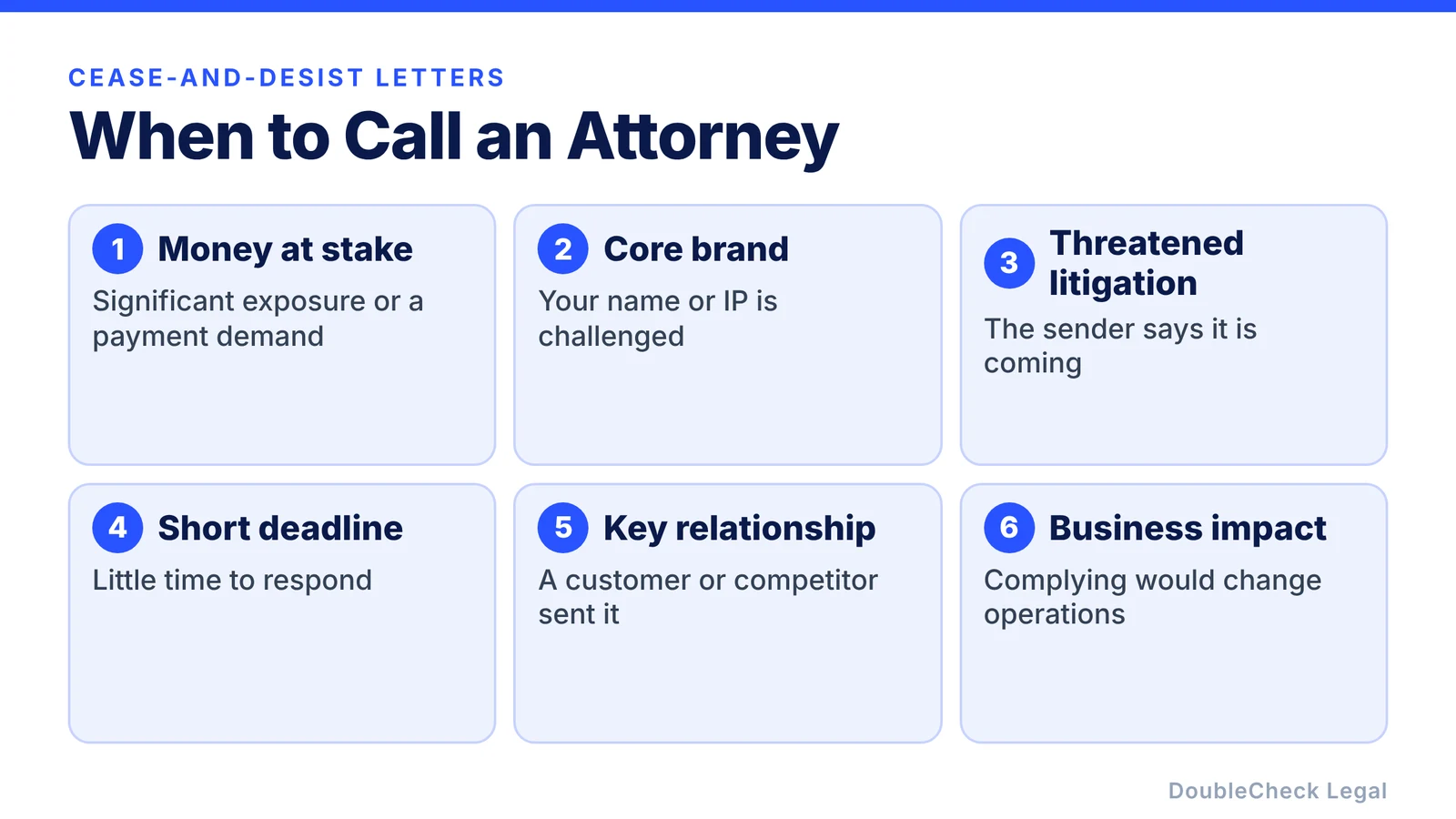
- significant money is involved,
- your core brand is challenged,
- intellectual property is important,
- an important customer or competitor sent the letter,
- the sender threatens litigation,
- you are being asked to pay money,
- there is a short deadline,
- important contractual rights are involved,
- or complying would materially affect your business.
A lawyer can help with what AI cannot easily answer: what is the best strategy? The answer may be to comply, partially comply, ask for more information, negotiate, reject the claim, or preserve defenses. It depends heavily on the facts. If you need to find counsel, see how to choose a good lawyer and how to get a referral.
Should you ignore a cease-and-desist letter?
Usually, pretending it never arrived is not a good strategy. That does not mean every demand is legitimate. It means ignoring the letter prevents you from intelligently deciding what to do, and a sender who is serious may escalate.
A simple workflow
If you receive a cease-and-desist letter:
- Identify what the document is.
- Do not immediately admit anything.
- Extract the claims, demands, and deadlines.
- Preserve relevant evidence.
- Use AI to organize and understand the issue.
- Verify the underlying facts and sources.
- Obtain professional advice when the consequences justify it.
AI can make steps three through six much faster. But the more serious the dispute, the less you should rely on an AI-generated response without professional judgment.
Where DoubleCheck fits
You can bring an existing cease-and-desist or demand letter into an AI-assisted workflow instead of starting from zero: use AI to understand the document, identify the allegations, organize the facts, and surface questions, then verify the important parts. If the matter warrants professional advice, DoubleCheck provides a path to independent attorneys.
DoubleCheck is built for businesses that start legal work with AI. Bring your question or draft, use an AI-first workflow to understand and verify it, and when professional advice is warranted, you can connect with an independent attorney. Attorneys on DoubleCheck are independent professionals; an attorney-client relationship forms only if an attorney accepts your engagement.
Receive the letter → understand it with AI → verify the facts → double-check → attorney when needed
The goal is not to panic. It is to understand what you received before you act.
FAQ
Is a cease-and-desist letter legally binding?
A private cease-and-desist letter is generally different from a legally binding court or administrative order. It is typically a demand that may precede litigation.
Do I have to respond to a cease-and-desist letter?
It depends on the circumstances. Even when a private letter is not itself a court order, ignoring a serious claim can carry practical risks.
Can I use ChatGPT to respond to a cease-and-desist letter?
AI can help summarize the letter, identify claims and deadlines, organize evidence, and prepare questions. Be more cautious about sending an AI-generated legal response without verifying the underlying facts and legal issues.
What is the difference between a cease-and-desist letter and a cease-and-desist order?
A letter is generally a demand from a person or organization. An order can be a legally binding directive issued by a governmental or judicial authority.
When should I talk to a lawyer?
Consider professional advice when the letter threatens litigation, involves meaningful financial exposure, affects valuable intellectual property or business operations, has a short deadline, or otherwise creates significant consequences.
General information only. This article is not legal, tax, investment, or accounting advice.