How to Write Terms and Conditions With AI: 9 Things to Check Before You Publish
Thirty seconds after asking ChatGPT for Terms and Conditions, you have 3,000 words of impressive-looking legal language. Can you publish it? Not yet. Here are nine things to check. This is general information, not legal advice.
Key takeaways:
- Tell the AI exactly what your product does, and do not let it invent rules.
- Make payment, subscription, cancellation, and refund terms match your checkout.
- Address AI features, user content, and liability language deliberately.
- Check how users actually see and agree to the Terms, then compare against the real product.
Terms & Conditions, also called Terms of Service or Terms of Use, should describe the actual relationship between your business and its users. AI does not automatically know what that relationship is.
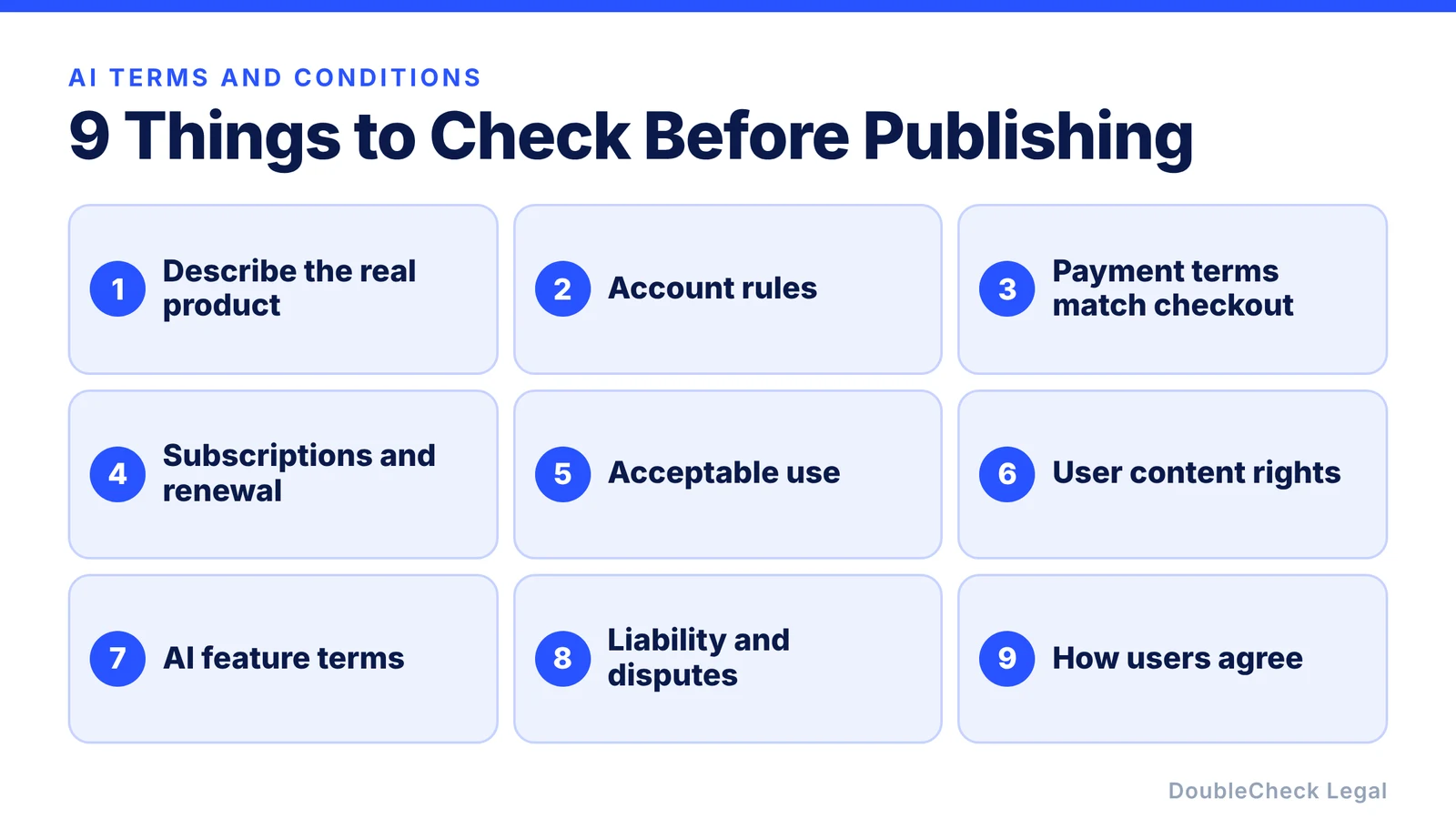
1. Tell the AI what your product actually does
Do not begin with “Write Terms and Conditions.” Explain the product:
“We operate a subscription SaaS product for small businesses in the United States. Users create accounts, upload documents, pay monthly by credit card, can cancel from account settings, and may generate AI-created content.”
Relevant facts include what you sell, whether users create accounts, whether customers pay, whether subscriptions renew, whether users upload content or interact with each other, whether your service includes AI, and where you operate. Generic facts produce generic Terms. For the general how-to, see our guide to using a terms and conditions generator.
2. Check the account rules
If users create accounts, your Terms may need to cover who can create an account, account security, accurate information, password responsibility, prohibited account sharing, suspension, and termination. Do not let AI invent rules your product does not enforce. If the Terms say “Users must be at least 18,” make sure that is actually your policy. If minors can use the service, additional issues may arise. Your legal document and product should describe the same reality.
3. Make payment terms match your checkout
This is one of the most important checks for a paid product. Verify price, billing period, free trial, renewal, taxes, refunds, cancellation, and price changes.
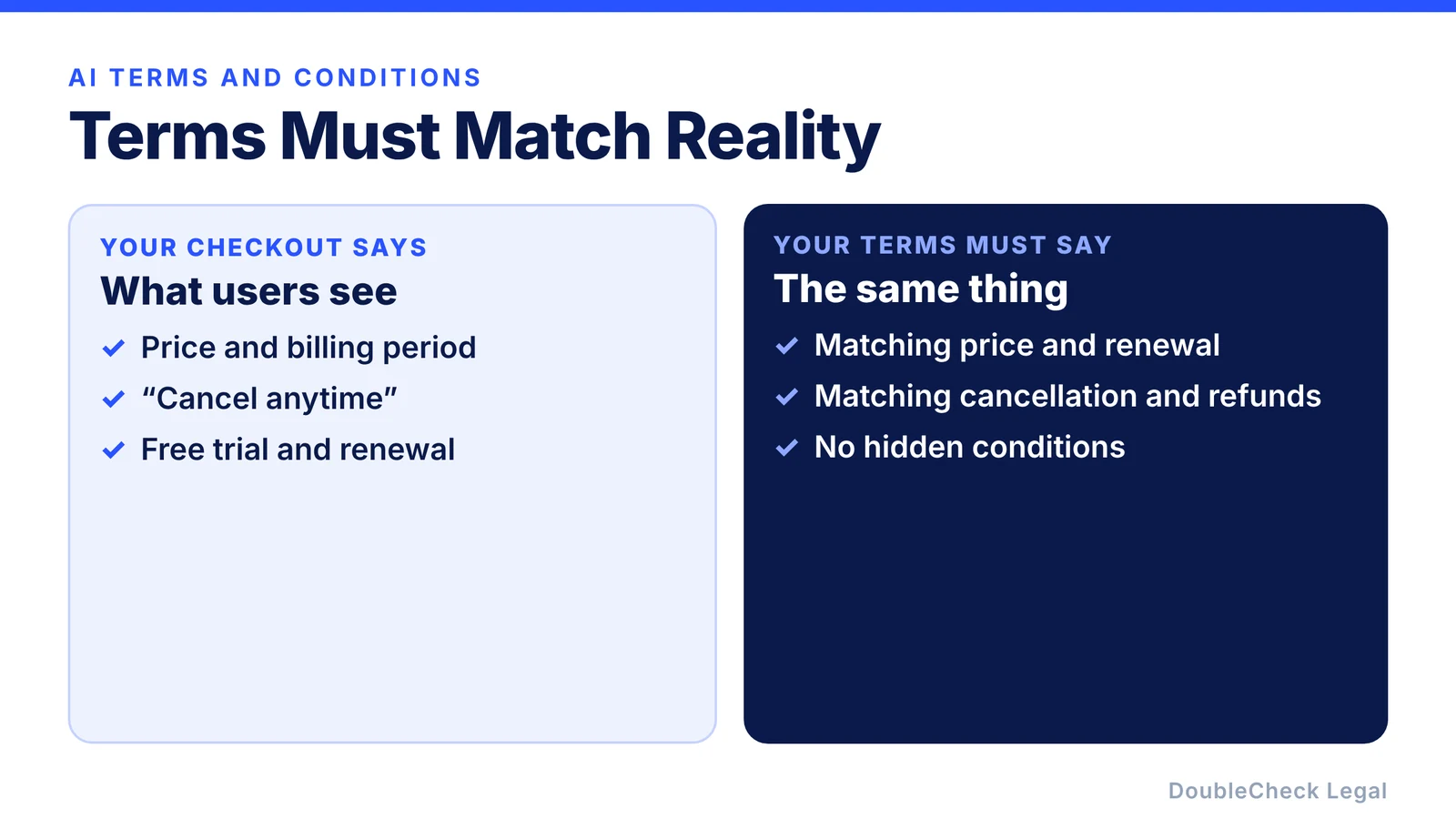
If your checkout says “Cancel anytime” but the Terms say “All annual subscriptions are non-cancellable,” you have a problem however professional the document looks. Regulators including the FTC have taken action against businesses that hide material payment and subscription terms or make cancellation unnecessarily hard.
4. Be especially careful with subscriptions and auto-renewal
If customers are charged repeatedly, ask: when does the subscription renew, how often, how much will the user be charged, how does the customer stop future charges, what happens after cancellation, and are refunds available? Clear disclosure of material subscription terms, informed consent, and an understandable way to cancel are recurring themes in regulatory attention to recurring-payment programs.
Do not hide the important economic terms inside 5,000 words of Terms. Your interface matters too.
5. Define what users can and cannot do
Your Terms may include an acceptable-use section. Users may not be allowed to abuse the service, interfere with security, scrape protected systems, upload illegal content, impersonate others, violate intellectual-property rights, reverse engineer certain technology, misuse AI features, or attempt unauthorized access. But do not simply copy another company’s list. Ask: “What behaviors could actually damage our product, users, infrastructure, or business?” Build from reality.
6. Decide what happens to user content
If people upload content, think about ownership and permissions. A customer uploads a document, a creator a video, a user a review, a company source code, an AI customer prompts. Ask: does the user still own the content? What permission does your company need to process it? Do you need to display it, store it, transmit it to another provider, or use it to operate the product?
An AI-generated Terms document may create an extremely broad content license simply because that language commonly appears in online agreements. That does not mean your business needs it.
7. Check your AI terms specifically
If your product includes AI, do not let the Terms treat it as ordinary deterministic software.
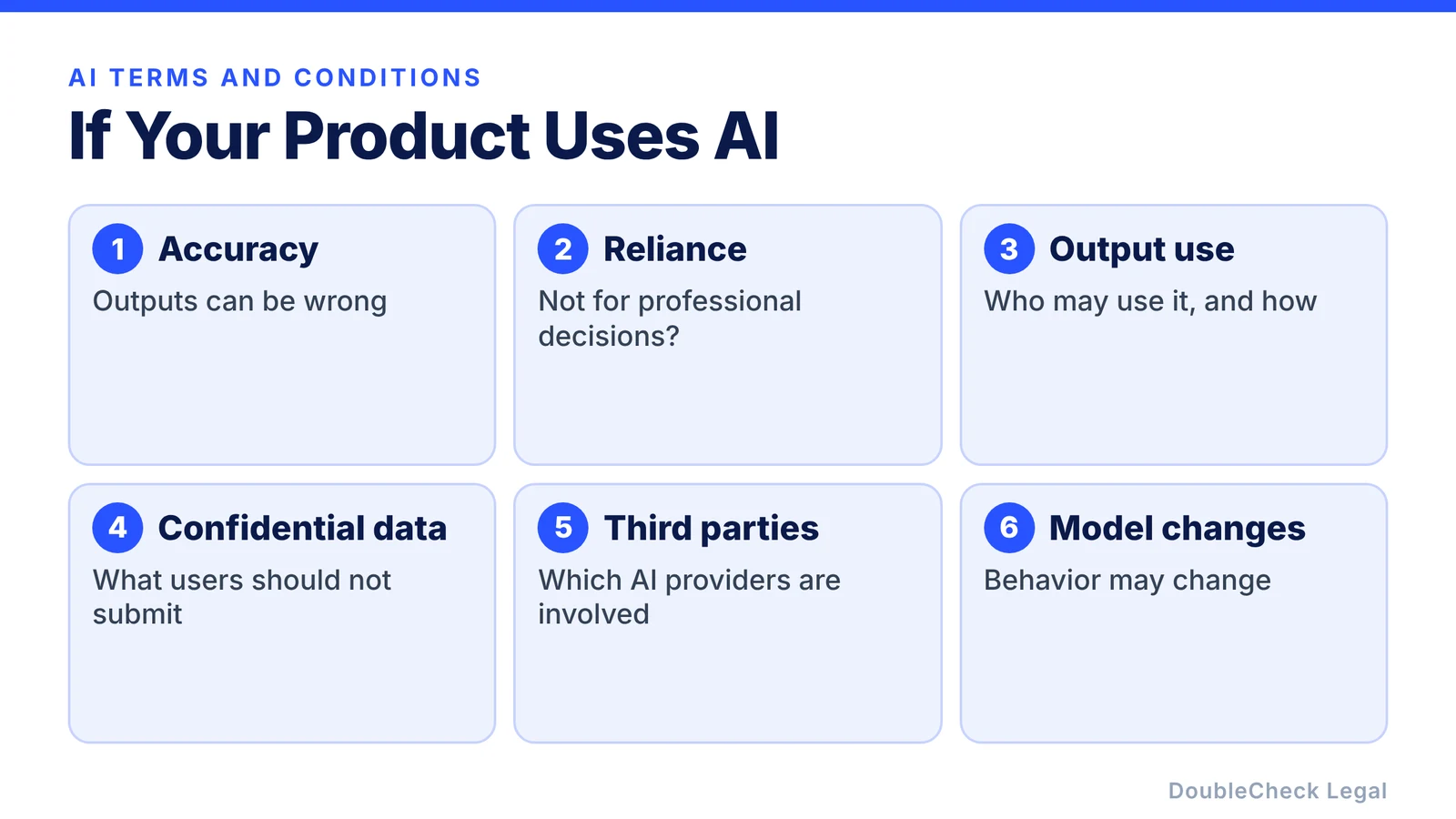
Consider whether AI outputs can be inaccurate, whether users can rely on them for professional decisions, who may use the output, whether users can submit confidential information, whether third-party AI providers are involved, whether there are content restrictions, and whether the underlying model can change. The exact clauses depend on your product, but if AI is an important feature, your Terms should not pretend it does not exist. For the AI-vendor side, see our AI vendor contract checklist.
8. Review liability, warranties, and dispute language carefully
AI generators often produce aggressive boilerplate, such as “THE COMPANY SHALL HAVE NO LIABILITY WHATSOEVER UNDER ANY CIRCUMSTANCES.” That may look impressive, but whether a limitation works can depend on the actual language, jurisdiction, type of customer, applicable law, and circumstances.
The same caution applies to warranty disclaimers, indemnification, arbitration, class-action waivers, governing law, venue, and liability caps. These are areas where professional review becomes more valuable, because small wording changes can have large consequences. Do not assume longer clause = stronger protection.
9. Check how users actually agree to the Terms
Publishing a /terms page is not the only issue. Think about the real customer journey: when does the user see the Terms, before signup or during checkout? Is there a checkbox? Is the link visible? Are important subscription terms separately disclosed? What happens when the Terms change?
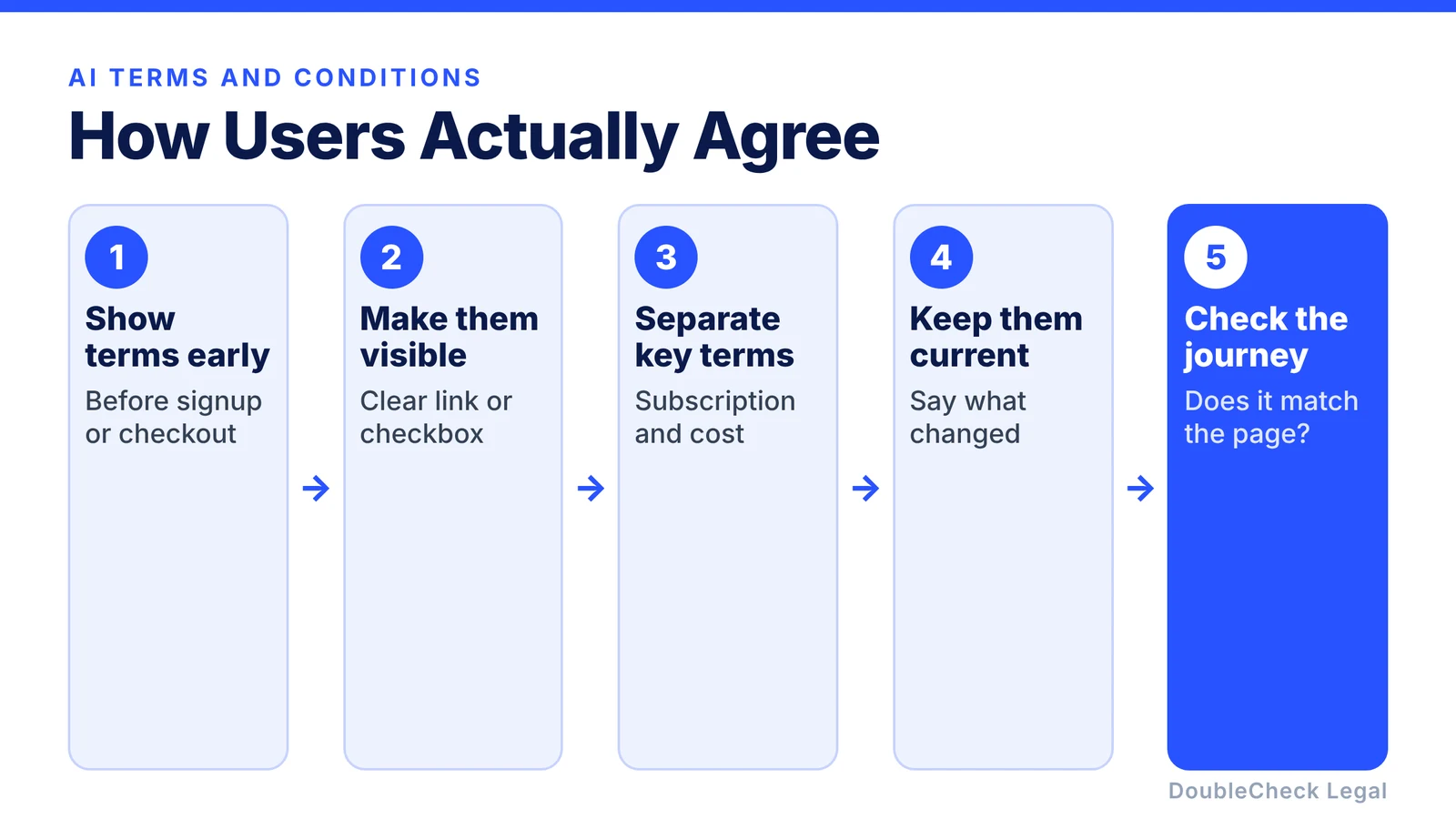
A beautifully drafted document does little if the business never properly presents it. Regulators have criticized practices that bury important information in dense Terms or use interface design that obscures material conditions. Legal drafting and product design meet here.
A better AI prompt
Instead of “Write Terms and Conditions for my app,” try:
“Draft plain-English Terms of Service for a U.S. SaaS business. Users create accounts and pay $29 per month through Stripe. Subscriptions automatically renew monthly until cancelled through account settings. Users upload their own business documents, which remain theirs. The product uses third-party AI models to analyze documents. Do not invent product functionality, refund policies, age requirements, legal rights, or business practices. Clearly mark every point where you need more information from me.”
Then ask: “List every assumption you made.” “Which provisions could depend on jurisdiction?” “Which clauses could create promises or obligations for the company?” “Compare the Terms against this description of our actual product and identify inconsistencies.” That is a far stronger workflow.
Terms & Conditions are not the same as a Privacy Policy
Your Terms generally govern the relationship between the user and your service. Your Privacy Policy explains how personal information is collected, used, and disclosed. There can be overlap, but one is not a substitute for the other. If your AI hands you one giant document mixing everything, check whether separating them would make the obligations clearer. For the privacy side, see what to check before publishing an AI-written privacy policy.
The final checklist
Before publishing AI-generated Terms, verify:
- Does the document describe the real product?
- Are account rules accurate?
- Are pricing and payment terms correct?
- Does subscription language match the checkout?
- Do cancellation and refund terms match reality?
- Are content ownership and licenses appropriate?
- Are AI features addressed where necessary?
- Have important liability and dispute clauses been reviewed?
- Does the website actually present the Terms appropriately?
And finally: did the AI invent anything? Ask it directly. Our guide to verifying AI-generated legal documents shows how.
When should an attorney review your Terms?
Professional review becomes more valuable when your product has many users, meaningful revenue depends on subscriptions, users upload valuable content, your product uses AI, you operate across several jurisdictions, consumers use the product, significant IP issues exist, or liability could be substantial. You can still do most of the preparation first. See how to find a lawyer to review a document you drafted with ChatGPT.
Where DoubleCheck fits
You do not need an attorney to begin with a blank page. In DoubleCheck’s 2026 survey, 47% of respondents using AI for legal drafting reported generating privacy policies or website terms of service with AI. Use AI for the first draft, give it accurate product information, challenge its assumptions, compare the Terms against your real checkout, then bring that work into DoubleCheck to identify missing information, examine important provisions, and surface sources.
DoubleCheck is built for businesses that start legal work with AI. Bring your question or draft, use an AI-first workflow to understand and verify it, and when professional advice is warranted, you can connect with an independent attorney. Attorneys on DoubleCheck are independent professionals; an attorney-client relationship forms only if an attorney accepts your engagement.
Describe your product → AI drafts → product reality check → DoubleCheck → attorney when needed
The Terms should describe the business you actually operate, not the generic internet company the AI imagined.
FAQ
Can ChatGPT write Terms and Conditions?
Yes. AI tools can create a useful first draft, especially with detailed information about the product, users, payments, subscriptions, user content, and business model. Check the draft against how the product actually operates.
Do I need Terms and Conditions for my website?
Not every website has identical legal needs. Terms become particularly relevant when users create accounts, purchase, subscribe, upload content, interact with others, or use an online service subject to specific rules.
Are Terms and Conditions the same as a Privacy Policy?
No. Terms generally govern use of a product or service, while a privacy policy describes how personal information is handled.
Can I copy another company’s Terms?
That can create significant problems, because their product, business model, payment structure, data practices, jurisdiction, and risks may differ from yours.
Should my Terms explain cancellation?
If you offer subscriptions or recurring charges, cancellation and renewal terms are particularly important and should match what users see at checkout.
Should a lawyer review AI-generated Terms?
The value of professional review increases with the product’s complexity, revenue, user base, jurisdictions, liability, and contractual complexity.
General information only. This article is not legal, tax, investment, or accounting advice.